Experiencing ‘The Sound of Music’ for the First Time

The Sound of Music is a nearly three-hour-long musical about an Austrian nun teaching some spoiled Austrian kids how to sing. I hope that’s explanation enough for why it took me well over three decades to watch this classic film. When I was a little kid, I didn’t want to watch musicals, period. They were verboten in little boy culture—a toxic hazard, like antique stores, asparagus and girl butts. My mom was (and still is, I’m pretty sure) a huge fan of musicals, but no mother is Icarus-like enough to try to get her snotty little jerk to plow through a three-hour musical history lesson. As I grew into my teens and my film fandom developed, I developed more patience for older films, but I wanted to watch R-rated adult stuff; mature, edgy classics like The French ConnectionThe Godfather and First Blood. Sound of Music was just too stodgy and clean. As I’ve grown into what can medically be described as an “adult,” I’ve gradually come to appreciate and enjoy musicals. Hell, I even write a regular column about opera. 

Nonetheless, when this assignment landed on my desk, I was still somewhat apprehensive. It’s kind of hard to explain why that was, but I’ll do my best to articulate it again: The Sound of Music is a nearly three-hour musical about an Austrian nun teaching some spoiled Austrian kids how to sing. Added to this: Julie Andrews never did much for me. Mary Poppins was all about the cartoon penguins as far as I’m concerned. Some of the songs I was familiar with from the film were far from favorites of mine: “The Sound of Music” and “Climb Every Mountain” always seemed forced and corny to me.

But by god, it’s partially my job to watch famous movie musicals for the first time—and not coincidentally, the 5th Avenue Theatre’s production of The Sound of Music is currently running through January 3. And so, a few nights ago, I brought home the Blu-ray and hunkered down. Here are some of the things that I learned.

This movie is absolutely wonderful.
You hear me, myself before three days ago? YOU ARE A FOOL. It turns out that there’s a reason this movie is beloved by all. How about that? So, all of those people that made it one of the biggest box-office smashes in film history, all of the academy voters who gave it approximately five thousand Oscars, all of the people at the AFI who placed it at #40 on the top 100 films of all time… I guess they weren’t totally full of crap, hard as that may be to believe. This movie is GREAT.

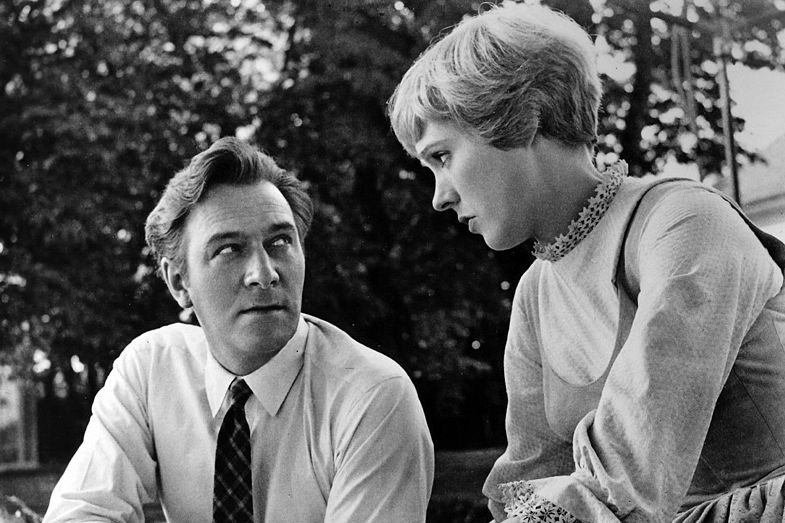
Robert Wise—whose work I’ve always admired—directed the bejesus out of it, as he is wont to do. The film begins with a spectacular helicopter shot pushing in on Julie Andrews swooning in the greenest field imaginable amidst an utterly spectacular mountain backdrop and it just keeps getting more impressive from there. It’s a three-hour movie that flies by at a breakneck pace. Julie Andrews is iconic in a challenging role. Those kids, those damned Von Trapp kids are the cutest damned things in the entire world. It’s just pure, heart-warming, life-affirming, toe-tapping goodness. One of the best representations of the kind of premium product Hollywood was occasionally capable of in the mid 20th century. I’ve watched three musicals for this column so far. I liked Dirty Dancing more than I thought I would, I tolerated Grease (barely), but I LOVED The Sound of Music.

I have pretty much seen half of this already through cultural osmosis.
This is one of the biggest, greatest, most cherished films ever made. The first half contained almost no surprises because I’d heard all of the songs or absorbed the rest through film and TV references, clips, retrospectives, conversations, MST3K quips, you name it. It reminded me of the first time I saw Casablanca or read Hamlet; about every other minute I thought, “Oh, this is where that line and/or image comes from!” Song-wise, everybody knows “My Favorite Things” and “Do-Re-Mi,” but “How Do You Solve a Problem Like Maria?” was one of the songs my mom would belt out while dancing around the house to embarrass me while my friends were over. I recognized another song because it was referenced in “I Believe” from Book of Mormon (of which I have the original cast recording). The Sound of Music is built into the cultural framework of Western society, like Star Wars and Mozart. Now I understand why. 

Robert Wise was a saint.
It was WC Fields who famously said, “I don’t like working with kids, now go fetch me seven gallons of scotch.” Thousands of other people have no doubt expressed similar sentiments (with or without the scotch), and there’s a good reason for that: kids are kids. They’re not famed for their reason, professionalism or cooperativeness. And poor, poor Mr. Wise had to handle seven of these things (well, to be fair, the older kids could’ve been in their 30s for all I know) for a movie that includes many, many elaborate song and dance numbers. If you want a really good example of setting the difficulty level for directing a scene to Maximum, look no further than the biking sequence in “Do-Re-Mi.” This is eight people, many of them children, all of them singing AND doing choreographed bike moves while a giant camera tracks alongside them in a truck. Just imagine the logistics of that. I promise you that these days they would do this all with CGI and then they’d say “Thank God we have CGI.” My best guess is that it took them fifty-six billion takes to get that shot. That kind of patience and dedication is astonishing, but a lot of this movie has that  “we’re not going to settle for anything less than perfect” kind of feel. It’s a highly polished gem, and I have no idea how Wise managed to live into his 90s after weathering that kind of stress.

The “So Long, Farewell” scene is absolutely intolerable.
If you are one of the deranged few who have still not seen this movie (what is wrong with you?), there is a scene in which the Von Trapp family is having a lavish party and the kids must go to bed. What happens next is absolutely one of the most shameless and brutal things that has ever happened in the history of film. The kids perform a song wherein each one of them bids High Austrian Society “So long, farewell, Auf Wiedersehen, adieu.” Then, one by one, they get kicked in the butt and prance up the stairs. Because the people who made this film are impossibly cruel, the bit ends mercilessly with the littlest girl being too tired to make it up the stairs, so she falls asleep in a little singing heap, so the other kids must scoop her up and carry her off as they all softly sing “goodbyyyyeee.” The partygoers down below wave up to them and reply “goodbyyyyye.” It is death by cuteness. It is demonic and unfair. It grabs you by the softest part of your soul and punches it in the balls repeatedly until you want to die. I can’t stand it. It’s the best.

Nazis? Nazis!
But that’s okay, because there are Nazis in this movie! Nothing even remotely cute about those guys! The Nazis are only a vague peripheral threat until the final third of the movie, when Anschluss finally drops. The big red swastika banners are particularly jarring when they arrive, as this is almost entirely a movie about love and life and loving life and impossible cuteness until the very last act. I vaguely knew that there were Nazis in The Sound of Music, but of all of the things that I had culturally absorbed about the film, I literally had no idea how it ended. So when Captain Von Trapp, Maria and the kids run afoul of the Third Reich, it was actually pretty damn suspenseful for me. Sure, I thought that it was somewhat unlikely that this adorable singing family with whom I’d just shared so many delightful adventures would be gunned down by goose-stepping monsters, but I didn’t know for sure.

But that’s okay, because there are Nazis in this movie! Nothing even remotely cute about those guys! The Nazis are only a vague peripheral threat until the final third of the movie, when Anschluss finally drops. The big red swastika banners are particularly jarring when they arrive, as this is almost entirely a movie about love and life and loving life and impossible cuteness until the very last act. I vaguely knew that there were Nazis in The Sound of Music, but of all of the things that I had culturally absorbed about the film, I literally had no idea how it ended. So when Captain Von Trapp, Maria and the kids run afoul of the Third Reich, it was actually pretty damn suspenseful for me. Sure, I thought that it was somewhat unlikely that this adorable singing family with whom I’d just shared so many delightful adventures would be gunned down by goose-stepping monsters, but I didn’t know for sure.

And you know what? If you are one of the warped fools who have still not bothered to watch this three-hour musical about an Austrian nun teaching some spoiled Austrian kids how to sing, I’m not going to spoil it for you here. You just have to experience it for the first time for yourself. And you really, really should. Millions upon millions of people (and now—finally—me) can’t be wrong. And go check it out onstage if you can. I’d like to go too, but I’m not sure I could handle it. Goodbyyyyyyye

Going to the Opera with Grandma: ‘The Pearl Fishers’

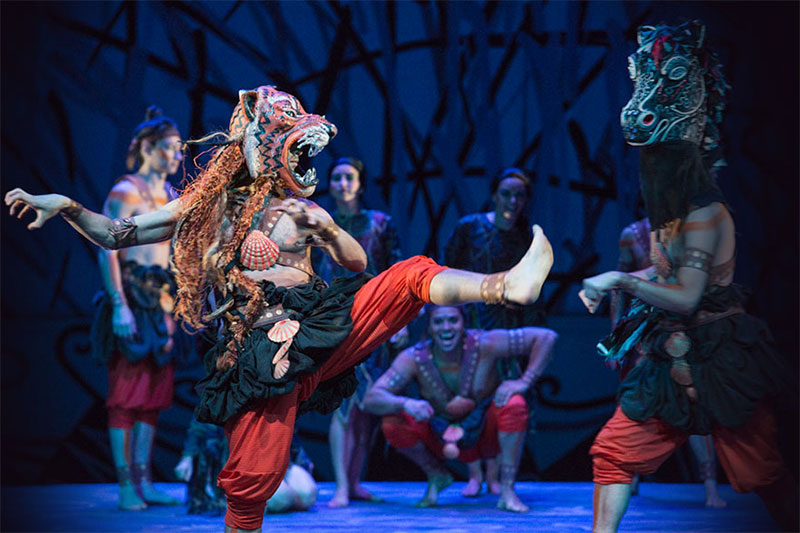
Bear with me when I say this because I actually mean it as a very high compliment: Seattle Opera’s The Pearl Fishers nearly put me to sleep. It’s a hypnotic swirl of colors and movement coupled with some truly gorgeous music by Georges Bizet. The problem here is that I’m genuinely becoming a fan of opera music. This was not always the case. Like a lot of people, I once found the singing to be a bit… much. But it turns out that opera is a lot like a fine scotch: it can be a totally entertaining and wonderful experience well before you learn how to truly appreciate it.

I’m not saying that six shows into this column I am now the Captain of All Opera Knowledge. That title belongs to Jonathan Dean. But I will say that nowadays I write while listening to Wagner and go to sleep listening to Verdi. Music that once seemed strange and overpowering to me is now a lovely comforting thing to pipe into my brain when I’m trying to slip off into oblivion. And the music of Bizet is nothing if not lovely and comforting.

The Pearl Fishers’ gentle music, cozy atmosphere and sensuous colors were lulling me into a state of pure relaxation until the spectacular conclusion of the second act, when it erupts in an intense flurry of thunder and damnation. It’s a classic bait-and-switch (rope-a-dope?) that leaves you stunned and breathless. As always with Seattle Opera, every aspect of the production is top notch. The set designs reminded me of Matisse, the striking costumes were rife with crazy hats that I was always afraid were going to fall off the dancers, and there was a climactic gunshot that scared the living hell out of me.

Fortunately, at my side as usual was the brave and knowledgeable Evelyn Troughten, an opera booster whom I once called “Gram Gram,” but I now call…well, that’s still what I call her. As is our tradition, we spoke before, during and after the show, and I learned stuff.

Before the show

GRAM GRAM: Do you know what else Bizet wrote?

Uh, well…uhhh…

Carmen.

Oh! That’s the first Opera I ever saw!

I know! But have you ever seen any other operas, besides Carmen?

Well, actually, this is the sixth Opera that we’ve gone to together…

Besides that, I mean! Any other Operas by Bizet?

No, it was just Carmen 20 years ago with mom and then the ones that we’ve seen.

Right, okay. Now would you like for me to make an interesting comment for you?

Yes!

The interesting fact I wanted to tell you is this: Pearl Fishers and Carmen are the only operas that Bizet wrote.

Wow, really?

Yes. He died young, so he only wrote the two operas, but they both have wonderful music. I remember when your mother took you and your brother to see Carmen and afterwards she said, “I didn’t know all of that music came from Carmen!”

All of the famous music ever comes from Carmen. I remember recognizing half the music from it, and that’s when I was a little kid.

You were a teenager.

Oh, okay. Well, I’m very excited then!

But Pearl Fishers is very different from Carmen.

But is the music still pretty good?

OH, IT’S GORGEOUS! [Laughs]

During intermission (after acts I and II)

What do you think so far?

Well, first of all, I have to say–If you’re in an opera, there’s no better way to ensure that two people sleep with each other than by telling them that if they do, everyone’s going to die.

[Laughs] And then they do it anyway, of course! Well, that’s men for you. What did you think of the depiction of Sri Lanka, it was called Ceylon back then, and the culture?

I have to say I really doubt that people in Sri Lanka were ever like this.

Right, exactly! You know, the composer, Bizet, and the man who wrote the libretto, they never went to Ceylon! They wrote this whole story that takes place there, but they didn’t really know anything about the place.

Yeah, that seemed pretty obvious.

And isn’t most opera fantastic, in that it’s not real? It’s like sci-fi today.

That’s a really apt comparison, because I think they took it about that seriously. They saw depicting a culture in a faraway land like we would see creating a culture on a faraway planet. Sri Lanka might as well have been another planet to most people in France at that time.

Right! And I’ve heard people say that the story is “lame.” So what?

I don’t know. It’s a bare bones, forbidden love story type of thing, but it’s not really a problem because of the beautiful music.

That’s it! The music is just gorgeous! Maybe I’m different than other people, but I’ve always gone to opera for the music. I would say story might be the least important thing.

That second act ends in a CRAZY over the top opera thing. People are getting sentenced to death, dozens of people on the stage, there’s singing and dancing and lightning and thunder. Wow.

It all works together. The dancing was wonderful. You know that all French operas have to have dancing in them, right? The King of France or whoever it was that had the final say-so thought that ballet was the thing. So every opera had to have it. You won’t see it in other operas. You won’t see it in Wagner. The first time I saw this one I thought, “there’s an awful lot of dancing in this.” But the second time, I thought, “there’s REALLY a lot of dancing!” [Laughs] But the dancing is very acrobatic and athletic. And you know I love dancing. Well, not doing it, I can’t do that kind of dancing. But I like to watch it!

Is there anything you’d like to say as a preview for the final act?

Anything I say would be a spoiler!

After the show

Well, I’m glad you didn’t give me any spoilers, because that ending was a lot happier than I was expecting!

Who do you think was the hero?

I think it ended up being about Zurga’s arc. That’s what the story is really about—him getting over his jealousy and anger and doing the right thing.

Yes, exactly. Everything involved in it: here’s his best friend, and they both fall in love with the same woman, although they don’t know who she is, other than a priestess, and Nadir goes off and happens to find her… so then she shows up at the village and, of course, Zurga expects the worst and then he has his heart broken.  But it’s the faith of two friends in each other. And when one thinks he’s been cheated on, there’s hate and jealousy-

But he doesn’t succumb to it.

Well, he does, but then he has to realize that he’s an honorable man. Because he realizes that she once saved him when she was a child, so he turns around and lets her go, because in the end, he is a hero!  

He sacrifices himself for both of them, which is a pretty far cry from how he is in the beginning of the act when he’s, you know, trying to rape her.

Right! Right! Because that’s his jealousy coming through there. There’s all these emotions between men who were childhood friends. And then there’s the man-woman type love as opposed to brotherly love. It’s really fascinating, when you think about it.

It is certainly the first opera we’ve seen where the main relationship is between two men, as opposed to a romantic relationship. Not that they didn’t get a bunch of romance in there, too.

Yes, they did. [Laughs] But as I said, I’ve heard it before that it’s a really lame plot! But I don’t think so.

Yeah, and there’s a lot of stuff about defying mob mentality, mob justice…

Right, the village was angry, they wanted to kill her. There’s some politics there; I mean, here’s a democratic society—I mean, as democratic as it could be, but they lost their democracy when they decided to go the route of being a posse! No trial, no court. But Zurga goes against their wishes in the end.

It’s interesting that we talked so much about how the plot is weak or whatever, and then we spent most of the time talking about the plot!

Well, it’s just what I’ve heard others say.


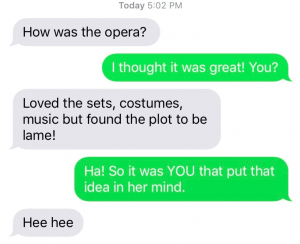
POSTSCRIPT: After I said goodbye to Grandma and left for home, I had the following text exchange with my mom:


Seattle Opera’s The Pearl Fishers runs from October 17th through the 31st at McCaw Hall.

The Theatre of West-Meets-East

Western theater has long been fascinated with “the Orient.” For hundreds of years, East Asia was like a distant planet to the people who live west of the Caucusus. A planet populated by strange, unknowable, alien-like beings. If you think this is starting to sound insensitive, well, that’s about perfect. Depictions of Eastern culture and people were often painfully uninformed until, oh, let’s say about 20 years ago. But much as we find Mars and Pluto fascinating today—despite and because of how little we know about them—writers and audiences couldn’t get enough of stories set in the “exotic” lands of the East.

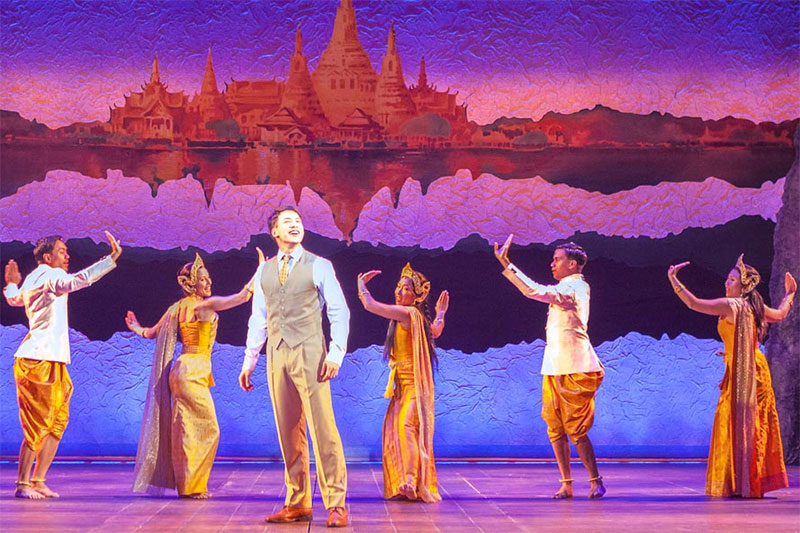
Waterfall, showing at the Fifth Avenue Theater through October 25, is a show that would scarcely have been imaginable 50 years ago. It’s an old-fashioned romantic musical for American audiences largely framed from an Eastern perspective. The story is narrated by a young Siamese/Thai (same thing, of course, but it shifts with the time periods depicted) man in the 1930’s who is fascinated by America, but ultimately a proud representative of his own national heritage. There is one representative of white America in the show, and cross-cultural misunderstandings certainly abound, but Waterfall is a story about Thai history and Thai people.

It’s taken a long time to get to the point where an Asian story can unapologetically stand on its own in front of a Western theatre audience. The evolution has been slow going and it has produced many cringe-worthy moments, but looking back can give you a good idea of how far we’ve come.

The Mikado (1885)

Gilbert and Sullivan’s Savoy smash hit was originally conceived as a way to covertly satirize British politics of the time. In telling the story of a wandering prince, his awkward romantic entanglements and an arranged beheading, however, the English masters managed to deliver a master class in cultural tone-deafness, which, in all fairness, probably seemed like vivid realism to London audiences at the time. Even while trying to atone for some of Mikado’s excesses in 1908, W.S. Gilbert still comes across as quite condescending toward an entire culture: “It has recently been discovered that Japan is a great and glorious country…the Japanese, however, attained their present condition of civilization very gradually, and at the date of my story they had peculiar tastes, ideas and fashions…many of which they discarded when they found they did not coincide with the ideas of the more enlightened countries of Europe.” Ahhh…the kooky attitudes of the past.

But wait! The Seattle Gilbert and Sullivan Society stirred up controversy just last year by staging an all-white “yellowface” revival of the classic, controversial musical. I didn’t see the show so I have to reserve judgment, but many people in the Asian community (and other communities, no doubt) were aghast. So, of course, it’s always worth pointing out that just because things are better now, doesn’t mean they’re great.

South Pacific (1949)

No article about shifting cultural perspectives in Western theatre would be complete without Rodgers and Hammerstein. But here’s a little twist! This show was shocking and offensive to some audiences at the time because of its positive portrayals of interracial marriage and racial tolerance. A lot of the outrage had to do with the song “You’ve Got to Be Carefully Taught,” which seems like a fairly safe, downright banal anti-racist ditty today, featuring lyrics like this:

“You’ve got to be taught
To hate and fear, 
you’ve got to be taught from year to year
It’s got to be drummed in your dear little ear
You’ve got to be carefully taught.
You’ve got to be taught
To be afraid of people
Whose eyes are oddly made
And people whose skin is a different shade
You’ve got to be carefully taught.”

I mean, can you imagine? Of course, repressed authority figures at the time absolutely could not imagine. They thought the message was downright communistic. An actual politician, on record, said “a song justifying interracial marriage [was] implicitly a threat to the American way of life.” Oh, and just for good measure, when the national show came to Georgia in 1950, actual lawmaker Rep. David C. Jones wrote, “We in the South are a proud and progressive people. Half-breeds cannot be proud.” It’s always jarring to remember that it was not all that long ago that not being racist was considered politically incorrect in many parts of America. 

Madame Butterfly/M. Butterfly/Miss Saigon (1904, 1988, 1989)

You can tie together a lot of history with the saga of Puccini’s Madame Butterflyand its modern adaptations. As far as operas are concerned, Butterfly was a much more gentle in its racial caricaturing than Puccini’s China-set Turandot. Cio-Cio-san, the Japanese child bride who pines for her disinterested American naval officer husband for years, is a sympathetic and tragic figure. The saga of their doomed relationship can be read as a condemnation OR a celebration Western attitudes of cultural superiority. Or neither, really.

M. Butterfly Playwright David Henry Hwang preferred to read it as a master class in exposing Western feminization of the East. His story is also about the doomed marriage between a travelling Western man (a French diplomat, in this case) and an Eastern woman (Chinese). Only in this case, the woman is a spy. Oh, and the woman is also a man, who successfully convinces “her” husband that “she” is female for 20 years. Sounds kind of ridiculous, but it’s actually based on a true story. Hwang makes this epic deception seem plausible by rooting the diplomat’s delusions in popular stereotypes of Asian women, and then Asians in general. They are submissive, mysterious, unknowable and weak. As the spy (Song) puts it, in one of his/her monologues:

“The West thinks of itself as masculine—big guns, big industry, big money—so the East is feminine—weak, delicate, poor… but good at art, and full of inscrutable wisdom—the feminine mystique. Her mouth says no, but her eyes say yes. The West believes the East, deep down, wants to be dominated—because a woman can’t think for herself. …You expect Oriental countries to submit to your guns, and you expect Oriental women to be submissive to your men.”

This is a righteously angry play, intent on turning the tables. In Madame Butterfly, the American sailor arrives just in time to see his lovesick Japanese wife committing seppuku. But in M. Butterfly, when Song reveals his true identity to his “husband,” he then coldly smokes a cigarette and watches while the Western diplomat does himself in.

Miss Saigon is a far more conventional adaptation of Puccini’s opera. Basically, it’s Madame Butterfly set during the Vietnam War. Butterfly is now Kim, a 17 year-old Vietnamese prostitute, and the Western man is an American soldier. It doesn’t work out. The show was a smash hit in London, but blew up into a massive controversy when the show moved across the pond to Broadway. Famed (and great) British actor Jonathan Price was all set to reprise his lauded performance as a pimp called The Engineer.

Problem was, the character was half-Vietnamese; Price was not. There were calls to recast the role with at least a partially Asian actor. The Actors Equity Association refused to allow the Price casting to stand. There were cries of racism against Asians. Then, of course, came the retaliatory cries of racism against Caucasians (boo-hoo). The show was cancelled. Then it was brought back. In the end, Pryce ended up playing the role and the show made a fortune, but the whole thing became a persistent open wound for the New York theatre community and (hopefully) a cautionary tale for theatre and the arts in general.

It proved, once again, that the theatre of West-meets-East has a way of bringing about unwanted discussions. That’s definitely a good thing.  


Waterfall The Musical runs at the 5th Avenue Theater through October 25th. 

Going to the Opera With Grandma: ‘Nabucco’

I’m trying to come up with the perfect metaphor for Seattle Opera’s Nabucco. Some way to describe an outfit known for producing quality work releasing something that blows all of its previous output out of the water. First, I wanted to quote the Emperor from Return of the Jedi: “Now witness the power of this fully armed and operational battle station!” But I don’t want to compare the benevolent Seattle Opera to the sinister Galactic Empire. PLUS we already knew that the Death Star was super powerful—it blew up a planet two movies previous.

Then I toyed around with some sports metaphors: Ali’s Rope-a-Dope, the Miracle On Ice, Michael Jordan’s entire career. None of them quite fit. So maybe the story of Seattle Opera’s Nabucco will become it’s own metaphor for some other writer down the line: “The Seahawks have been really, really good for a long time now, but WOW I had no idea they were capable of scoring 200 points in a single quarter! This is like Seattle Opera’s Nabucco production from 2015!”

This is the fifth production from Seattle Opera I’ve covered since I started this column and each and every show I’ve seen offered some kind of sensory delight: Don Giovanni’s breathtaking set design, Tosca’s intimate grandeur, Semele’s psychedelic video elements and Ariadne Auf Naxos’ anything-can-happen comic insanity. Nabucco, however, is somehow on another level.

First of all, it was composed by Giuseppe Verdi (Fun Fact: his name is Italian for “Joe Green”!), so the music is gorgeous. The second act chorus spectacle “Va, Pensiero” helped unite Italy during its 19th century struggle for independence. Added to all of that prestige, however, this specific production is wholly original. The orchestra has been brought out of the pit and sits on full display on the middle of the stage, so the audience is treated to the performers mingling with the musicians along with a vast, 50-person chorus, which lingers in the background. It’s visual and sonic overload, in the best possible sense. In addition to all that, the cast is impeccable. And the costumes. And the story. And the video elements. It’s an undeniably impressive and powerful experience.

Perhaps my excitement is just a reflection of my rookie status in the world of opera fandom. Surely shows like this come around fairly often, right? Fortunately, my opera buddy and biological grandmother Evelyn Troughton was in attendance with me to put such notions to rest. As you’ll see, she was just as blown away as I was despite having seen an estimated one million operas in her lifetime. She helped me put everything in perspective over the course of the show, but she was, sadly, unable to help me come up with a proper metaphor.

Sandwiches with Grandma

Before the show

How many times have you seen this run of Nabucco?

This will be the fifth of this production. I knew this one was going to be different because I read about it. As I may have said, I’m a traditionalist. But I still like it.

So what genre of opera would you say this is? Tragedy? Comedy? Knowing the subject matter, I’d be surprised if it was a comedy, but you never know.

It’s not a comedy. It’s not a tragedy. Because the main characters don’t die.

Spoiler alert!

[Laughs] It’s a drama. Historical drama. It’s based on the Bible. It’s the story of Nebuchadnezzar, a.k.a. Nabucco and the wars they had in those days, against the Hebrews. They capture the Hebrews and take them back to Babylon as slaves. Beautiful music. When you hear Mary Elizabeth Williams you’re going to be thrilled. And the Zachariah, his name is Christian Van Horn, he’s really a splendid bass. So I don’t mind seeing it five different times.

What should I be paying the most attention to as the opera begins?

You should pay attention to everything. You hear Mary Elizabeth or Zachariah and you won’t have any trouble paying attention. Pay attention to how different it is from most operas, which you can’t miss.

After Act One

Well, first off, this is so far my favorite opera. There’s nothing not to enjoy about it. They’re throwing everything at you all the time. And yeah, it’s totally different!

I told you so!

The placement of the orchestra in middle is so cool that it’s hard to see why Operas don’t do that more often. 

Well, I guess because it’s not traditional.

Have you seen anyone else do it?

No…

And you’ve seen a million operas.

Not quite a million yet! [Laughs] But no, this is the first time that I know of that it’s been done. And it gives you a whole different perspective, doesn’t it?

The four times you watched this before, did the audience gasp when the curtain draws open to reveal the orchestra like they did tonight?

Yes! For most people this is the first time they’ve seen anything like this. So it’s quite a surprise for people who regularly watch opera.

There are four layers of action. The singers in the front, the orchestra, the choir behind the orchestra and the big screen in the back with the video content. There’s so much to look at. And the plot’s pretty interesting, too.

Just “pretty” interesting?

Well, usually I feel like the plot’s kind of secondary in most operas to the music. But this moves so fast. Remember, in Semele, how they repeated themselves over and over, like they had just a little bit of story that needed to be stretched out to fill the time? This one seems like they had a ton of story to cram into a short amount of time. So it flies by.

You remember why that was with Semele, right?

Yeah, because the audiences back then were drunk and not paying attention!

They don’t need to do that here. This got your attention, didn’t it?  And this isn’t your first Verdi, by the way. Tosca was Verdi, remember?

Oh right! That was my favorite until this one. I guess I’m a Verdi fan. Who knew? But this one is definitely my new favorite.

It gets better. I’m not going to tell you anything more about it, though. Something really amazing happens in the next act, but I want you to be surprised by it. You’ll know it when it happens.

After the show

“Go thoughts.”

Excuse me?

“Va, Pensiero” is translated “go thoughts.” The first words that came up, they’re sending their thoughts to their country, their homeland.

Ohhhh…okay. [Note: the author didn’t quite know what Ms. Troughton was talking about at this point in the interview]

They’re singing “mi patria”—“my home country.” That’s what they were singing about. You know, they were enslaved in Babylonian Assyria and they were homesick. And that’s what that whole song was about, being homesick.

OH! The song that the chorus was singing! The big, spectacular…

The most spectacular thing that you will ever hear?

Yeah, that’s the best thing that I’ve seen since we started going to the Opera. That was incredible.

Stunning. So they’re enslaved and they’re standing there by the river, so I expected to see a big projection of a river or of stars in the sky or something. And I asked Aidan about it and he said that he thought that any projections would distract from the song.

I think that was the right decision. When you have a fifty-person chorus and the prettiest song that you’ll ever hear, you don’t need anything else.

Yep. I could go see it again!

I could watch this a few more times.

[Laughs] I saw Nabucco in Washington, D.C. and I don’t remember a thing about that production, but this one, this I’m going to remember. 

I’ve been really impressed with everything I’ve seen at Seattle Opera so far but this was still some how EASILY the best of all of them. It was like they were throwing everything they had at us.

Well, you know what the man says, when somebody asks him which one is his favorite opera, he says, “The one I’m at!” [Laughs]

Yeah, but in all honesty, I’ve liked all of the operas we watched, but when we saw Tosca, that shot right up to the top and stayed there. But with this one, I thought…

Goodbye Tosca!

Yeah. I mean I still love that show but this one was so striking in the way they staged it and the cast was so great. Who was the actress who plays the bastard Princess?

Mary Elizabeth Williams.

Unbelievable. Everyone was great, but it’s a testament to her performance that in a show packed with talent she still totally stole the show. I kind of felt bad that anyone had to follow her in the curtain call after that standing ovation.

It’s been that way every night. Jonathan came up to me at the end during the applause and he said, “Do you think they liked it?” [Laughs]


Nabucco is going into its final week at Seattle Opera. Get tickets here. Seriously, you should get tickets. I don’t know if I mentioned it, but it’s really good.

Experiencing ‘Grease’ for the First Time

My first writing assignment for Encore was to watch the film Dirty Dancing for the first time in my life and record my thoughts. I liked it more than I thought I would, particularly that beam of inarticulate light that was the young Patrick Swayze. It wasn’t the kind of movie that I’d watch twice, but I could definitely see what the hype was all about. Did I have the time of my life? Not necessarily. Had I never felt that way before? Perhaps, perhaps.

And now, my friends, the wheel has come around once more. Encore has called upon me to watch YET ANOTHER beloved musical period piece about dangerous love that I had somehow managed to go my whole life without seeing. You see, starting July 9 one of the most beloved and successful musicals ever to feature the line “Bite the weenie, Rizz!” is coming to 5th Ave

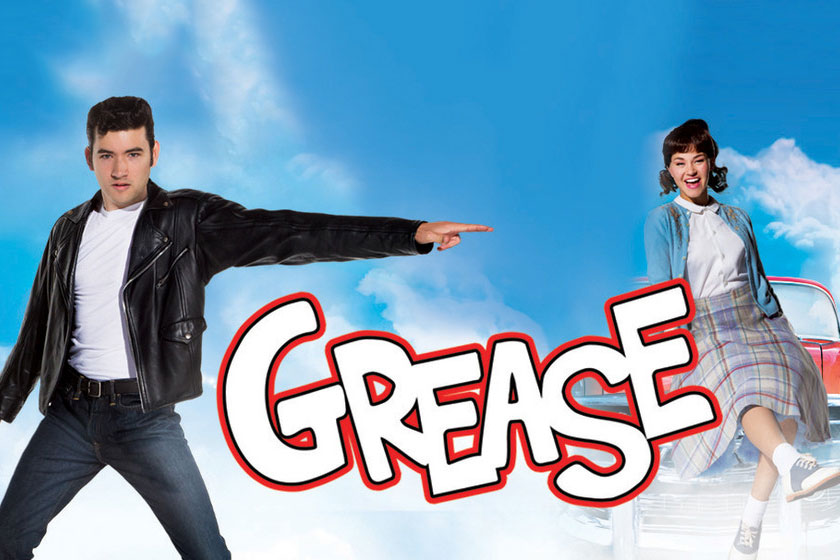
I just watched Grease for the first time. I honestly can’t explain why I’ve never seen this classic—it’s one of the biggest box office hits of all time, filled with smash hit songs and iconic performances. Really, though, it just never came up. I don’t think a single person has ever said to me “You know what? You should really check out Grease.” Maybe I just put out that cynical, this guy would never like Grease kind of vibe. It’s probably the same reason Mormon missionaries take one sight of me when I open the door and say, “Eh, never mind.”

Maybe I’ve just gone my whole life without running into real Grease aficionados. That’s no mean feat; clearly there are millions of them out there. But let’s stop beating around the bush and get down to brass tacks! I’ve got a lot of weirdness to cover. Here’s what I learned watching Greasefor the first time.

Grease is not a very good movie.

Settle down. I didn’t say it’s not fun or that the songs aren’t super-catchy. It is, and they are. But it is a very ramshackle little film: tonally disjointed, indifferently directed and featuring a pretty weak lead performance by Olivia Newton-John. You get the feeling that if this movie had any kind of plot whatsoever, you would be lost within five minutes. It was based on a very popular musical from 1971, so maybe the producers felt like the property and the songs were so beloved that they could put very little talent behind the camera and it would still work out okay, so long as the performers were appealing enough. Clearly, they gambled correctly.

At the helm was some TV director named Randal Kleiser (who went on to have further unremarkable journeyman success with Blue Lagoon, Flight of the Navigator and Honey I Blew Up the Kid) and he fills the movie with the kind of competent, unremarkable imagery that you might expect from a director whose name you’ve already forgotten. I watched this baby on Blu-ray and let me tell you, it looks adequate.  

Moreover, Grease can’t seem to decide what kind of movie it is. It’s kind of funny, sometimes. Kind of romantic, I guess. It’s a musical that goes long stretches without any songs. Sometimes there are fantasy sequences. Sometimes there are attempts at genuine emotional character arcs, but they are quickly abandoned. It tries to be sweet, dirty and cynical at different intervals, but none of it melds together. It feels more like a collage than a complete, cohesive whole. Mostly, it’s a sex, songs and nostalgia delivery system, and it certainly delivers on those three fronts.

What it lacks in quality, it makes up for with pure sleaze and energy.

Right now, I’m wondering just what I can get away with quoting from all of the lewd and lascivious dialogue in this movie. The song “Greased Lightning,” which is supposed to be about a car, is actually about how John Travolta’s character Danny is going to have lots of sex and enjoy himself very much in the process. I think there are twelve lines in this movie that aren’t explicitly or implicitly about sex. Here’s a passage of dialogue between Danny and one of his doofus pals:

SONNY: You mean she puts out?
DANNY: Oh, come on, Sonny, is that all you think about?
SONNY: Friggin’ A!

That exchange could just as well be between John Travolta and the movie Grease. Sometimes the characters get into trouble or interesting, formative events transpire, but the movie really isn’t interested in all that. Grease just wants to ditch all the drama and peek up ladies’ skirts from under the bleachers or figure out who has bigger jugs than Annette. Sure, Dirty Dancinghad some pretty ribald dancing in it, but Grease might as well be called Dirty Everything.

As a stand-up comic, I used to tell a joke about the song “Summer Days,” pointing out the horrifically suggestive nature of the line “Tell me more, tell me more, did she put up a fight?” Had I actually seen Grease, I could’ve had a solid 40 more minutes of material. It’s like Porky’s with songs and no nudity.

That said, if you get a bunch of good-looking, talented kids together and make them dance around and spew non-stop smut out of their mouths, you won’t hear me complaining (much). The movie is undeniably fun. It’s the kind of fun you have when you’ve had one too many shots at the bar with your friends and you all spill in to the streets at 2:00 a.m. with your arms around each other’s shoulders, shouting things at terrified strangers. It’s bad fun.

Newton-John Travolta are the Yin and the Yang of musical performers.

Newton-John has a wonderful voice. You have to give that to her. She belts out her songs like a person who was given one great gift, and that gift is definitely singing. Acting-wise, she’s a few clicks better than an athlete guest host on Saturday Night Live. Travolta, on the other hand, is pure charm and magnetism. From the moment he first cocks his head and beams at the camera, you’re thinking Oh, this guy knows what he’s doing. He’s funny, cocky, and absurdly handsome; he’s at peak Young Travolta. And he’s no slouch in the dance department, either. His voice, however, is a clear explanation for why his singing career never really took off.

But while I’m on the subject of Travolta: hmmm…absurdly handsome, cocky dancer in a romantic musical? Am I the only one thinking of Patrick Swayze in Dirty Dancing right now? There are a lot of parallels between these two iconic breakout roles. They’re both swaggering, steamy dance-hunks with hidden hearts of gold and soft spots for “nice girls.” But the question is: who does it better? To find out who’s the best of the period piece bad-boy dance-hunks, I put together this helpful and accurate chart:

Sensitive Dance HunkTravolta (Danny)Swayze (Johnny)
Handsomeness109.5
Sensitivity/Romance49
Dance ability910
Acting ability73
Danger factor58
Swagger811
Total4350.5

Oohh, sorry JT, that’s clearly Swayze for the win! I’m sure you all saw that coming.

Stockard Channing blows everyone else out of the water.

Channing plays “Rizzo,” a brash young lady who, well, has sex a lot. Everybody in this movie has sex a lot, but I guess Rizzo somehow finds time to do it more. She also smokes, drinks, eats twinkies and can’t stand squares. She’s awesome.

During a sleepover, while the square (and boring) Sandy (Newton-John) is in the bathroom, Rizzo sings a mocking song about chaste, boring gals, laughingly singing “Look at me, I’m Sandra Dee, lousy with virginity!” and “I’m gonna get my kicks when I’m still young enough to get ‘em!” She’s not some lost, wayward soul who has sex to be liked. She just really digs sex, and doesn’t care about what anyone thinks about it.

At a certain point, she has a pregnancy scare, and you start to think that the movie is going to punish her for her wanton ways. The movie itself seems conflicted about her. Remember, Greaseis just like Danny’s doofus pal Sonny. It loves sex and ladies, but it’s also kind of dumb. Much as the movie halfheartedly tries to be judgmental of her, however, the character and Channing’s dominating performance always win out. By the end, as a casual aside, Rizzo shouts down to her friends from a Ferris wheel that the pregnancy was just a “false alarm.” And really, what else would you expect from Grease? If Rizzo had a baby, that might cut back on the amount of time she could spend having sex or talking about sex, and then she could no longer exist in this movie’s bawdy universe.

Every high school in every era had WAY more sex than mine did.

That’s just clearly a fact. There must have been something about the mid to late 1990s. I blame Clinton.

It’s all just good songs, dancing and chaos.

The producers of Grease were right. These songs are classics for a reason. Just put some people in front of a camera, play the songs, make the kids dance and everything’s going to work out all right. There’s a scene later on when a TV dance competition comes to Rydell High. The host nearly makes out with an under aged girl and it’s played for laughs, but that’s not what I wanted to talk about. If I were to detail all of the pervy sexism in this film, I’d never finish writing this column. 

The school gymnasium is packed with kids eager to win the big dance off. After the show begins, one kids screams “Hey! There’s the camera!” as if the immobile, six-ton Golden Age of TV monstrosity had somehow been invisible up to that moment. All of the kids pour into the frame, waving, smiling and dancing. We see folks a home smiling and waving at their kids on screen. That’s what Grease offers: the pure, senseless, giddy thrill of youthful energy and movement. Plus sex.

And so, in the end, Travolta and Newton-John—who have clearly been in love since the beginning of the film—reaffirm that they indeed are in love, wave to their friends and fly into the sky in a car with a transparent hood. There have been exactly zero flying cars depicted before this moment. That’sjust the kind of movie it is.

Bob Fosse’s Dance (Dance) Revolution

Bob Fosse was one of those cultural forces of nature who obliterated himself only after obliterating his art form and remaking it in his own image. Think Orson Welles or Kurt Cobain, Richard Pryor or Virginia Woolf. Not to mention Lenny Bruce, about whom Fosse directed a knowing and sympathetic biopic in 1974. These are artists whose impact was so great, even they could not withstand it. As a composer and choreographer, his most famous musical was Chicago—a perfect fit for Fosse’s style, with all of its outsized experimentation, sleaze and hard cynicism.

Cabaret, at the Village Theater through August 2, was not one of Fosse’s own creations, but he directed the brilliant Academy Award-winning adaptation of it (also in 1974—he was, to say the least, a workaholic) and it’s not hard to figure out why. Cabaret is about massive cultural changes as they are reflected through art. It’s about tumult, sex, outsiders, music and dance. Fosse was very much that guy.

In September of 1987, a week after Fosse’s death, Richard Christiansen of the Chicago Tribune wrote: “Bob Fosse’s death last Wednesday did not come as a great surprise. Fosse himself had virtually predicted his massive heart attack in detail in his 1979 semi-autobiographical film, All That Jazz.” Absolutely true. All That Jazz, one of the craziest, smuttiest, most inventive and shamelessly personal musicals ever made, is Bob Fosse saying, “I can’t go on like this much longer, but I’m not going to stop, even to save my own life.” Fosse’s cinematic stand-in, played by the late Roy Scheider, drinks, pops pills, smokes like an industrial chimney and blows up every important relationship in his life.

It’s all about the work for him. Nothing else matters. Fosse/Scheider may lament his seemingly inescapable death and the wreckage he’s left in his wake, but as long as his work stands up, it’s worth any sacrifice. It’s hard not to admire and romanticize bombastic figures like this, terrible as it may be to work with and/or love them. Other phrases that turn up in Christiansen’s eulogy include “his working method was relentless,” “incessant drive for precision,” and “a modern personification of the hard-living, hard-working showman of consummate drive and talent.” He was a full time artist. He was only moonlighting as a human being.

There’s a scene in the 1953 film Kiss Me Kate where Bob Fosse appears for about a minute. It was a very small part, one of Fosse’s first noteworthy appearances in a motion picture. This scene absolutely electrified the world of dance, and you can see why if you watch the movie all the way through. It feels like this: regular musical, regular musical, regular musical—HOLY CRAP WHAT JUST HAPPENED?! He enters the scene sliding (a signature move) and immediately carves a notch in the timeline, squarely between the past and the future of dance. The outlandish, physically challenging movies, the brazen sexuality, the rock-star swagger—all are fully formed.  It’s like LeBron James showing up at a Celtics game in 1952, when people were only doing layups. Ohhh, I didn’t know people could do THAT.

Fosse’s 1972 film version of Kander and Ebb’s 1966 Broadway musical Cabaret was a decidedly loose adaptation. As a film director, Fosse’s work was surprisingly cinematic, considering his theatrical origins—full of dazzling cinematography, breakneck editing and realistic performances. Many details were changed from the musical, but the film still captured the feeling of social and cultural change flourishing under the shadow of the encroaching oppression of the Nazi regime in early 1930s Berlin. The film is PG, but still feels somewhat dangerous today. It’s surprising how frank both the stage and film versions are about sexuality (though I’ve recently come to learn that supposedly stodgy old musicals can often be quite shocking).

Cabaret is very much in Fosse’s wheelhouse. It’s got sex, bohemianism, gritty showbiz details and a pervading sense of anti-authoritarianism. Plus, of course, meticulously crafted song and dance numbers. It also has an acute awareness of mortality. The good times at the Kit Kat Klub and the romantic seesawing of the protagonists are always pervaded with a subtle but unmistakable sense of sadness, because the viewer knows what the characters do not: just how tragically precarious everything in their world is. Of course Bob Fosse loved it. He successfully predicted his own death, after all.

Going to the Opera with Grandma: ‘Ariadne auf Naxos’

Another opera, another show unlike anything I’ve seen before. Richard Strauss’s Ariadne auf Naxos (running at Seattle Opera through May 16) could best be described as a Hollywood behind-the-scenes screwball comedy. But, you know, with opera. And written about five years after Hollywood was even invented. And German. But all of the familiar beats are there! There’s a frazzled, idealistic auteur struggling with compromise, there are temperamental actors, world-weary producers and clueless moneymen blithely pulling the strings.

The pace is reminiscent of Howard Hawks classics like His Girl Friday and Bringing Up Baby. Characters dart this way and that, popping off one-liners in every direction. (Just to be clear: they sing the one-liners. Beautifully.) The situation begins dire and winds its way up to hopeless, as the wealthy benefactors of a two-part show (opera in the first half, comedy in the second) decide that it would be a lark if both acts fused together. The artists have about fifteen minutes to figure out how to make this seemingly impossible compromise.

The resulting show within a show has to be seen to be believed: lovely, stately, traditional opera, routinely punctured with clowning and smutty songs. As always, Seattle Opera pulled together an insanely talented group of people onstage and off. I’m only four operas in so far, but I’m very much beginning to understand why Seattle is considered one of the country’s premiere opera destinations.

This one was a real treat, and along with me as always was the one and only Evelyn Troughton: music fanatic, Seattle Opera volunteer, and—not insignificantly—the mother of my mom. She was kind enough to share her thoughts with me before, in the middle of and after the show.  

 Preshow

Thoughts before we head in?

Okay, this one is very different. As they all have been, from what you’ve seen. [Zero opera is what she means.] It’s a comedy. There’s this wealthy fella who wants to impress all of his friends and he hires some people to put on some shows. One’s an opera; one is a comedy. The first act sets it all up, but it’s short. The second act is quite long.

You know how I’m familiar with Strauss, right? Like most people, probably, it’s because of 2001: A Space Odyssey.

Oh, yeah? When I saw that movie, I was amazed. I’d never thought of the beautiful “Blue Danube” [Different Strauss, still a great scene] as traveling music! And that opening, I don’t know what they call it, but it’s wonderful, with the big booming drums. Wait, where are our seats? [Looking at the tickets] Section 2, row U…oh, we have to get going now.

After Act One

Grandma and I chat while enjoying some snacks in the pressroom.

Wow.

Are there a couple things you’d like to ask me about? Castrati? Trouser roles?

That’s not a woman playing the composer?

That’s a woman, yes! She’s in a trouser role!

That’s what that’s called? A trouser role? Is that the way this is usually done for this opera?

Yeah! Trouser role! Yes, it was written that way for this.

Why is that?

Oh, because… well, way, way, way, back when, women were not allowed on the stage. And so they had the castrati. And then that, of course, became illegal.

Rightly so.

[Laughs] That’s what everybody says!

You wouldn’t agree?

No, no, no. It’s a good thing! [Laughs] I agree with you.

Just making sure we’re on the same page. But wasn’t that way before this was written?

[Leafing through the Encore program] Well, Jonathan Dean might discuss it in here. I guess I’m not entirely sure why.

At this exact moment, Jonathan Dean shows up at our table. Fantastic timing.

Dean: Opera number four, isn’t it?

It’s quickly becoming my favorite, I think. This one is awesome.

Dean: I can’t pick a favorite. I want all of them!

Grandma: Who was it that said: “Whatever opera I’m at, that one is my favorite?” I need to make categories for my favorites: favorite soprano aria, favorite tenor aria, favorite bass aria…

Dean: I see, like, an Internet meme of Evelyn’s top-ten opera lists.

Grandma: What did he say?

Trust me, it’s never gonna make sense to you. [To Dean] We were just talking about the “trouser role.” Why was it written that way?

Grandma: I’m not as knowledgeable as he thinks I am. [Laughs]

Dean: Well, here it is: the man who wrote this just really liked women. He did a lot of this kind of thing, because for him it was just a lot easier to work with them. He liked writing for women, and he liked the scene where they were in love with each other. He kind of knew–with the tenors that were available to him in those days–that it would be a headache [to work with them].

And that’s based on the specific personalities of the tenors he knew at the time?

Dean: Yeah, the egos that go into the job and stuff like that. The character is also supposed to be a teenager. He’s like Mozart, a young kid. Think of the guy who played Mozart in Amadeus.

Tom Hulce.

Dean: Yeah, he had this weird, high-pitched giggle and was really immature. That’s part of what goes into this character. So it’s easier for the mezzo-soprano to have that kind of impact. Certainly a bass or a tenor would’ve been totally wrong. Emotionally, he’s in a frenzied kind of state.

I knew this was a comedy going into it, but often times, like with A Midsummer Night’s Dream and such, I’m thinking, “Oh, this is what they considered a comedy back then,” but I’m not actually laughing. But this one is really funny.

Dean: That’s true—the humor in Ariadne is very contemporary. I also think it helps that we’re in Seattle and there are so many Seattle in-jokes. Like when we get to the next scene, it’s basically on Lake Washington in this guy’s mansion and he’s got Dale Chihuly pieces all over the place.

It’s a fantastic setup for a second act: “Here’s a crazy thing that shouldn’t exist! Here we go!” Cut to black.

Grandma: Then there’s a curtain call for everyone in the first act that you won’t see again. It’s two operas in one!

I guess since the composer character took a bow that means we’re not going to see him/her again. Which is sort of a tease, being that they set up the romance between him and the comedian lady.

Grandma: [Silence]

For the record, a wry smile from grandma.

Grandma: [Laughs] You want a few grapes? You need some fruit in your diet.

After Act Two

I’m trying to collect my thoughts. That was pretty crazy.

It takes a while to get your head together after seeing something that is so full of… it’s just full! So many different things that are so different from what you’ve seen.

There’s a lot going on. Some times it’s straight up comedy, then there’s some real hardcore, serious opera, and then the comedy will come out and make fun of the opera for being so serious. But the last ten, 15 minutes of it was just pure power Opera.

Once Bacchus shows up, yes. They had a whole set of comic stuff. It was very long, and her aria about how she’s with one man after another and another, flirting with the diners. Pure comedy. What she was saying was… well… was she saying what she thought and felt? Or was it part of her act?

I don’t know! There are actors playing actors who are in and out of character. Layers upon layers.  

And what I also thought was humorous was when the nymphs said that Bacchus the god was a young man, a boy.

A “lad.”

Yeah, and he comes in, clearly a big burly man. The point is, was that part of the humor? Him not being a youth as they claimed him to be? Was that some kind of stage director’s humor? I have all these questions that I wonder about. So I’m going to have a lot of questions when I go in to volunteer on Monday.

The Phantom Has Arrived

The Phantom of the Opera has arrived in Seattle and it’s a pretty big deal. As far as the world of theatre is concerned, it’s quite literally the biggest deal. Phantom is like the New York Yankees of musicals: nothing else comes close to matching its dominance over the years. It’s the longest running Broadway show ever. It’s sold almost six billion dollars in tickets over its entire run—that’s more than the worldwide grosses of Titanic, Avatar and Alvin and the Chipmunks 3: Chipwrecked combined. It’s got the biggest set pieces, the gaudiest costumes, the most beloved songs. Everybody wants to see this thing, no matter what anybody says or writes. I think the only reason they get the press involved is out of habit at this point.

That’s definitely for the best, because the good people behind the Phantom juggernaut invited me and some of my fellow local entertainment journalists to pop in to the Paramount on Friday to, in the words of stage manager/tour guide Heather Chockley: “do a little press day where we get to talk to a couple actors, we do a little costume spiel, and then we get to see the chandelier.”

I arrived at 11 am and the place was already filled with busy-looking people briskly pushing and pulling things around. I met up with Chockley right on schedule. She is the quintessential stage manager—friendly, efficient, exceedingly knowledgeable and decidedly in control. She has clearly done this press routine at least a quarter of a million times at this point. This junket is probably number 76 on her 500-point to-do list for the day.

This particular tour has been going on for over a year and half, so all of the kinks have been worked out by now. There are 38 cast members, twenty travelling crew, 75 local crew, and a 15-piece orchestra. 1,200 costumes. It takes 20 semi trucks to carry this behemoth show from town to town. It’s a massive, mobile, entertainment machine with thousands of moving parts. According to Chockley, they have “one guy downstairs whose entire job is doing laundry. All day long.” I have no idea why, but that sounds like an awesome job to me. I would have loved to interview that guy. In my imagination, he wears an eye patch. I can’t explain why.  

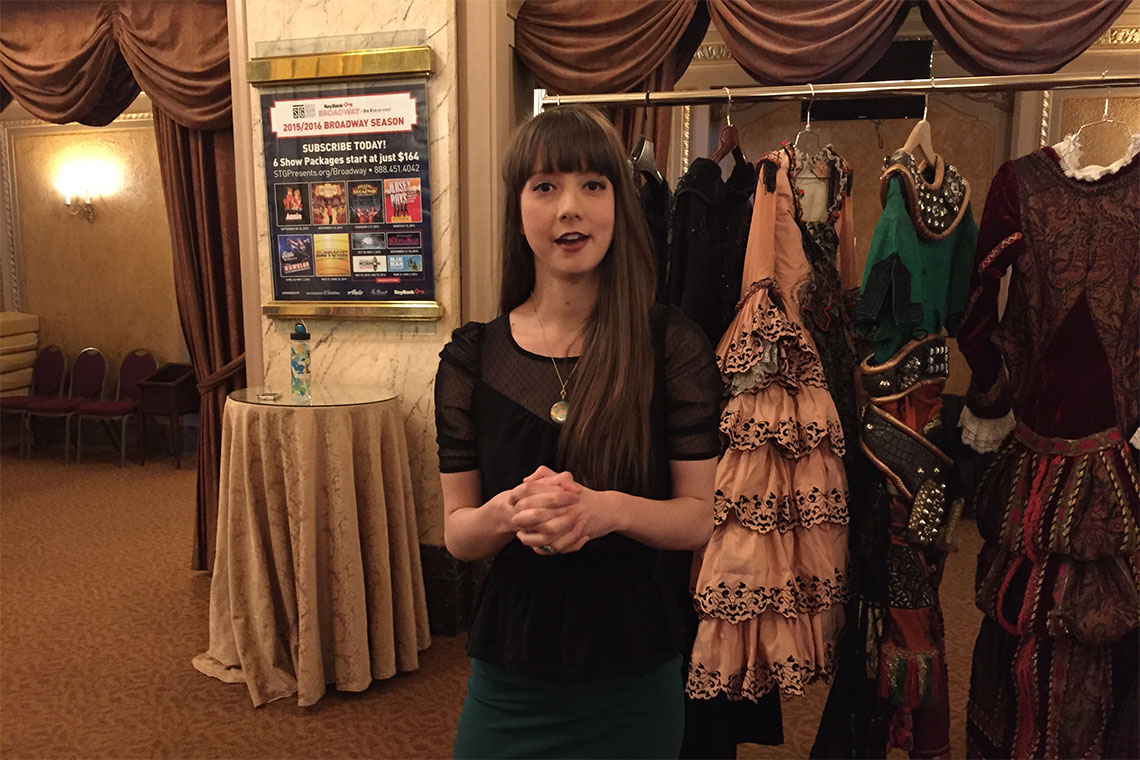
There was a rack of costumes for us to look at and photograph. Chockley knows a lot of stuff about these super famous costumes (“The show has been completely redesigned except for the costumes. It’s hard to update costumes when they’re this amazing to begin with”), but I glaze over a bit when words like “bustle,” “crinolines” and “taffetas” start getting lobbed around. I think she noticed, because she then pulled out the Phantom cape, acknowledging that men generally aren’t very interested in costumes, but they always go nuts over the cape. Fun fact about that cape: it cost about $25 thousand for materials and labor. “That’s more than my car!” Chockley observes.

Then came the actors! I love actors. The lead came down the stairs to greet us, but we were all too slow on the draw to ask any questions and within seconds he bolted to get coffee. “Wait, where did he go?” asked one of my fellow reporters. Katie Travis, who plays Caroline, joined us next. She’s very patient and kind. She looks all of us in the eye and seems very engaged with our questions. “Do you have a routine for relaxing and exploring when you get to new cities?” I ask.

This is a stupid question, but she gives it her best. “I try to explore cities as best as I can, but you have to lay low and take care of your voice, and just do whatever it takes to keep your focus on the show.”

This is a phenomenally talented person who has a lead role in a multi-million dollar entertainment enterprise. This isn’t some kind of lark for her, even if it does involve lots of dancing. “It’s a huge, all-encompassing challenge, but it’s all passion and heart,” she says, and you believe it. Six shows a week. For over a year and a half. She’s living her dream, absolutely, but that doesn’t mean it’s not a hell of a lot of work.

Phantom of the Opera chandelier

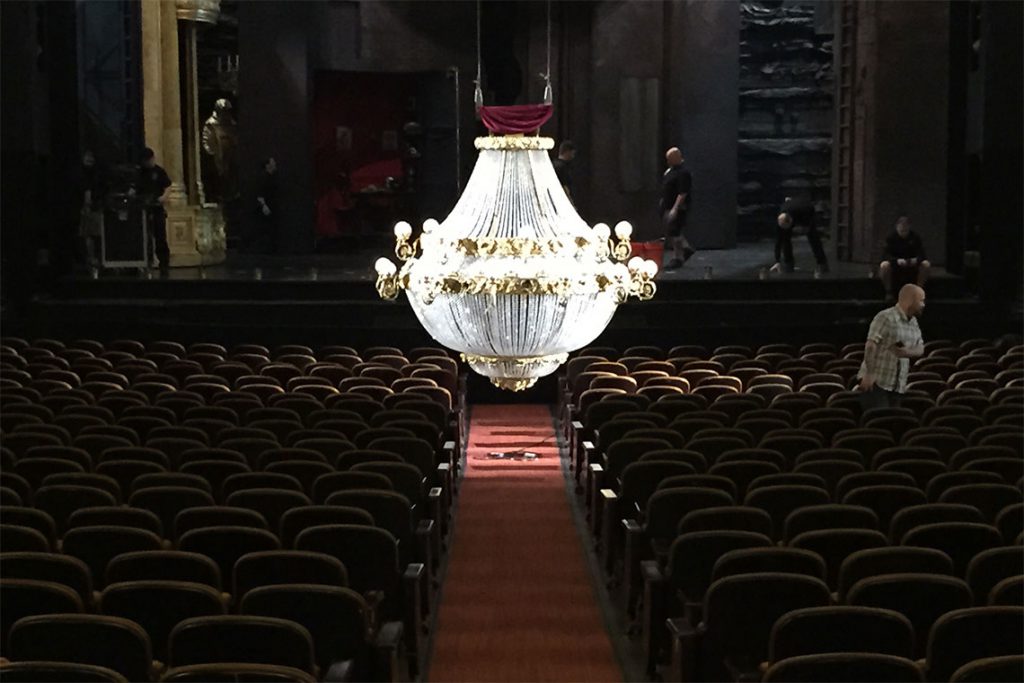
“Okay, they’re ready for us!” Chockley announces. We file into the auditorium and there it is: the famous descending chandelier, fully descended. We’re here specifically to observe it being lit up. I took a video of the event, but another cameraman had to squeeze past me so I stopped filming at the exactmoment of illumination. Of course, it’s not the lighting of the chandelier that’s really spectacular, though it is quite lovely. The money shot is when it drops on the audience. The thing weighs over a ton. “We do make each theater provide us with an engineer’s letter stating that it can withstand the weight,” Chockley explains, which is surely a relief.  But they’re not going to drop it for us today. You have to go to the show to see the real fireworks.

The lighting ceremony is the main event, and immediately afterward we are politely dismissed. There is a show starting in one hour and the frenzy is reaching its peak. Dozens of people are walking and running in every direction, carrying props, costumes, and tables, talking on their headsets. Everyone is moving fast, but nobody seems remotely anxious. They’ve all done this before many, many times. This is a well-oiled fantasy machine. Scores of hardened professionals working long hours in a high-pressure environment for months on end. The end result, if history is any indication, will be an enormous amount of fun.

Seven Awesome William Forsythe Quotes

I understood the imperative in Europe to be that your job was to further the definition of your practice. Not to challenge it but to say, ‘what else does it do?’

William Forsythe is an innovator, working at the highest level of an art form that has been around for hundreds of years. That’s a daunting task. Hundreds of years, building up traditions, presuppositions and expectations. This doesn’t lead to a culture that’s always enamored with the new. But that’s exactly what Forsythe has consistently brought to the world of ballet, creating an exiting and demanding form of modern choreography that explores the boundaries of the art while fully embracing it’s history. As such, he’s thought a lot about what innovation means and why it is important.

This means that while he is personable and unpretentious, he often speaks in amazing aphorisms like this about the artist’s journey. If you have any interest in creating art, listening to him speak casually about his craft is like getting a pep talk from a motivational speaker. 

The worst thing you can do with this work would be to tick off all the boxes: ‘I did that, I did that and I did that.’

See what I mean? This is the kind of thing Forsythe says all the time in casual conversation. Of course, in this case the conversation was happening in front of an audience of about 100 people in a lecture hall, so I suppose it wasn’t the most casual of circumstances. Peter Boal (previously on Encore here), artistic director of Pacific Northwest Ballet, was interviewing him as a part of the PNB Lecture Series.

Since the 1970’s, Forsythe, a New Yorker, has primarily worked in Germany, for the Stuttgart Ballet and Ballet Frankfurt. His life reflects his approach to work. He wants his dancers to learn by doing, to come to the material through their own experiences, to risk failure in the pursuit of discovery.

It has a reputation in the dance world of being the true test of your endurance. There was a principle dancer in San Francisco who said she would much rather go through another childbirth than do this piece again.

This is in reference to the first piece of his new show with PNB, The Vertiginous Thrill of Forsythewhich runs through March 22nd at McCaw Hall. Boal described The Vertiginous Thrill of Exactitude as a “thirty minute ballet compressed down into ten minutes” because they have the same number of steps. This is black belt ballet. Hardcore ballet.

We don’t generally think of ballet as being physically punishing, because the whole idea is for it to look graceful and elegant in execution. But Forsythe’s work demands athletes. Just as in the world of sports, people are constantly getting bigger, stronger and faster then they ever were before, dance evolves to become more and more challenging and demanding.    

How do you say no to Jesus, right?

Forsythe was telling a story about meeting Rudolph Nureyev, one of the most famous dancers of all time. He described the Russian’s presence when he entered the room to that of Jesus to people in his profession. Forsythe was eating lunch in his dressing room at the Joffrey in the ’70s when Nureyev propositioned him. I’ll just let him tell the story:  

“So, he looks me up and down and he goes ‘What are you doing tonight?’ I said, ‘Oh, I’m busy, um, I’m performing something!’ And he said ‘What are you doing this afternoon?’
‘Um… oh, I have a rehearsal.’
‘What are you doing…right now?’
I said, ‘I have lunch!’ [Laughs] How do you say no to Jesus, right?”

Some of the best dancers I’ve ever worked with are the ones that started out with hip-hop and moved to Balanchine.

Apparently the movie Step Up wasn’t too far from reality. Forsythe is willing to draw from any and all sources in his choreography. This hip-hop influence is noticeable in his dancers’ routines, but not overwhelmingly so. A step here, a glimmer there. His work mixes the old and the new in a way that neither favors nor detracts from either. It’s ballet as you know it. But it’s way different.

This applies to the music selection and the costuming. Vertiginous Thrill features tutus, as you might expect, but these ones are lime green and shaped like potato chips. So, you probably didn’t expect that. 

Have you heard about this word, monopoly? Which is not just a game?

Are you aware of the great ballet shoe conspiracy? According to Boal, PNB spends a quarter of a million dollars per year on pointe shoes. That’s right. There 26 ballerinas in the company, and each one, on average, goes through a pair per day. At 80 to 85 dollars per pair, and supposedly there is only one place you can get them! This seemed like a frustrating but inevitable reality for Boal and Forsythe, who didn’t want to name the shoe manufacturer in question. I’d like to further investigate this story, but I’m afraid of what will happen if I dig too deep and upset the shadowy overlords of Big Pointe Shoe.

What is the present composed of right now, as opposed to what I think it’s composed of?

Forsythe spoke a lot about Marcel Duchamp’s “Art Coefficient” proposal, which is “the difference between the intended but unexpressed and the unintentionally expressed.” Basically, he advocates the shedding of delusions. From his perspective, innovation and originality can only be achieved if you see things with absolute clarity. You have to know how your own hopes and fears are influencing your perception of reality. “Seeing the future” was a recurring theme in this talk. That’s something he’d like to help his dancers and his students do. And you can’t do that if your jumping off point is an incorrect vision of the present.

Going to the Opera With Grandma: ‘Semele’

I used to naively assume that all operas were the same. If you don’t get around to seeing too many operas, you might have a similar generalization in mind: people in costumes singing old stories on stage in foreign languages with crazy opera voices. Classy, impenetrable stuff. Having just watched my third opera for this column, however, it finally dawned on me just how incredibly varied these things can be. Don Giovanni was an absurd sexual morality tale. Tosca was an intimate, emotional piece of historical tragedy. Then comes Handel’s Semele, and now anything seems possible. 

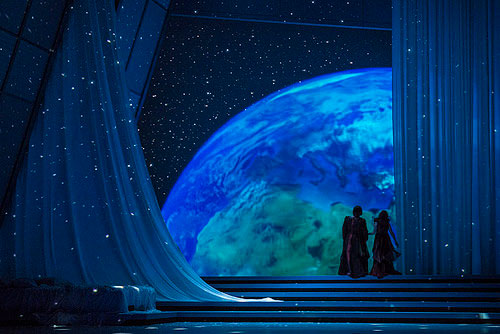
Two things must be stated up front. First of all, Seattle Opera’s Semele is crazy. It’s a weird story to begin with because it’s about Roman gods, and everything those guys did was perplexing. Added to that, it’s filtered through the specific sensibilities of mid-18th century England. But it’s the way Seattle Opera stages this rarely done piece that truly makes it unique. Spare, modernist sets couple with the extensive use of digital projections and truly outrageous costume designs (two words: laser fingers) left my jaw hanging open for much of the show’s three and a half hour running time.

Which brings me to my second point: I was nursing a particularly harsh head cold, so I was blitzed on over-the-counter medication during the whole show. This was not in any way detrimental to my enjoyment, but it might have been a bit detrimental to my level of comprehension.  

Fortunately, at my side as usual was my trusty opera expert and grandmother, Evelyn Troughten, who talked me through the experience in the intermission after each act. 

 Act 1

So, Juno’s mad. Semele is sleeping with Juno’s husband? Is that what’s going on?

Yes! Yes.

And that’s Jupiter.

Yes! That’s Jupiter.

Juno is Jupiter’s wife.

Yes.

This is your classic “Mortal sleeps with God and God’s wife gets mad at mortal” thing. That never works out well for the mortal.

True. Why else are they gods? What you want to do before the day is over is go down and look at the instruments. [Author’s note: no edit here. This was a natural, if abrupt, shift in the conversation that’s not at all unusual with my grandmother] They have a virginal and they have a harpsichord, and they have an instrument that’s a bass lute. The virginal is a smaller version of a harpsichord and the reason it’s called a virginal is because it was played by young girls who theoretically or maybe actually were virgins.

Theoretically? Well, one would hope.

One never knows! So you should go down and take a look, these are very rare instruments. You may never see them again. Well, harpsichords you see around quite a bit.

I see harpsichords constantly! This opera is very simplistic and very complex at the same time. I only have a vague idea of what’s going on at any point.

You see, I know because I read about it. And I went to that talk, the pre-performance at the Queen Anne library. The opera also has a blog and they put information out and you can read about these things. The ideal is to familiarize yourself with the story so that you understand what’s going on.

I’d never seen opening credits for an opera before.

I’ve never seen anything like that before! Anywhere. That’s what surprised me the most. You’ve got this curtain hanging. You’ve seen curtains before and you think nothing of it. And then all of a sudden “Semele” is projected on there. And I thought, “Wow, this is different.” And then: people. The cast! You’d see the real person on stage, and above them, their names and the character they play projected on the curtain! I don’t know how they did it, but it was clever! That’s what I liked best. Because it was different. I like different things.

I kind of forgot where I was with some of those trippy projected visuals. Which is fine, because I can’t tell what’s going on anyways. I’m just listening to the music and voices.

Well, you remind me of what it was like when I first started going to the opera. They didn’t have the supertitles. I’d just listen to the music because it was so gorgeous, didn’t have a clue what they were saying.

Act 2

At this point we were fortunate to be joined by Jonathan Dean, the director of public programs and media for the Seattle Opera, who gave us a bit of historical context for the piece.

Dean: Most of the action of the story is in the final act. That’s why it’s longer. When this was written, a lot of people couldn’t show up at the theater at the beginning of the show. They’d come later on, and they didn’t pay any attention. That’s one of the reasons people repeat themselves so much in this show. You were sort of lucky if you got the audience to pay attention.

So the repetition is literally just to get it through to people?

Dean: Yeah, the opera was a very different place back then. It was much more like going to a casino. And these people would step out in these elaborate costumes and sing these amazing things and the people would be like, “Oh, okay, this is pretty good.” There’s a very funny one in the next act, the line is “Myself I shall adore if I persist in gazing” and he overdoes it to the point of stupefaction! [Note: Indeed!] The other thing about it is, it’s an ancient story, but it’s satire for a specific period: the first half of the 1700s. There are funny, coded messages that they would’ve gotten at the time.

I can tell that there’s all kinds of stuff that I’m missing. If only there were footnotes for opera!

Dean: Well, you could’ve come to our pre-show talk—

Grandma: I tried to get him to come to that and told him that’s part of going to the opera!

It’s okay! The projected visuals are working pretty well for me, because I’m on cough medicine, so I’m kind of in a trance looking at this stuff.

Dean: Well, that’s actually sort of like—because again, when people would go to the theater back in those days, they were drinking heavily, they were gambling. If they had a private box, they could close the drapes and carry on their illicit affair in there.

It was rowdy.

Dean: Yeah, it wasn’t polite like it is going to an opera today. It was a little bit more upscale than bear-baiting, which was going on across the street!

Act 3

Give me a quick first impression of this opera.

The production was just out of… they said it was going to be great and really different, but I could never have thought that it could have been so good.

What was your favorite part?

There’s no favorite part. Because it was all good and the music was lovely.

My favorite part was the lady with the laser fingers.

Well yeah. I suppose so.

I’m a sucker for laser fingers.

I guess you have to say that was the most fun part. Her costume was great. I’d heard about these costumes, and I’d seen drawings of them, but the drawings didn’t do them justice. And it was good that they used people that looked like the kind of people that the opera was about. Somebody that a god would fall in love with.

Closing thoughts? What would a person going to see this piece need to know, aside from having an extensive background in Greek mythology?

I would say that it’s the most unusual opera I have ever seen. For many reasons. The projections. The opening credits. The repetition in the libretto. I would say that it’s nice music, and even beautiful in some places. And you’ll hate yourself if you don’t go see it. I don’t know if any other opera company would be bold enough to do it.

That’s a pretty good one to go out on.


Semele runs through March 7 at the Seattle Opera.