Caitlin Sullivan makes some of the most inventive and engaging theatre in the city. As Artistic Director of the Satori Group, that Genius Award-nominated font of collaboratively generated new work, she’s directed the acclaimed world premieres of innovative plays like Winky, Fabulous Prizes, reWilding and this year’s Returning to Albert Joseph.
It’s been a busy time for Sullivan. This past spring she was awarded a prestigious fellowship with the New York’s Drama League Directors Project and she’s been ferrying between coasts since—she heads back east tomorrow to direct Dipika Guha’s Mechanics of Love as part of The Drama League’s Directorfest. I caught up with the highly mobile Sullivan for this week’s installment of Five Friday Questions.
What’s the best performance you’ve seen lately?
Kendrick Lamar’s recent performance on SNL. I can’t stop thinking about it. It felt like it was talking forwards and backwards, a performance aware of its place in history, a throwback with an emotional current that is specific, necessary and now, an articulation that reached beyond where my words end.
Other bests: Industrial Revelation’s and Jinxx Monsoon’s performances at the Genius Awards made me both proud and humbled to be an artist in this community.
Writer/perfomer Hannah Bos’s performance in The Debate Society’s latest show Jacuzzi was masterful. The company creates these incredibly detailed theatrical worlds and then she lives joyfully and surprisingly inside of them. I love watching an actor blur the line between creation and interpretation.
And finally, I am loving Aminatou Sou and Ann Friedman’s podcast Call Your Girlfriend. Those ladies are performing female friendship at the highest level.
What music gets you pumped up? What do you listen to when you’re sad?
I’ll say that those states aren’t mutually exclusive. I think my favorite music helps me ride between. [Frank Ocean’s] Channel Orange has been my most listened to album for the past few years. The Talking Heads are a constant. And I’m always returning to LCD Soundsystem, especially when it gets dark and dreary outside—I like my dance music with a serious side of melancholy.
More to the question: Laura Marling’s Once I Was An Eagle makes me weep and my heart soar, and Fiona Apple is great for both wallowing and moving through that into anger and action.
As for pure pump-ups: Beyoncé. A year later, it’s still got me. It’s a perfect pop moment. And I am far from immune to the charms of Taylor Swift. 1989 pro-tip: forget “Welcome to New York” ever happened, put “Blank Space/Style/Out of the Woods” on repeat.
Do you “treat yourself” to anything special after a show closes?
Sleep, time with family and friends and getting out of town (wherever town is right now). I have been known to show up to opening with a suitcase in tow.
What is the most indispensable thing you own?
Probably my phone and whatever notebook I’m currently working out of. My Kitchen Aid mixer is probably my favorite possession. I do a lot of baking, especially when I’m in the middle of a project. It’s a huge stress relief.
And my Miseducation of Lauryn Hill world tour t-shirt. I never travel without it. It’s perfectly worn from fifteen years of love and a reminder of one of the best performances I have ever experienced.
In highly welcome local theatre news, the Seattle Rep announced yesterday that Robert Schenkkan’s Tony Award-winning play All the Way has become the highest-grossing production in their history. Less than two weeks after opening, ticket revenue has surpassed Lily Tomlin’s The Search for Intelligent Life in the Universe and Carrie Fisher’s Wishful Drinking for the top spot. Sales have been so brisk that the Rep added a second “marathon day” for audiences to experience both All the Way and its followup, the world-premiering The Great Society. The two shows overlap through December and January.
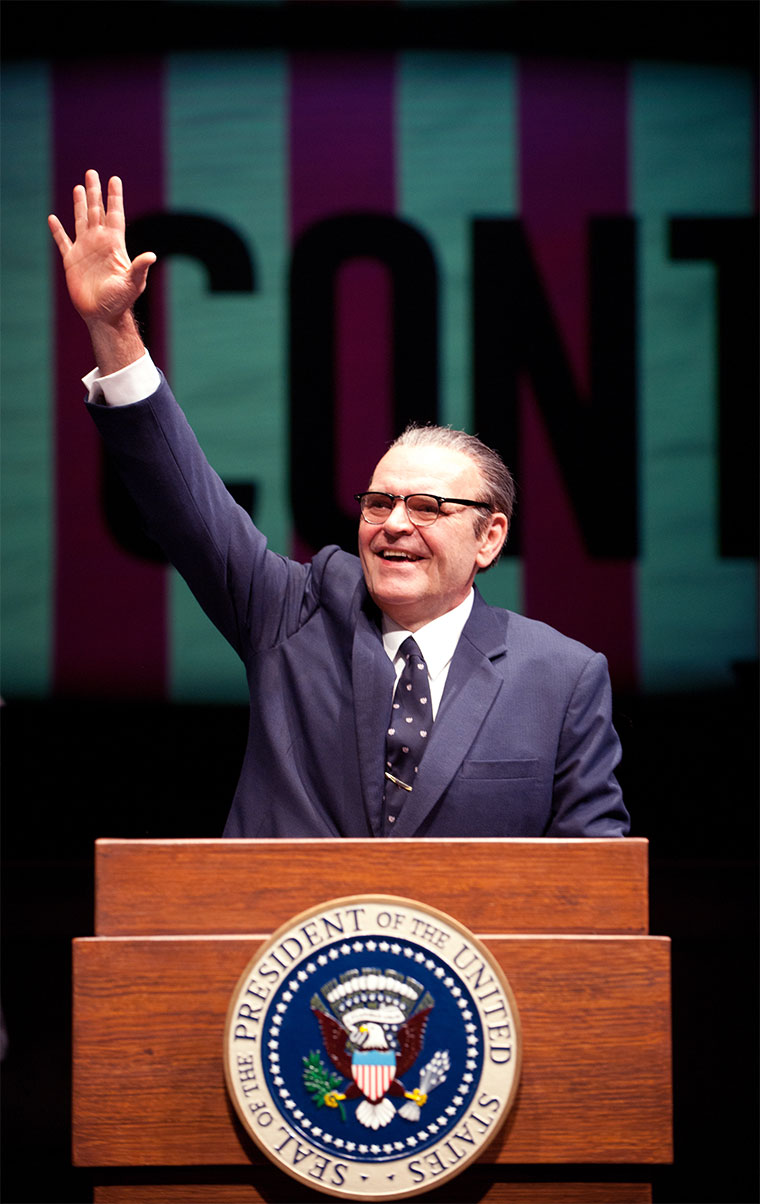
Jack Willis (pictured) stars as LBJ in the role he originated—covered by obscure upstart Bryan Cranston in the Tony-winning Broadway production—and Bill Rauch directs. The plays run until January 4.
Check out our interview with the plays’ dramaturg and longtime Schenkkan collaborator Tom Bryant and Gemma Wilson’s feature and review of the show for City Arts and stay tuned for more about the blockbusting production here at Encore.
William Poole is a Seattle actor seen most recently in ACT’s Vanya and Sonia and Masha and Spike, Christopher Durang’s Tony Award-winning takeoff on Chekhov and the idle rich. Poole played Spike, the hunky boy-toy, holding his own as the youngest talent in a cast of accomplished veterans and getting big laughs from his physical (and sometimes nearly naked) performance.
Fresh off the run of shows at ACT, I checked in with Poole for this week’s installment of Five Friday Questions.
What’s the best performance you’ve seen lately?
Rosamund Pike in Gone Girl. Going in, I didn’t know what to expect. I hadn’t read the book and didn’t know much about the story. The plot was a bit shocking but Ms. Pike nailed her performance. She was stunning, vulnerable, manipulative and downright psychotic. Kudos to her.
What’s your favorite place to go after a show?
Currently it’s a tie. I always like to find an inexpensive local watering hole when I’m working on a show. While at ACT, I’ve most often found myself at Dragonfish Asian Cafe (Pine & 8th) or McMenamins Six Arms (Pike & Melrose) for post-performance food and drink.
Both places are within walking distance of the theatre and both have killer late night happy hours to satisfy the hungry, parched thespian in all of us.
Do you “treat yourself” to anything special when a show you’re in closes?
I don’t have any traditions or treats when I close a show and sometimes closing can be bittersweet for an actor. However, after Vanya [which closed last Sunday] I will be purchasing the boots that Spike wears in the final scene. I think my feet have developed a special connection with my character’s boots. Besides that, they are pretty darn cool looking.
What is the best meal in the wintertime?
Wintertime makes me think of the holidays and the holidays make me think of a big prime rib roasting in my grandma’s oven. Give me some potatoes and gravy on the side, with a piece of my mom’s Lemon Sour Cream Pie for dessert and I promise not to bother anyone for at least ten minutes.
What is the most indispensable thing you own?
My 24 Hour Fitness gym membership. I’m at the gym four to five times a week lifting weights and playing basketball. It gives me something to do during the day while I’m waiting for an evening performance. Without it, I fear I would be terribly lazy, bored and cranky.
Alex Highsmith is a 25-year-old actor from Utah who recently settled in Seattle. You might know her from her brilliant performance in the Intiman’s Angels in America as Harper Pitt, a Valium-addicted, hallucinating Mormon housewife married to a closeted gay man.
She infused her character’s desolation and befuddlement with native charm and genuine humor, wresting laughs out of the bleakest of domestic circumstances. She’s talented. Highsmith joins me for the inaugural edition of Five Friday Questions.
What’s the best performance you’ve seen lately?
Confession: my first instinct upon reading this was to say Beyonce’s halftime show at the Super Bowl two years ago. Seriously, it gave me chills. It was the first time I felt like I had seen a real, all-around rock star performer in my lifetime, plus I’m a Millennial and a sucker for pop R&B.
However, the best performance I’ve seen lately, truly, would probably have to be those of Anne Allgood and Chuck Leggett in Angels in America. And yes, I was in that show, so this is totally biased and maybe partially a lazy answer but it keeps coming back to me and I’ve thought it for months.
There’s a scene in Part II where Roy (Chuck’s part) is just about to die and Ethel Rosenberg (Anne) sings him to sleep despite her complete hatred for this guy. I’ve never gone from astonishment to tears to laughter and back again in such a short span of time. Like two minutes. Then they both walk off stage and Chuck eats soup and Anne knits.
It’s so innate for those guys, and they never linger. I think that’s what makes the best performances “the best”—watching is like trying to hold water in your hands. It feels so true and good and like nothing else in the moment but you can never quite hold on to it. I learned so much from watching them, on and off the stage.
What’s your favorite place to go after a show?
Oh geez… the bar? Any bar? I’m relatively new to Seattle, and even more so to the theatre community here, so I don’t have my own “Cheers” or whatever yet. But I think it’s the same for many actors or artists in general, for that matter; after a show, or any sort of display of “your stuff,” there’s this straddling of a line between needing to intake and to outpour. Like, I’m exhausted and need to curl up into a ball somewhere warm and quiet but I also need to keep riding the wave of energy I’ve been on for the last however-many hours or I’ll feel crazy.
It’s something I’m actually starting to pay real attention to as I grow into myself as an actor, because it can change from day to day, and honoring those changes is, I think, what keeps one going. But also I usually just want wine and Solo Bar in Queen Anne is good for that.
Angels must have been an exhausting marathon to run—did you “treat yourself” to anything special when it closed?
Yes. A good, solid cry and a trip home. That show was so much fun and if my body (and my contract) would have let me, I would have done it forever. But as soon as the show closed I got strep throat and also super sad. Closing a show is like ending a lifetime, and there’s a bit of a grieving process that goes along with it, as well as some physical catch-up.
Luckily, my mom was in town to see closing night and after realizing I had a week of down time between projects she scooped me up and took me home to Utah. I did absolutely nothing for four days. It was awesome.
What is the best meal in the wintertime?
Okay, here it is: the frozen beef bourguignon from Trader Joe’s, two par-baked rolls (also TJ’s) and a bottle of Two Buck Chuck. Twelve dollars, twelve thousand calories, and a rough morning. Best meal ever.
What is the most indispensable thing you own?
My relationship with my mother. She is so effing wonderful, and as I get older I find myself calling her less and less for things like money or emergencies and more and more for advice and guidance. I would definitely be dead without her. Well, I guess that’s true no matter what way you look at it, but you know what I mean.
The dramaturge Tom Bryant has been working with Pulitzer Prize-winning playwright Robert Schenkkan for a quarter of a century, and this year he will see the world premiere of their newest effort, The Great Society (opening at the Seattle Rep December 5), as well as the production of their Tony Award-winning All The Way (opening November 14).
A specialist in historical drama, Bryant works closely with Schenkkan from early in the script-writing process all the way through to the final production, reading the same sources, mining for “nuggets” of dramatic possibility from those texts, and molding the theatrical elements to create a work that remains true to the historical record while also pointing at greater human truths.
I talked to Bryant about the upcoming plays from his home in LA.
You’ve been collaborating with Robert Shenkkan for almost a quarter of a century now?
[Laughs] Basically. Robert and I first started working together on The Kentucky Cycle in ’89. Way, way back. We went through that whole process of development through the Intiman Theatre and finally the Kennedy Center on Broadway.
A Pulitzer Prize right out the gate.
Sometimes these projects pay off I suppose, huh?
I’d imagine that would cement a collaboration pretty well.
Yeah. It was so great to work with Robert. He’s such an amazing writer, and that type of historical play is kinda my specialty.
I’d imagine the LBJ plays are a dramaturge-heavy field, because there’s a historical record of everything. How do you balance the dramatic needs of the play with obligations to actual history?
I think Robert gets it very much right. He’s always quick to state that this is his dramatization of history, so it’s not as if this is meant to be an absolutely correct historical account. Of course, historical accounts themselves vary, given different points of view and disputations about fact. I think the clear bright line is, what we’re selecting are moments, nuggets of history that dramatize the dilemmas of the characters. That’s what Robert is after, and I think it’s mostly true in terms of those accounts. Certain scenes, conversations between people, perhaps we don’t know what happened, but in general it’s very faithful to the basic history itself.
And what does your role look like in the workshopping process, day to day?
It depends on the stage of the process. I started working with Robert on Great Society and All the Way before they were written. There’s a huge research phase that happens first; we go through tons and tons of material. It’s kind of like panning for gold. You’re looking thru history and coming up with these nuggets and going, Oh boy, that’s a wonderful anecdote, that’s an important event, this is an amazing possibility for a scene between two people that would really be dramatically exciting. So Robert and I are both reading the same books and looking for this kind of material.
Then a lot of the stage that follows is outlining, with a lot of discussions about what would be a great dramatic structure to the thing. Then Robert goes into his writing process.
So that’s the first phase, poring over research and trying to find things that are usable. The second part is refining the various drafts through the workshop process and looking at how things land. You’re hearing them read out loud and then making decisions about structure and form. Generally that’s what I’m focusing on.
And looking at how the thing would play in front of an audience, trying to troubleshoot that process. Then production is something else, you’re looking at the whole thing in terms of the production values and seeing how that is playing in front of an audience. It’s trying to gauge how the piece is dramatically effective, how it’s coming across and how to maximize its potential.
All the Way was a Tony Award-winning show starring Bryan Cranston at the white-hot nuclear peak of his massive fame. No pressure there, right?
Bryan was absolutely wonderful, and of course, like everyone else I’m a huge fan. That was an incredibly fortuitous meeting of that project, which he really embraced, with his just coming off Breaking Bad at the time. A wonderfully fortunate convergence.
I read that Robert Caro didn’t want to meet with Bryan Cranston because he didn’t want it to color or infect his view of LBJ. I’d imagine as a dramaturg it’s the opposite; you have to confront those two elements, the actor and the real man.
I hadn’t heard that. As a dramaturg I’ve read voluminous amounts of material. Caro’s books are really wonderful. There’s any number of books that were such great accounts of LBJ: Doris Kearns Goodwin’s, Nick Kotz’s Judgment Days. I had five shelves with about 100 books that I’ve gone through looking for these various nuggets of dramatizable events and information.
What are these nuggets? Clarifying moments of actual dialogue? What are you looking for in a nugget?
A lot of it would be key events, like Pettus Bridge and the march to Montgomery. You look at an event like that—what an amazing thing to put on the stage. Or a lot of times it’s confrontations between characters. In All the Way there’s a wonderful scene between LBJ and Judge Smith, who at the time was in charge of the rules committee in the House and had the power to block civil rights legislation. There are a number of accounts in the books of that dialogue between them in which LBJ deliciously outmaneuvers Smith.
Another classic example is the meeting with George Wallace and LBJ during Martin Luther King, Jr.’s Selma campaign in 1965. This was a two-hour conversation between the men that was quite heated, and the various anecdotal accounts from many different sources are just wonderful. You couldn’t ask for better material—rich in character, the things the men said to each other, the sense how of LBJ outmaneuvered people. Those are the kinds of moments you’re looking for.
How much do current events figure into it? Something about these plays has really struck a chord in this time of the first black president, the events in Ferguson. How much are you informed by contemporary events as you’re making this historical play?
I think indeed Robert’s initial selection of LBJ for the American Revolutions Project was based on what he considered contemporary relevance. Since that selection, we see things constantly happening which reference that period. For instance, the Supreme Court recently struck down many of the provisions of the Voting Rights Act. Looking at that, you realize how hard it was to get the civil rights bills passed, and then you look at now. You see various forms of voter suppressions starting to happen. In that sense there is very literal resonance.
In a larger sense, you see a lot of the same arguments today about government; how big or small it should be, how much government should intervene on behalf of minorities in various situations. All these issues are still with us. We’re still dealing with them.
Have we learned anything?
The amazing thing about LBJ was the amount he accomplished. The Civil Rights Bill of 1964 and the Voting Rights Act of 1965 completely changed the South forever. Racism is ongoing in our country, but the state-mandated policies of segregation and unequal treatment were struck down in that period. Those achievements are amazing.
Take Medicare: this has become an absolute fact of American life now. Lyndon Baines Johnsons was the person who made that possible.
So absolutely, things have changed for the better. There are entire institutions that didn’t exist when he took office in November 1963 that are now taken to be the bedrock of government policy in the US.
What are you working on now? Do you stay with the play or move onto other things?
All the Way has been on Broadway and is done as far as development. It remains to be seen what kind of changes might happen with The Great Society. I’m going up there in December and we’re gonna take a look at some things, but boy, it seems to be incredibly effective. We’ll see what happens.
I’m working a bit with Robert on the adaptation of All the Way for HBO, and right now I’m working with Bill Rauch and Lisa Loomer on a play called Roe about Roe v. Wade.
Staying in the political-historical vein, your wheelhouse.
As a fight choreographer, Peter Dylan O’Connor creates plausible onstage violence. Even in a comedy like Twelfth Night (at Seattle Shakespeare through November 16) his goal is to make the audience fear for the characters without fearing for the actors. It’s a craft that combines artistry and physicality with genuine safety concerns.
In addition to the sword-and-dagger business, he also works as an actor, director, scenic designer, photographer, producer and supervisor of the Cornish scene shop, bringing a multi-disciplinary approach to each of these trades. I talked to him about Twelfth Night, fight choreography and his problem-solving approach to theatre.
Could you walk me through the fight choreography process for Twelfth Night?
When Aguecheek fights Viola, neither of them know what they’re doing. They’ve both been told the person they’re fighting is the most amazing fighter in the world, so they’re super-intimidated and they come into it thinking the other person is a much better fighter. That’s the conceit of the play; that comes out of the text. You have to approach this particular storyline from a different place than you would, say, Othello or Henry IV.
We went in early in the rehearsal process, the first week, and very quickly set up what we thought might work. I really had to rely on the actors and say, “Here’s a simple sketch of what we think it might be. You guys go away and flesh out the characters, and then let’s come back and see if it actually works.”
I’m never going to come in with the fight already choreographed. Let’s figure this out organically, right here in the room. What’s your intention? When you say that line, what do you think it means? I use [the actors] as a platform for the story because they know it better than I do and they know their level of experience better than I do.
What percentage of fight choreography is stylized narrative movement versus portraying realistic violence?
Well, the illusion of violence is the ultimate goal. We want to make sure that the audience is scared when a knife is pulled, or at least that they feel threatened for the character. We want the level of tension in the room to rise.
Of course it’s all a facsimile of reality because it’s the theatre. We’d respond really differently if a gun is pulled at McDonald’s. You expect it at the theatre, but it still has to raise the tension.
In Twelfth Night’s case it’s very stylistic. The mood, the lights, the music, the costumes are all indicative of that. But nowhere did we approach the material as if we wanted it to look like it wasn’t real. We wanted everybody to think they’re really hitting their swords together. It’s just as important, even though the play is stylistic, to make the violence seem real. That raises the stakes for everybody.
Trying to find the illusion of violence is a very different process than actually being violent. When I was a kid I had a really strong temper, and I think that becoming a choreographer was a really effective way of exorcising some of my rage. [Laughs]
What artistic statement can you make within that role? Or are you just subordinate to the needs of the play?
It’s both. You have to pay attention to the needs of the play and what the director wants to do, and you have to bring a set of chops to the table, too. It’s the same as a good sound designer or a good actor.
You do so many other things: photography, directing, acting. You run the scene shop at Cornish.
I’m the shop foreman. I build all the shows that are supported by the production department for the theatre department.
You try to keep students from losing fingers in their time there.
That’s the most important thing, to make sure everyone leaves with all their fingers attached to their bodies.
What’s the craziest thing you’ve had to build there?
I don’t know if it’s the craziest, but it’s the most recent weird thing we had to build. Paul Butraidis is directing a production of Three Sisters at the Cornish Playhouse, and one of the last props that had to be built was a clock that would explode. It had to be safe and look like a clock, and the designer wanted these very geometric forms. Essentially the clock looks like the structure of a Rubik’s Cube. There are all of these cubes attached, and when it blows up the cubes are pieces in various forms, but then it has to be put back together so we can use it for the next show. We ended up using magnets and wood glue and paint to create the illusion.
You’re using an analytic side of your brain there, real nuts and bolts. It’s not just the artistry of it; in that capacity you also have to make things that actually work.
I’d say 90% of the reason why I’m in all of these theatrical elements is because for me, the process is all about problem solving. Whether I have to figure out how to do a comedic fight for Twelfth Night–that’s a set of problems that have to be solved–or whether it’s building a clock that has to explode and come back together.
The rules are always different because the needs are always different, so you have to have a broad sense of how you approach the problem-solving. That’s what I find really fascinating. The process for me is the same despite the medium. How do you solve the problems that are in front of you, how do you lift up the story you want to tell?
Next month O’Connor co-directs Theater Anonymous’s It’s a Wonderful Life, a production where nobody knows the cast, including the cast, until the night of the play. Actors rehearse with only the directors, then sit in the theatre and deliver their first line from the audience before joining the rest of the cast onstage. Crazy, huh? Show runs one night only (for obvious reasons) on December 14 at the Cornish Playhouse.
Last spring the Seattle Symphony launched a new label, Seattle Symphony Media, to release their own recordings with a greater degree of creative and financial control. They’ve since put out four albums, with plenty more in the vault awaiting release–they’ve recorded every performance since Benaroya opened in 1998.
The first thing you notice about the albums is their striking cover designs. A vivid departure from the genre’s norm, they feature brightly-colored photographic details of graffiti and other painted, manmade surfaces. The effect is abstractly expressionistic, in the manner of color field paintings. On closer inspection, the planes of color reveal microcosmic texture and detail, with lines extending beyond the frame and suggesting broader movements. It’s smartly evocative packaging for a forward-thinking symphony.
I was curious about this marriage of classical music and contemporary aesthetics, so I talked to the designer responsible: Jessica Forsythe, Art Director of the Seattle Symphony’s sales and marketing department.
It’s got to be difficult to interpret classical music visually.
I found that using these paintings and photographs was the best way to interpret it. If you look at a lot of classical music, the [album] art is always nature landscapes, and I find that harder to relate to than an abstract painting.
Or else it’s a stodgy portrait of the composer—
Yeah. That doesn’t really evoke any sort of mood.
You’ve shifted the focus from nature and pastoral scenes to the manmade world.
When we were launching the label, we wanted to have our artistic statement with the music be in line with the packaging, making sure that they spoke to each other. We have the Dutilleux and the Ravel and a lot of pieces that other organizations don’t really put out there, so we wanted to make sure that we were making a bold statement on both the musical side and the artistic side.
The fonts and layouts have a contemporary feel. You don’t see any serifs, it’s streamlined.
We want it to speak to the more current audience. It’s in line with our whole approach.
Part of my process is to get early recordings from our sound engineer, and I’ll just sit and listen to them while I’m working on other projects. I listen for what mood it invokes in me. I have something called synesthesia, in which you actually see color when you hear music, so I use that to my advantage.
I’d imagine that would be a superpower for a designer!
It is kind of a superpower!
So these are the colors you perceive as you’re listening to the music?
Yes. I’ll listen and distill the music and get a real sense of what colors I feel it is. It’s gotten to the point where I’ll do one mockup and show it to our Executive Director and he’s like, “That’s it! That’s exactly that piece!”
Do you think other people with synesthesia see the same colors as you do?
I don’t know. It’d be interesting to find out. I’ve had this conversation with others and they’re like, “Yeah! Middle C is blue or orange!”
Looks like I talked to the right person about classical music album design.
It’s been pretty fun for me on a personal level. I’m looking forward to doing the upcoming ones.
ACT announced that Artistic Director Kurt Beattie will retire at the end of the 2015 season after twelve years at the helm of the award-winning organization currently celebrating their 50th season. He’ll be succeeded by Associate Artistic Director John Langs.
“Kurt has been steadfast in his commitment to our loyal audience, to shepherding new works, and to creating a groundbreaking new programming model through our Central Heating Lab,” says Board President Colin Chapman, “We know that his legacy will continue to feed the artistic soul of ACT for years to come.”
Beattie has long roots at the theatre, playing his first role there in 1975. In 2001 he became Associate Artistic Director and was then promoted to AD in 2003. He’s overseen eleven Mainstage world premieres in his tenure and countless memorable productions, along with developing the Central Heating Lab and overseeing the multi-year collaboration with the Hansberry Project.
Next year Beattie will direct Cat on a Hot Tin Roof and Travesties. After that he’ll serve as Artistic Director Emeritus, shepherding long-term projects already in development as well as acting and directing for future productions.
His successor, John Langs, is an award-winning director who’s received accolades for his work in New York, LA, Chicago, and Milwaukee and overseen a dozen premiere productions. Next year he’ll direct The Three Sisters in the Central Heating Lab, Mr. Burns, a post-electric playon the Mainstage, and the 40thh anniversary of A Christmas Carol.
This week the Seattle Rep presents a workshop staging of Cheryl L. West’s BasketCases as part of their New Play Festival. West is a celebrated playwright who’s been making theatre in Seattle since the 1990s. Most recently, her play Pullman Porter Bluespremiered at the Rep in 2012. She’s also written for movies and television, from BET to Showtime to Robert Townsend’s award-winning web series Diary of a Single Mom. I caught up with West in between rehearsals to talk about the new play.
I don’t think I’ve ever seen young women’s basketball portrayed in any medium. What drew you to the subject?
Both my kids and my brother’s kids play sports, so I was thrust into the world of AAU and competitive basketball. I knew nothing about it—it was a world that seemed very foreign to me. I started interviewing people all over the country, and everybody has a story of some kid’s parent that threatened somebody or started a fight. All these horror stories, and yet there’s a lot of great things that come out of sports as well.
This play looks at mothers who come to a tryout and end up playing bigger games with each other than the girls do. These are over-the-top parents, and the stakes are very high when you’re at a tryout. Everybody wants their child to make it.
What seems so inherently comical about children’s sports is that the adults, who should know better, are taking it so seriously.
It becomes a metaphor for how we are in this country about winning. Everybody wants to be a winner and anyone who’s a loser gets shunned or shamed. We carry it on through our kids to be winners, to come out on top, by any means necessary. Sometimes we lose sight of what that is doing to the child, and we also lose sight of what it’s doing to us as parents.
Your children leave you inch by inch, but if your child discovers sports, music, acting, dance—whatever that passion is—they leave you quicker. Parents want to stay relevant to be a part of that, and in trying to stay involved and connected, that’s when some of the zaniness happens.
That passion the child develops, for whatever they’re interested in, becomes larger and they need parents less, or at least the parents perceive that. You want to hold on a little bit longer, so you’re doing all the driving, taking the kid to the gym, doing a lot of stuff to stay involved, particularly when your child is going to the elite status. It can get very costly and time-consuming and it affects the entire family.
You’ve also worked in TV and movies. Does that process look different than writing for the stage?
It’s a very different process. TV and film tend to be a director’s medium, and things get changed more frequently. Onstage you have much more control; your vision gets up there. In theatre you’re much more involved as the playwright.
The playwright is queen and there’s no suits jumping in-
I didn’t want to say that, but yes. [Laughs] Oftentimes in film it’s not that way. But I’ve done a couple projects with Robert Townsend and he involves me to the end. We just did a film that now is on BET, and I was involved all the way up to casting and promotion.
What can we expect to see from BasketCases in the workshop format?
You’re going to see people with scripts in hand. However, I will say there are bleachers in the theater, and there are two basketball hoops and they will get used at some point.
At the heart of it, it’s about the relationship of parent to child and how we negotiate that. And on the other side, what games do we play when we walk into an arena? What games are we playing on the sidelines?
Name: Rocket Zeyl Age: Between 16-18 years Breed: Jack Russell terrier Human companions: Jennifer Zeyl and Matt Starritt
You’ve probably spent more time in theatres and around theatre people than most humans I know. Have you gained any insight into the dramatic arts over the years?
I was there when Jen and Matt founded the Washington Ensemble Theatre. I’ve teched at every theatre in town: Intiman, Seattle Rep, ACT, Children’s, the Center House, the Bath House, WET, the Erickson, West of Lenin, Annex. I’ve even spent time in a handful of theaters that are no longer around, in indoor theaters, and in outdoor theaters.
There are two things I’ve learned about the theatre. They all smell about the same: dusty. They all have leftover food under the seats. You’d be amazed at what you can find under those seats. Once, I found a whole fried chicken. I wasn’t allowed to eat it.
Sometimes I think of my house as a sort of “dog terrarium” for my mutts. As the companion of a set designer, if she had to create the perfect environment for you, what would it look like?
I’ve always been interested in bringing the outside inside, and my favorite scenery does just that. Big sprawling landscapes, trees, sky. I’m especially interested in the incorporation of actual, real, found natural elements (trees, hay, telephone poles, leaves, etc.) into scenery. I know humans don’t appreciate smell in the same way that I do, but I find that nothing draws me into the work onstage like all those smells on something that has been left outside for a very long time. Smell is real. Everything else is pretend.
Your other human companion is a sound designer. What sound cues or background music would best personify you?
I’ve always thought that sound was rather nifty, but at my age (I’ve lost most of my hearing at this point) it doesn’t really do much for me. Music can be calming, and loud noises exciting but I think that Matt should focus on something more interesting. They eliminated the Tony Award for sound this year. I think that says a lot. Hopefully they’re making room for smell design. Now, that’s something really spectacular, The Tony Award for Best Smell in a Play/Musical.
If you were to write a play, what would it be about? What style of playwright would you be?
I tend to get pretty sleepy. I am 81 in human years, after all. If I were to write a play, I’d do some things differently. I’d make the seats more comfortable for dogs. I can’t tell you how alarming it is to be folded up into the seat unexpectedly. Why do they fold up at all? You’re lying there, curled up, drifting off while someone on stage yaks away about some people problem, and just as you hit dreamland, you’re smashed between the seat and the seat back. It’s awful.
So everyone would get a bed. Also, there’d be snacks. Then, since everyone is comfortable, I’d actually feature sleeping. Sleeping through the show wouldn’t be gauche as it is now, it’d be expected. Required even. Everything should be in service of this.
The action on stage would be slow. 5 minutes of repeating action. A man eating dinner and reading. Someone taking out the trash. Raking leaves into pile. Over and over. That way when you doze off for a couple of minutes you don’t feel like you’ve missed anything. The scenery would be pastoral, the sound calming. The lighting wouldn’t change very much either. And smells. Wonderful smells of all kinds.