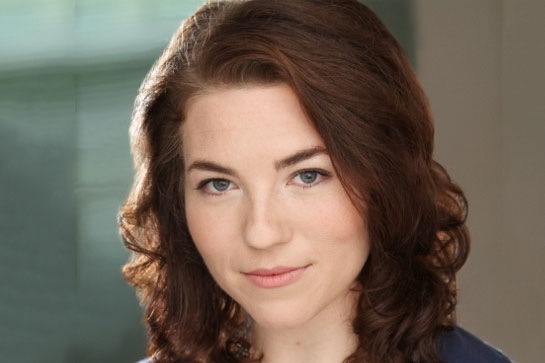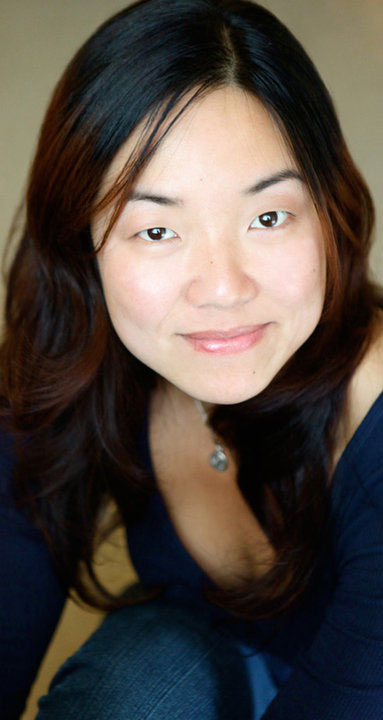
In Conversation with Desdemona Chiang

Desdemona Chiang is a stage director and University of Washington MFA graduate based in Seattle and San Francisco who puts the spotlight on the marginalized and forgotten. In her work with Azeotrope she’s directed edge-seeking plays like Adam Rapp’s bleak, graphic Red Light Winter. At the more traditional end of her oeuvre, this month she directs Measure for Measure at Seattle Shakespeare, their first restaging of the play in twelve years. It’s been acclaimed as “perhaps the best show Seattle Shakespeare has ever produced.” 

I talked to Chiang about the show, finding contemporary relevance in Shakespeare and the challenges of bi-urban living.

Measure for Measure is a play that many people aren’t very familiar with. Can you tell me about the choice and what it’s like as a direct a play that isn’t in the “canon?”

Measure for Measure has always stood out to me as one of the plays that aren’t about the kings and queens and royalty and nobility. It doesn’t take place in a lady’s boudoir; there are no ladies-in-waiting or garden shenanigans.  

It’s his most populist play. It’s about social justice in a way that I don’t see very often done in Shakespeare. It’s not about love or monarchy or parentage. It’s about the difficulty in balancing morality and economy. It’s about a city that’s destitute and morally corrupt. Sex work is rampant as the way of the town and Angelo, the new deputy, wants to clean it up, so he makes fornication punishable by death.  It’s an Old Testament biblical rule that hasn’t been enforced, just like we don’t really enforce sodomy laws in this country but they exist, technically.

So it’s the question: What right is it of governments to legislate people’s personal lives? And what do you do when a city is so poor and in so need of that economy to survive? How do you balance that?

Is that what you look for, some sort of current relevance?

I think we keep doing Shakespeare because it is constantly relevant, otherwise we wouldn’t be doing it. It sounds nice and the poetry is lovely, but certain plays continue to persist—why do we do Shakespeare and not Marlowe? Why aren’t we doing more Thomas Middleton? Something about Shakespeare still rings true.

How does a director “bake that into” a script?

I always have my own personal in. I think it varies from director to director, but for me it comes down to being able to answer: why do we do this play today and why do we do it here?

Lately all the conversations about who’s in power and the legislation on sex and women’s bodies—these aren’t all things Shakespeare wrote about, but they’re in the zeitgeist. I’m a woman who is very pro-feminist; it’s a streak in me that is conveniently amplified by the script.

This play presents a very patriarchal world. Women are either prostitutes or nuns. Women have very limited options, and when you live in a world that gives you limited options, what do you have to do to make ends meet?

Is there a thru-line between your Shakespearean choices and some of the more boundary-pushing work you’ve done with Azeotrope? How do you square those sides of your directorial career?

With Azeotrope, our mission has always been to tell stories that people don’t want to talk about—sides of humanity and community that typically go unrecognized and unacknowledged. We think that Shakespeare writes about fancy people and the wealthy and the middle class—and he does—but I’m always interested in the part that no one sees.

In this case it was the difficulties of sex workers. I totally understand the play is not about sex work—it’s actually more about the eternal struggle between the moral right and the human right—but my way in is always to look for: Who’s the person that’s not being talked about? What is the side of society we’re not getting to see?

You’re still toggling between here and the Bay Area. Does that give you any insight into each city’s theatre scene? Does it inform how you operate within those different scenes?

Going from city to city, you find that most theatre communities are constructed very similarly. If you were to take a cross section of Seattle and the Bay Area you’d find the same layers. You’d find your top layers of equity houses, your middle-sized houses, your fringe houses, your kooky avant garde house, your Shakespeare house. I think there’s just  indifferent proportions—we’re all looking at the same slice of pizza but it’s just different toppings, I guess. That’s a really bad analogy! [Laughs]

It’s cool to be able to work in both cities. They’re both progressive, more or less liberal communities that have very pro-art cultural omnivores who are interested in arts education and a future for our children. Those are values I see across the board in both communities.

We’re having discussions in Seattle about displacement and gentrification and artists being able to live in the cities where they work. Do you see that as part of the theatre dialogue, the role of the artist in the life of the city?

It’s a tricky conversation. I work in both cities because I can’t afford to not do that without compromising what I do for a living. There’s just not enough plays being produced in Seattle and too many directors who are directing, so I have to go where the water is. It’s challenging because the Bay Area has greater demand financially as a resident, so I can afford to live in Seattle more than San Francisco, but I’m loyal to both cities and I love them both. They’re both artistic homes for me. But I’d love to be able to stay in one city and work if I could without having to be a barista or wait tables on the side.
Five Friday Questions with Opal Peachey

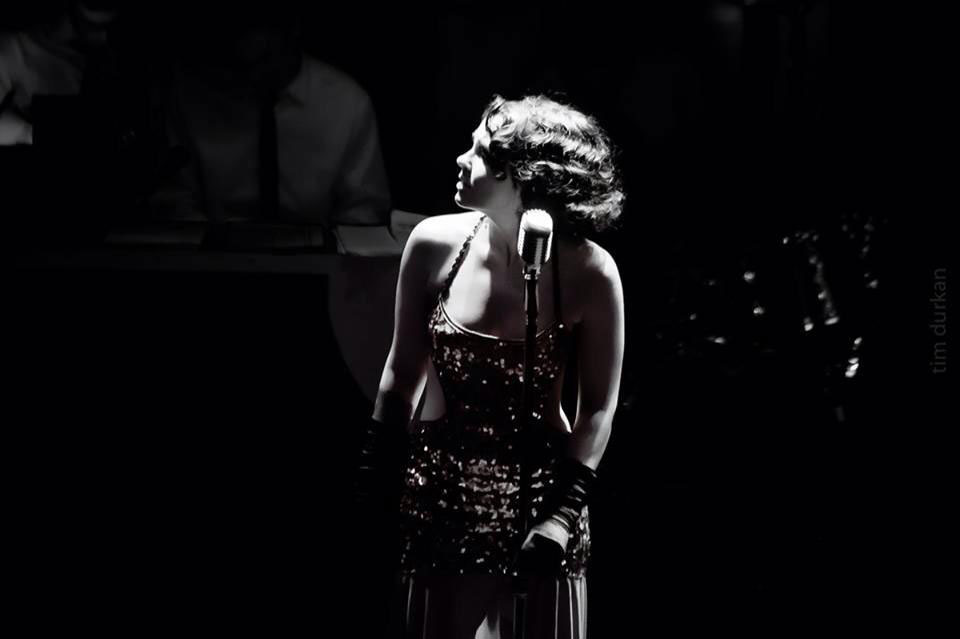
Opal Peachey is a native Washingtonian, Cornish graduate and company member of Café Nordo, that beguiling hybrid of conscious cuisine and theatre that’s set to open a permanent location in Pioneer Square in March. As a cabaret artist she’s co-created two musicals with Encore fave Mark SianoModern Luv and Seattle Vice. As an actor, she performed most recently as Rosa Saks in the last summer’s Gregory Award-winning The Amazing Adventures of Kavalier & Clay at Book-It. She’s a multi-talented entertainer and she’s got style. Peachey joins me for this week’s Five Friday Questions.

What’s the best performance you’ve seen lately? 

Do not get me started on Seattle actors—we have talent and technique in this town that would rival any of the big, bad cities of America. I’ll be honest, the performance that comes to mind was very raw, a shoestring show produced by two up-and-coming young women called Four Story House. Antoinette Bianco conceived the production and Erin Bednarz produced it. It was an immersive theatrical experience leading small groups through a house on MLK. Four short plays with various topics. The performance in question was by Carol Thompson. She played an addict. It moved me, and that is no short feat.

What’s the best meal in Seattle? 

I was born and raised in Washington State and I will pay a pretty penny for some amazing sushi. In my neighborhood, that means Momiji on 12th and Pine. Get their albacore belly and transcend to the next level of yummy. When someone else is paying, I go for the Omakase—the Chef’s choice of the day. Daring! They also have an actor friendly 10pm–1am happy hour during the weekday.

What music gets you pumped up? What do you listen to when you’re sad? 

Oh my gosh, it’s a little embarrassing but when I am on my head phones and I need a boost I totally blast T-Pain’s “Take Your Shirt Off.” If I’m down and out and want to revel in it, Lana Del Rey or Joanna Newsome. Damien Rice’s new album has been really doing it for me as well.

What is your most indispensable fashion accessory? 

Elbow length satin gloves. Black, white, red and rhinestone, they turn a cute outfit into a Fancy Lady.

What’s the most useful thing you’ve learned about working in theatre? 

How to self-promote and self-produce. That and loyalty will get you further than any god-given talent.

Five Friday Questions with Frank Boyd

In his solo show The Holler Sessions this month at On the Boards, Frank Boyd plays a radio DJ ranting and grooving live on the air to great jazz. Have you heard a more intriguing and appealing show concept lately? Boyd played Joe Kavalier in last summer’s Book-It world premiere of The Amazing Adventures of Kavalier and Klay. He’s a member of New York’s Elevator Repair Service, where he performed on their critically regaled GatzHe’s also a member of NYC’s the TEAM, with whom he partnered to produce The Holler Sessions. He keeps busy. (Check out Gemma Wilson’s excellent feature on him over at City Arts.) Boyd is voluble and passionate about music and performance. He joined me for the year’s first Five Friday Questions.

What’s the best performance you’ve seen lately?

Industrial Revelation. That’s one of the best shows I’ve ever seen. It was so good that after the show I didn’t even want to talk about it, especially not in terms of genre or style or any of that stuff we say after a show. For me it floated above all that and it still does. Even calling it a concert feels weird. I was watching D’Vonne, Aham, Evan and Josh just be up there as much as I was listening to the music.

It seemed to me like they were not trying to be cool or be successful or even be good up there. I think it ran much deeper than that. I don’t really enjoy watching performers hit their marks, so to speak. I’d much rather watch somebody who’s really involved with something, really in the middle of something. And a part of that means the performer is not always totally conscious of exactly where they are going. For me, that’s what it means for a performance to be alive. And those guys are of course highly skilled in technical terms too. In that combination is where the good stuff lives. 

And Lisa Kudrow on The Comeback. That is some thunder time right there. Kudrow is also credited as a creator, writer and producer of the show. She has so much game. Valerie Cherish should go down as one of the iconic characters of our time. I think she says a lot more about our world right now than Don Draper or Walter White.  

What’s the best restaurant in Seattle?

“Best” is tough. The only thing more subjective than theater might be food. I’ve been to Brimmer & Heeltap a few times recently and that place is tasty. Although I don’t care for the name. There are a lot of “&” names going around right now. 

Oh! That taco truck on 15th Ave NW and Market St in Ballard in the parking lot of the Shell station is very, very good! I think it’s better than El Camion and it’s definitely cheaper. And you can watch Telemundo in a heated shanty-like structure. 

What music gets you pumped up? What do you listen to when you’re sad?

Freddie Hubbard’s “Blue Frenzy” has been getting me real pumped up. So has Cannonball Adderley’s “This Here.” Those recordings are infectious, pulsating, bluesy and wide awake. I don’t know what I would do without them.

That Cannonball record, the live recording in San Francisco, is an all-timer for me. Cannonball was incredible. He’s got just as much game as any of the great sax players of that time in my opinion, but for whatever reason he never quite obtained the stature of Bird or Coltrane. Cannonball really had his shit together. He always played sober. Maybe this has something to do with it; he didn’t have the tragedy cred that those other guys had—and that people have since foolishly romanticized.  

When I’m sad it depends. Sometimes you wanna keep going down you know? Esther Phillips’s “No Headstone On My Grave” comes to mind. Watch out. Use with caution.

Also Magnolia Electric Co. That is some beautifully sad and lonely stuff. Jason Molina was a gifted songwriter. He passed away in 2013. “Hammer Down” is pretty much a perfect 3 minutes. And “The Dark Don’t Hide It” is also a favorite of mine. Anything from that album really (What Comes After the Blues).  

What’s your strategy for coping with the long Seattle winter?

Oh man I’m still experimenting with that. Winter sucks. The short days are the hardest part. Although drinking coffee in the dark feels pretty cool to me. I’d like to start doing a week in Cuba to break up the gray, but it doesn’t sound like Marco Rubio is gonna let that happen.  

What’s the most useful thing anyone’s ever taught you about working in theatre?

The central importance of listening. That’s the ballgame. If I don’t listen, truly take in, nothing else really matters. I wish theater was more like the NFL in that way. You know: if we don’t have a real awareness of what’s happening around us at any given moment we run the risk of being obliterated by a 300 pound human sledgehammer. That would encourage listening. And at the end of the day it’s easier that way. It’s a lot less work to let the people I’m up there with affect me than it is to drum all that up by myself. This sounds simple but it’s very difficult. I think it can take like 20 years to get really good at this.

Midweek Moment of LBJ: Holiday Edition

On Christmas Eve of 1967, the Accidental President was a victim of circumstance. Gone was the dominant political architect portrayed in All the Way. By the final act of The Great Society, the disastrous escalation in Vietnam has overtaken the Administration and threatens to consume LBJ’s ambitious legislative agenda, deftly indicated by Christopher Acebo’s steadily crumbling set.

By Christmas, LBJ had already made the painful decision not to run for reelection. He planned to announce his retirement in the upcoming State of the Union address, secretly assigning that portion of the speech to a former speechwriter but concealing it from the rest of his staff. He ultimately decided to leave the announcement out to keep the stench of lame duck off of pending legislation.

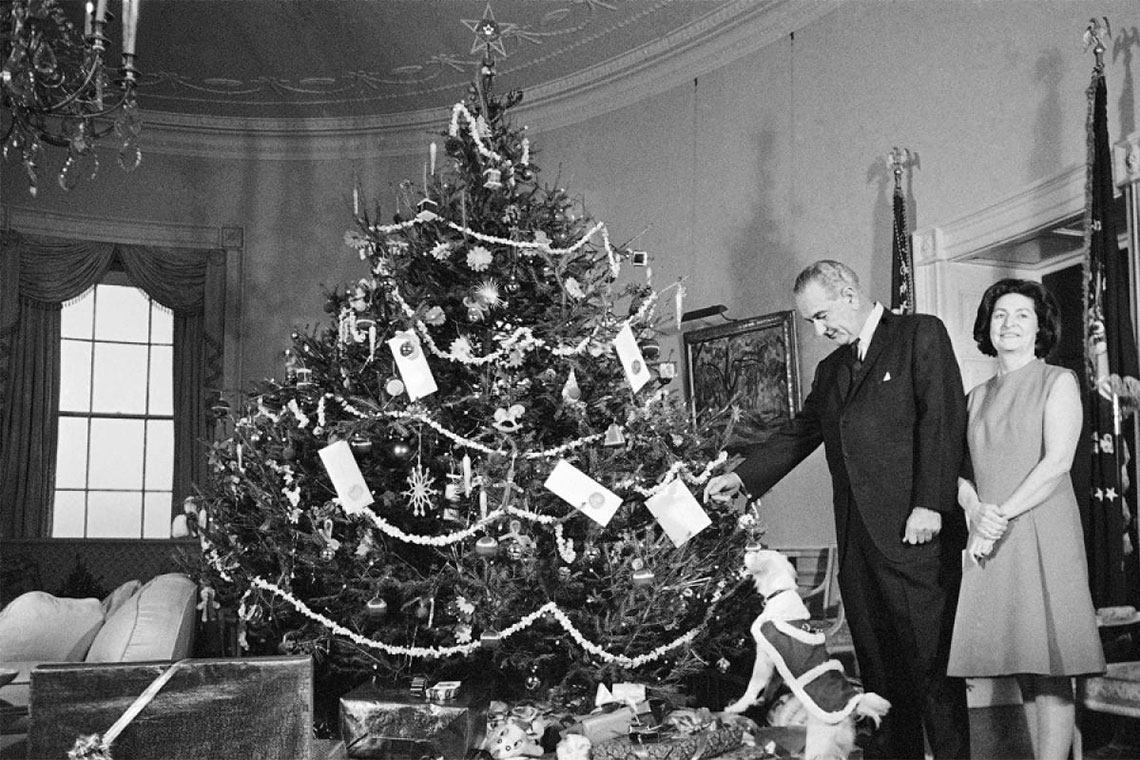
With that tragic backdrop, here’s the Johnson family Christmas card for 1967:

Heedless of the holidays and the futility of his prospects, LBJ still worked furiously to find a way to bring the war to a close, embarking on a globe-circling mission that started with a state visit to attend the funeral of Australian Prime Minister Harold Holt, who had disappeared while swimming off the coast of Victoria (and whose body was never found).    

From there, LBJ secretly flew to the U.S. base in Korat, Thailand where he surprised airmen just returning from nighttime combat missions, then on to Cam Ranh Bay in South Vietnam where he handed out medals and visited with the wounded.

As more unannounced stops were added to the cryptic itinerary, an increasingly exhausted press corps began grumbling about the marathon holiday jaunt. Here’s an account from Sid Davis, one of 52 reporters on the press charter plane, revealing a cranky and driven LBJ who’d be right at home in a scene from the Schenkkan plays:

“Reporters’ complaints made their way to the president through notes assembled by White House press officer Tom Johnson. He quoted The Washington Post’s correspondent Carroll Kilpatrick as saying the president was being ‘too secretive, placing unmerciful pressure on the staff and the press.’

‘We’re sleeping on the deck,’ complained one reporter.

‘The president is fatigued,’ said another.

And this one: ‘LBJ is trying to kill us all.’

In a column in Life magazine, Time magazine columnist Hugh Sidey dubbed the president ‘Lyndon B. Magellan.’

LBJ was not amused. He told the press pool aboard Air Force One that while he was desperately seeking peace, their buddies on the press plane ‘are bitching about their comfort.’ One sympathetic reporter assured the president the press was supportive. When the reporter left the compartment, LBJ whispered to ABC’s Frank Reynolds using an indelicate term to call the reporter a brown-noser.”

The contingent finally made it to Rome for a secretly-brokered meeting with Pope Paul VI, where the Air Force One helicopter became the first to land in the Vatican Gardens, bypassing rush hour trafffic with Presidential swagger. LBJ hoped the Pontiff could help broker a deal to end the war, if not at least advocate for better treatment of American POWs in North Vietnam. He was met with understandably benign skepticism and blessings but no breakthroughs.

What makes this trip a classic Midweek Moment of LBJ: Holiday Edition is the gift exchange that happened on December 23, 1967 between the two world leaders. Pope Paul VI gifted Johnson with a beautiful 15th century oil painting of the Nativity, and LBJ gave the Pope a bronze bust…of himself. That’s right: LBJ liked to gift heads of state with busts of himself. It’s such an illuminating Johnsonian nugget it’s hard to believe it didn’t make it into at least an early draft of the Schenkkan plays. 

Here’s State Department Chief of Protocol James Symington on LBJ’s ultimate white elephant gift:

“You can’t fault a man for wanting to give mementos and gestures of his friendship. But what [LBJ] wanted to take with him was, I don’t remember the exact figure, something like two hundred busts of himself. Some of them were white marblish in appearance and others were bronze-looking. It is, I think, unusual for a man to give a bust of himself in his lifetime, although it’s difficult to give it any other time. But to make a mass-production gesture really boggles the mind…

Today, there are heads of state all over Asia who are trying to decide what to do with the President’s bust. But not just heads of state, because that would have been only a dozen or less [of the busts]. As I say, we had hundreds of them, so many, many people—cabinet ministers and all kinds of functionaries—received one. The President would say, ‘I want a white one.’ ‘I want a bronze one.’ And you never had the one he wanted and you had to go back to get it. [LBJ would exclaim] ‘Damn it! Can’t anyone do anything right?’”

And here’s a photo of the moment in the Vatican on Christmas Eve’s Eve (note Il Papa’s bemusement):

I think we can all relate. Merry Christmas, everyone!

Symphonic Side Gigs: Stephen Bryant and String Quartet River Rafting

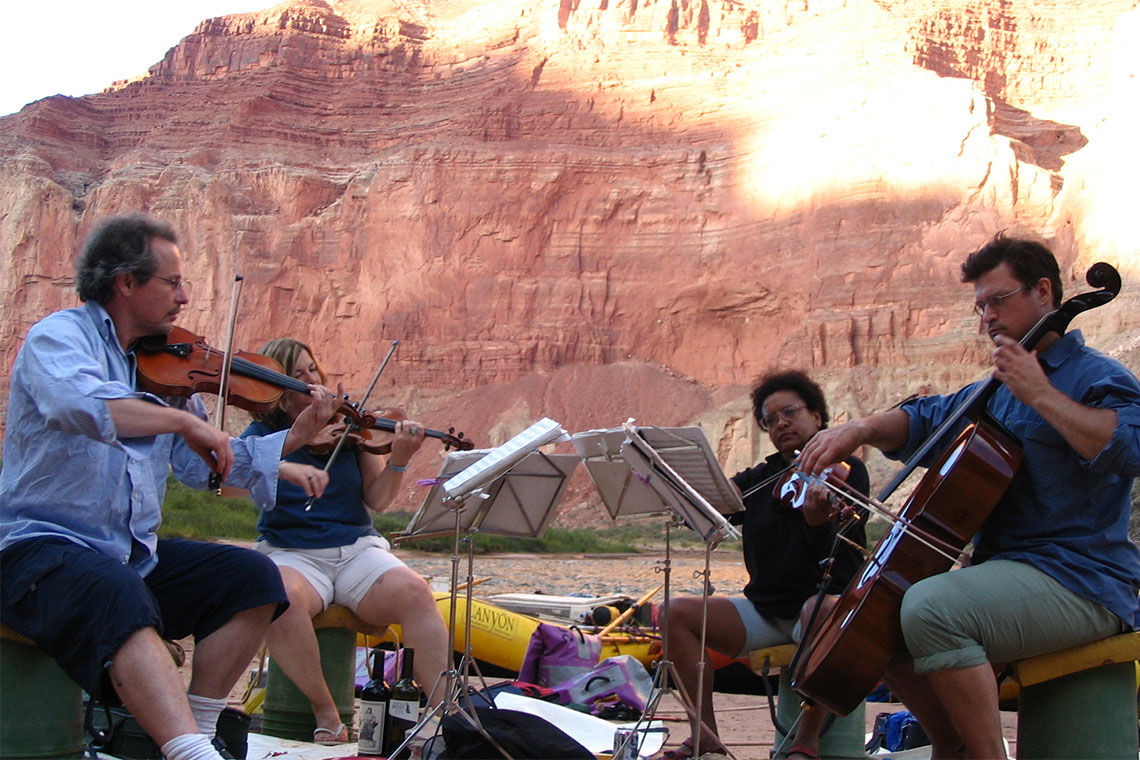
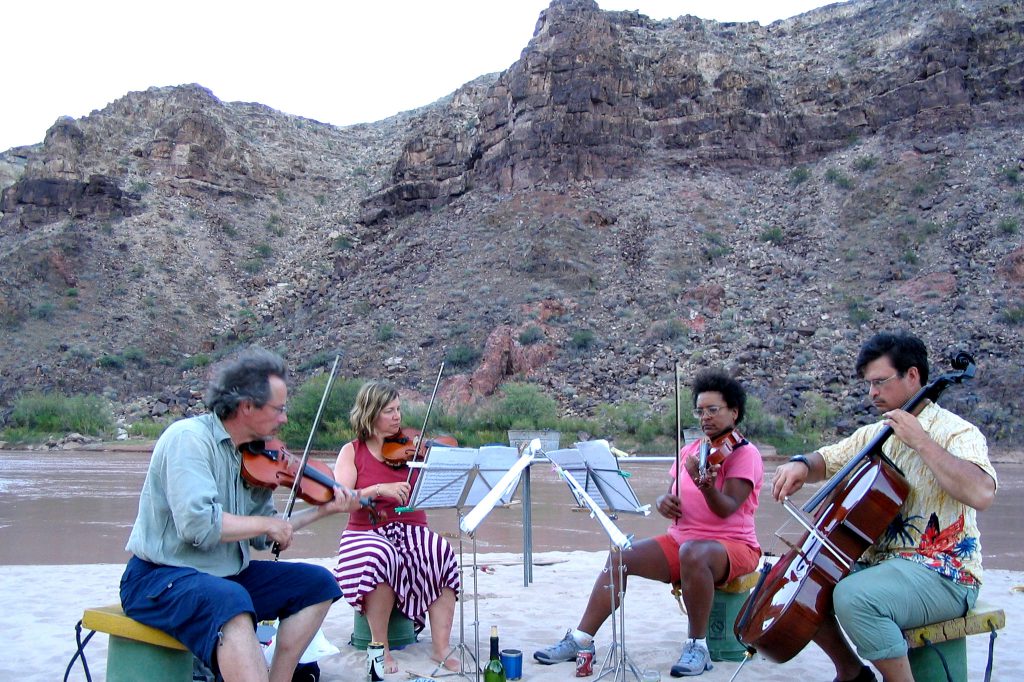
Stephen Bryant has played violin with the Seattle Symphony for thirteen seasons, but he’s got another gig he’s been doing even longer. Every summer for the past 26 years he leads a string quartet into the wilds of the Grand Canyon where they play concerts on a river rafting tour, hiking into a different side canyon each day to perform in sublime natural amphitheatres. The work of the great composers mingles with the sounds of wind, water and wildlife.

I spoke with Bryant about his interesting side gig.

I’d imagine your colleagues are used to playing in the completely controlled, acoustically perfect environment of a place like Benaroya Hall. Here you’re going into the wild and presenting the same music. Does that give you any insight into the music, playing it in different settings?

Absolutely. I gotta say, Mother Nature is intelligent. For example, there’s a side canyon called Black Tail that I like to play Shostakovich in because there’s a darkness to it. It was an Anasazi site. It happens to sit right on the Great Unconformity—geologically there’s 800,000 years of rock missing—and all of this comes together to form the most perfect concert hall.

I’ve had experiences with, shall we say, ghosts in that particular canyon. I’ve seen things that defy conventional explanation. This particular side canyon, whenever we play Shostakovich it gets incredibly quiet; the birds stop chirping, the frogs stop. It becomes really quiet, and always after [we play] there’s this incredible assortment of natural sounds. I bring a recorder along and record an hour or two just to listen to the music of nature.

Conversely, if we’re playing Mozart, for example, I find there are certain birds, like the canyon wren, who love to participate. The ravens really like Beethoven. One of the side canyons has a creek right below the “stage” making a burbling sound, and what I’ve discovered with playing in that environment is that your diminuendos disappear completely into this natural sound, and when you play very softly it’s like the music comes right out of the sound of the water.

Most of the concerts happen early in the morning because these are summer trips and they get very hot. By nine or ten in the morning we’ll be playing a concert, and after lunch we’ll go rafting and do the rapids.

Then you get into another spectacular campsite. There are beaches all along the Grand Canyon where the side canyons empty in, and we set up camp in those places. After we get our camp set up the quartet will play a different kind of music than we would in the morning. In the evenings we’ll play popular music, cocktail music. The guides prepare hors d’ouevres and it’s a magical time on the river.

For me to play this great music in that environment—there’s nothing better. I get goosebumps just telling you about it.

River rafting string quartet

It’s the most amazing place. What it gives is so much; a chance for reflection, for solitude, a chance to appreciate beauty and let the mind subside. You listen—really listen—and that means you’ve gotta stop thinking.

The intellect wants to cut in: “Oh, I hear the ‘A’ theme there, and this is a reference to that, and that’s a little out of tune.” Are you listening or are you busy thinking and critiquing?

I teach people how to listen by simply putting their attention on their breathing. Once you put your attention on the breath, the mind has to follow and all of a sudden you notice a lot more because your senses fully open up. That’s the time to look at the [canyon] walls and listen to the sound of the wind or perhaps the sound of Beethoven or Stravinsky.

I’ve seen the amazing power this music has in so many places. The Seattle Symphony has sent me to a dementia and Alzheimer’s facility—these people are in rough shape, but by the end of a Beethoven string quartet they’re so focused and cheerful. They’ve forgotten their troubles.

Last month we played at Monroe [Correctional Complex] and the prisoners loved it. One asked me if I’m ever afraid coming there and I said, “The first time I was, then I met you guys and realized that here is an audience that really knows how to listen.” They love doing the breathing. You can get a little bit of freedom from the constant flow of thoughts.

Is there any place you haven’t played yet that you’d like to play? Any setting or environment?

There are a lot of those. Every time I’m looking at National Geographic and I see their gorgeous pictures from wherever—could be an ice cave, an underground cavern. I’d love to play in Carlsbad Caverns.

Five Friday Questions with Allison Strickland

Allison Strickland’s been prolific lately, from last spring’s lead role in Taproot Theater’s In the Book Of to Clea in last summer’s Black Comedy at Strawberry Theatre workshop. Last month she finished a run of August Wilson’s The Piano Lesson at Syracuse Stage and she’ll revisit it next month at the Rep. Recent Questions subject Caitlin Sullivan described Strickland as “a total badass.” I’ll add that she has utterly fierce and funky taste in music. She joined me for this week’s installment.

 What’s the best performance you’ve seen lately?

I haven’t seen it live, but Lauryn Hill put out a song called “Black Rage” in response to the events in Ferguson. Putting out something as brutal and beautiful and relevant as that song is, I think, working on the highest level as an artist. My generation is seriously lacking in mainstream political music. Party escapist music certainly has its place, but where are our Nina Simones, Public Enemys, John Lennons, Marvin Gayes? This is the closest we’ve gotten in too long.  

I just saw Cabaret on Broadway—cliche, I know—but the performance that actually struck me was Alan Cummings’s understudy. I was kind of bummed that Alan wasn’t going on, but then as I sat watching I just kept thinking what an amazing opportunity this guy has, how terrified or excited he must be to go on and what a thankless, unwinnable job it is to replace the guy you know everyone bought the tickets for.

After the show this teeny old woman goes up to the usher and says, “Fantastic show, but where was Alan?” Firstly, I thought that was hilarious, and secondly, this guy just sang and danced his heart out, but that was that. I’ve been thinking a lot lately about what success means for me, and to see a guy who isn’t a name get up there, just do the work and kick ass because that’s his job—I thought, Alright, that’s a real actor right there.

What music gets you pumped up? What do you listen to when you’re sad?

You know, I’m one of those people who listens to “pump you up” music when I’m sad. If I sat around sad, listening to sad people singing about being sad I’d jump off a cliff. So I either go super funky with it—I love old soul, Otis Redding, Betty Davis, The Temptations, The Impressions (yes, I’m secretly a little granny)—or lately I’ve been listening to more and more hip hop, pre-Kardashian Kanye, Jay-Z, music that really hypes you up and makes you feel unstoppable.  

And of course, what seems to be the running theme with Five Friday Questions: Beyoncé. She makes you feel sexy and empowered. It’s that divine feminine energy that society seems to desire and fear in equal parts. She gives you the permission to sing along with the lyrics “there’s nothing not to love about me” and totally mean it. 

If I’m feeling like keeping it mellow I’ll put on jazz or old timey reefer music. And if I must, and it’s the odd night I want to hide under the covers and get down on some chocolate peanut butter ice cream until I cry myself to sleep, I’ll throw in some Adele and call it good. 

What’s your best method for coping with the long Seattle winter?

I’m the worst person to ask. I don’t mind the grey, but I absolutely hate being cold. I even have a song I sing that used to drive my friend crazy, it’s to the tune of Al Green’s “Tired of Being Alone,” called, “I’m So Tired of Being Cold.”

My way of coping this year is to just really appreciate it. I’ll be moving to NYC next year (where it’s nice and warm in the winter) so I’m just trying to soak in all the time I can with my mom and my amazing friends and eat at all of my favorite spots. That’s generally the best way to cope with anything, surround yourself with people you love and who make you laugh. And a hot toddy never hurts.

Do you have any opening night rituals?

I don’t know that I have any opening night rituals per se.

A weird sense of calm usually comes over me until about 30 minutes before places. Luckily, that’s not really enough time to have a full-on freak-out, so I just say a little prayer, try to keep my body as relaxed as possible and give thanks to the people who came before me. 

I’m gonna get really hippy woo-woo on you—and it’s not necessarily on opening nights—but about this time last year I realized that at some point in every run since my very first play I have a moment standing backstage, listening to my fellow actors or the murmur of the audience, and it hits me just how many people worked hard to open doors for me to do what I do. As a person of color and as a woman, it’s not lost on me that my voice and body is still somewhat of a rarity on stage. I love telling stories and playing make-believe, and my biggest hope is that I’ll do enough in my career to continue opening doors so that in 50 years, when a woman is standing backstage listening for her cue, she’ll think of me.

What’s the most indispensable thing you own?

I go through these cycles of hoard and purge, hoard and purge. It’s hard for me to let go, but when I do I really REALLY let go, to the point that my Mom has to convince me to keep certain things or at least to give them to her so she can keep them for when I inevitably want them back. She’s saved me from a lot of forgotten memories, but there’s still some excellent clothes that I still mourn, like the most perfect peacoat that I bought in London and donated instead of just getting relined like a normal person. Right now I’m in purge mode, but I do love my lap top.

Midweek Moment of LBJ: Dog Ears

One of the most striking features of the LBJ plays currently running at the Rep is the sheer depth of authentic detail infused in the scripts. Nearly every word uttered onstage corresponds directly to an event well-documented in the annals of the Presidency. Even a seemingly cast-off line can lead one down an archival rabbit hole–hence this ongoing weekly segment.

As the shows’ dramaturg Tom Bryant said in our interview, much of Schenkkan’s early writing process focused on scouring the ample historical record for these illuminating moments: “It’s kind of like panning for gold. You’re looking through history and coming up with these nuggets and going, ‘Oh boy, that’s a wonderful anecdote, that’s an important event, this is an amazing possibility for a scene between two people that would really be dramatically exciting.’”

The subject of this week’s Midweek Moment occurs late in Act One of All the Way, in a meeting between Johnson and Senator Everett Dirksen, the bloviating Republican Minority Leader who’s threatening to block passage of the Civil Rights bill with 40 proposed amendments. LBJ opens the contentious exchange with this random quibble:

LBJ: Everett, what’s this bullshit about how I treat my dog?

Dirksen: I’m sorry?

LBJ: My dog! Little Beagle Johnson. Why are you being such a shit-heel with the press about me pulling his ears? The little sumbitch loves to have his ears pulled! Hell, I thought you were running the Senate Republicans, not the ASPCA!

Dirksen: Mr. President, I was just kidding with the press about that.

This exchange deftly illustrates several things about LBJ: his domineering and often crude conversational style, his willingness to hold a grudge no matter how trivial and his shrewd technique of backfooting adversaries by confronting them forcefully and directly about perceived personal slights. 

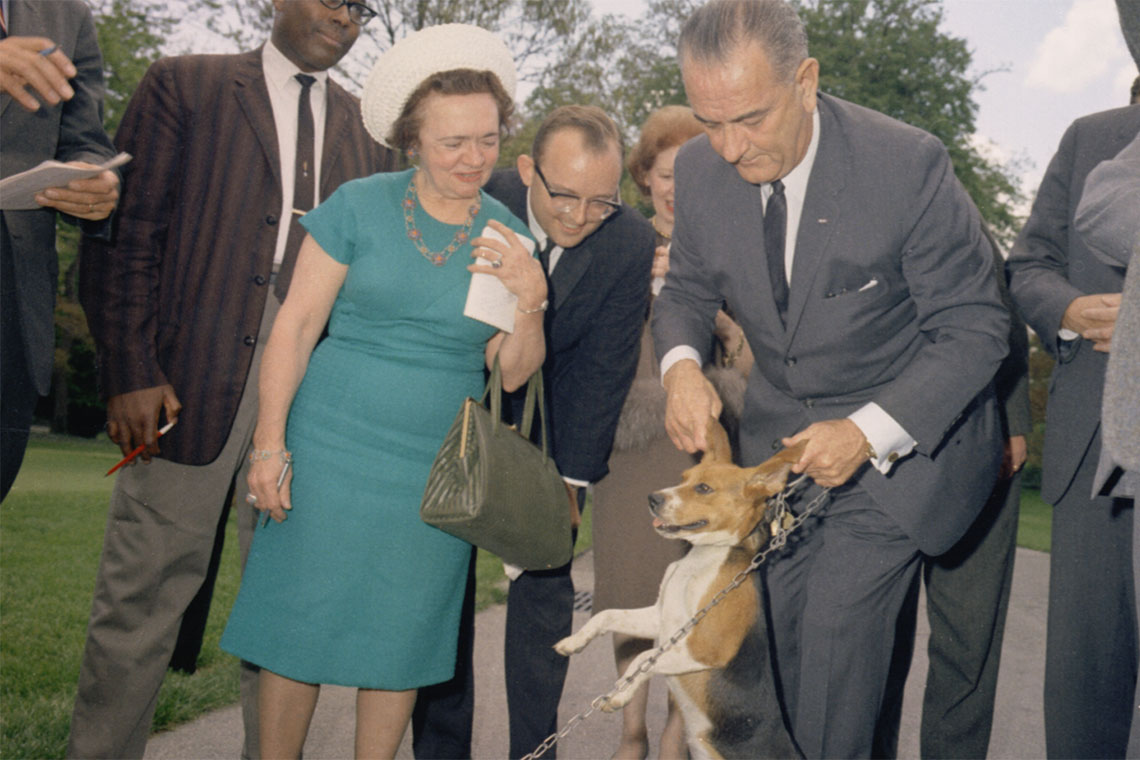
Naturally, the moment is drawn from real life: LBJ lifted his pet beagle, Him, by his ears on the White House lawn to pose for an AP photographer and it sparked nationwide outrage among animal lovers. 

Here’s LBJ in a phone call from April 29, 1964 with Senator Mike Mansfield discussing the Civil Rights bill and griping about Senator Everett’s harping on The Dog Ear Incident.

http://player.history.com/pservice/embed-player/?siteId=hist&tPid=21167675

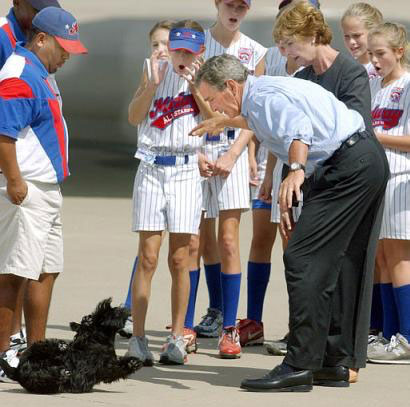
This might have been the first “scandal” involving presidential pets, but it wasn’t the last. Witness George W. Bush dropping his beloved Scottish Terrier, Barney, in front of a group of mortified schoolgirls:

George W. Bush and Barney

Five Friday Questions with Emily Chisholm

Emily Chisholm is a Seattle actor, Cornish grad and company member of New Century Theatre Company (who recently moved into their shiny new space at 12th Ave Arts.) Chisholm received a Gregory Award nomination for Outstanding Actress for last spring’s production of Bethany at ACT, and this March she’ll play Rose in NCTC’s West Coast premiere of The Flick. She’s also learning to play the ukulele. Chisholm joins me for this week’s installment of Five Friday Questions.

What’s the best performance you’ve seen lately?

It’s from last year, but it is still buzzing in my head: Cherry Jones in The Glass Menagerie. She reinvented Amanda Wingfield. That production is probably the best thing I’ve ever seen. Memory is the driving dynamic of the play, and the production captured that so thoroughly and creatively. I’ve never seen a play so successful in artistry, creativity, risk and storytelling.

And I’m a little obsessed with Robin Wright in House of Cards. It is such a subtle, complex, vicious, and elegant performance.

What’s your favorite place to go after a show?

If I performed in the show, my favorite place to go is home! I like to walk home and go to sleep! Isn’t that boring? But walking is the best. It releases left over performance energy and it gives me time process the show: what worked, what didn’t, what to try next time. And then I sleep. What could be better? Otherwise, if I have friends in the audience or if I attended the show, I go to Cafe Presse for basically everything. It’s like The Max in Saved By The Bell, perfect for every occasion.

What music gets you pumped up? What do you listen to when you’re sad?

Right now I love HaimRhyeWashed OutGrimes, and Black Mountain. If I’m “pumped” I’m probably dancing. Robyn will get me dancing, Beyonce too. Prince and Michael Jackson will always work. Three of my favorite songs for dancing: “Crown On The Ground” by Sleigh Bells “Losing You” by Solange, and “Poison” by Bel Biv DeVoe.

For quieter times, “Bright, Bright, Bright” by Dark Dark Dark is gorgeous. “Proserpina” by Martha Wainwright is devastating. I love Echo & The Bunnymen for rainy days, especially “The Killing Moon.” But the saddest thing I have ever listened to is Henryk Gorecki’s Symphony No. 3, The Symphony of Sorrowful Songs. It can wreck a person.

Do you “treat yourself” to anything special after a show closes? 

Occasionally. I think I could get myself into trouble if I really made it a tradition. It depends on the show and whether I think I’ve earned it. But if something strikes me, I might buy myself a little gift. My only rule is that it can’t be theme-related. 

What’s the most useful thing anyone’s ever taught you about working in theatre?

An actor has to be an advocate for their character. Everyone I have ever worked with has taught me this directly and indirectly.

And my favorite: the speed of fun is faster than worry and slower than panic. I learned that in a clown workshop.

Five Friday Questions with Spike Friedman

Spike Friedman is as versatile a theatre artist as you’re likely to find. He’s a playwright and founding member of the Satori Group. He covers sports and culture for Grantland and writes the hilarious Seahawks game recaps for the Stranger. He’s also an Upright Citizens Brigade-trained sketch and improv player. (Full disclosure: Friedman also starred in this video I made with Encore contributor Travis Vogt that was a finalist in this year’s SketchFest Seattle Comedy Film Challenge.)  

Friedman’s got a worldly sense of humor and an active curiosity that makes no distinction between high and low culture. He’s always working on something weird and wondrous. I caught up with him for this week’s installment of Five Friday Questions.

What’s the best performance you’ve seen lately?

A tie between New York Giants wide receiver Odell Beckham Jr.’s circus catch against the Dallas Cowboys from two Sundays ago and the cinematography of Emmanuel Lubezki in Birdman. I think my own lack of physical abilities draw me to admire the truly virtuosic and acrobatic, and both Beckham and Lubezki blew me away with their virtuosity and acrobatics. It’s also worth noting that Lubezki, who is by far the best cinematographer working right now, also has an Instagram account that’s playing on another level. 

What’s the funniest thing you’ve seen/heard in the last month?

Moving from the peak of cinema to the dregs, The Worst Idea of All Time podcast is two comedians from New Zealand who watch Grown Ups 2 every week and then immediately record a podcast about the experience. I just discovered it a couple weeks ago and have already burned through the first 20 or so episodes. It’s so funny. 

They’re on week 40 and are targeting a full 52 episode run, which means they’ll have watched Grown Ups 2 52 times, which is goddamn insane. Their camaraderie, which seems to run in direct contrast to Grown Ups 2’s apparent misanthropy, makes the whole project deeply satisfying and makes me want to watch Grown Ups 2 (despite their weekly sign-off, “DON’T WATCH THE FILM”).

Unfortunately that garbage movie is not available on any streaming service, nor is it rentable on iTunes. I’d have to pay 10 bucks to watch Grown Ups 2 just so I can more deeply in on a joke. Nice try, Sandler, but that’s not gonna happen (yet anyway… I’ve decided that when I’ve caught up with the guys on the podcast, I’m watching the film).

What music gets you pumped up? What do you listen to when you’re sad?

I’m in a sketch show called Buddies with Ubiquitous They running at the Pocket Theater this month and one of my co-stars, Jason Miller, is supposed to make me a “night running” mix to get me pumped up before the shows. He hasn’t done this yet, so I’m shaming him online (while also shamelessly plugging our show). Sans this as of yet non-existent mix, I’ll go with the song “Just” by Radiohead to get me pumped and every other song by Radiohead for when I’m sad.

What’s the ideal setting for writing a play?

Depends on the point in the process. Early on I like to be as far from everyone as possible so I can spew out whatever I’ve got in my brain onto the page. Then when I have to do the grittier work of defining a story arc or composing a treatment, I like to work closely with a couple collaborators by day, and then recede to my own space at night for scripting. My best time for pumping out text usually comes after 10 pm, because I’m a crazy person for whom the rules don’t apply (or because I’m lazy and deadlines don’t count until whomever you owe a draft to is awake in the morning).

What’s the most indispensable thing you own?

I hate that the answer is my MacBook Air, but man, I would not be able to survive without it. It’s light and powerful and small, and I do all my work on it. I’m writing these words on it right now! Say hi, MacBook Air.

[…]

Nothing. It’s shy. Shy but great. You’ll have to trust me on this. 

I’ve got a pretty great dog too whom I would not be comfortable dispensing of. Let’s put my dog Edgar Martinez Friedman in a tie with my MacBook Air for the top spot.

Midweek Moment of LBJ: The President Orders Pants

In observance of the triumphant, record-breaking run of the LBJ plays currently underway at the Rep through January 4, we present a new weekly segment taking a closer look at the powerful, indomitable and sometimes downright unusual man who was our Accidental President.

For this week’s installment, here’s a charming animation of an actual recorded White House call from LBJ to the Haggar clothing company in which the Chief Executive describes his particular specifications for a pair of pants.

You might recognize some of the, ahem, specialized anatomical terminology from the masterfully introductory first act of All the Way in which a tailor struggles to fit LBJ as he barks into the phone at a series of notable figures from J. Edgar Hoover to Robert McNamara (and Martin Luther King, Jr. holds on line three.)

Here’s the video by animator Tawn Dorenfeld: