Drag Queens Cassie O’Hara and Anita Goodmann on ‘Kinky Boots’

This month the 5thh Avenue Theatre mounts the touring Broadway production of Kinky Boots, the Tony-winning musical with songs by Cyndi Lauper and book by Harvey Fierstein. In the show, the owner of a beleaguered shoe factory enlists the help of a drag queen to save his business by producing a line of fabulous (and sturdy) footwear for larger-footed divas.

Recent local contestants of RuPaul’s Drag Race have put Seattle on the map; Jinkx Monsoon won season five and BenDeLaCreme won Miss Congeniality last season. I’d imagine we’ve got as discerning an audience as you’ll find for cross-dressing spectacles, so in the interest of providing Encore readers with the most cultivated possible perspective on the show, we sent a pair of drag queens en femme to opening night.

Cassie O’Hara and Anita Goodmann have been blending drag, burlesque, fashion, and comedy in Seattle for years, and they collaborate on the quarterly sketch/improv show The Anita Goodmann Experience. They’re delightful. I talked to them the day after the show.
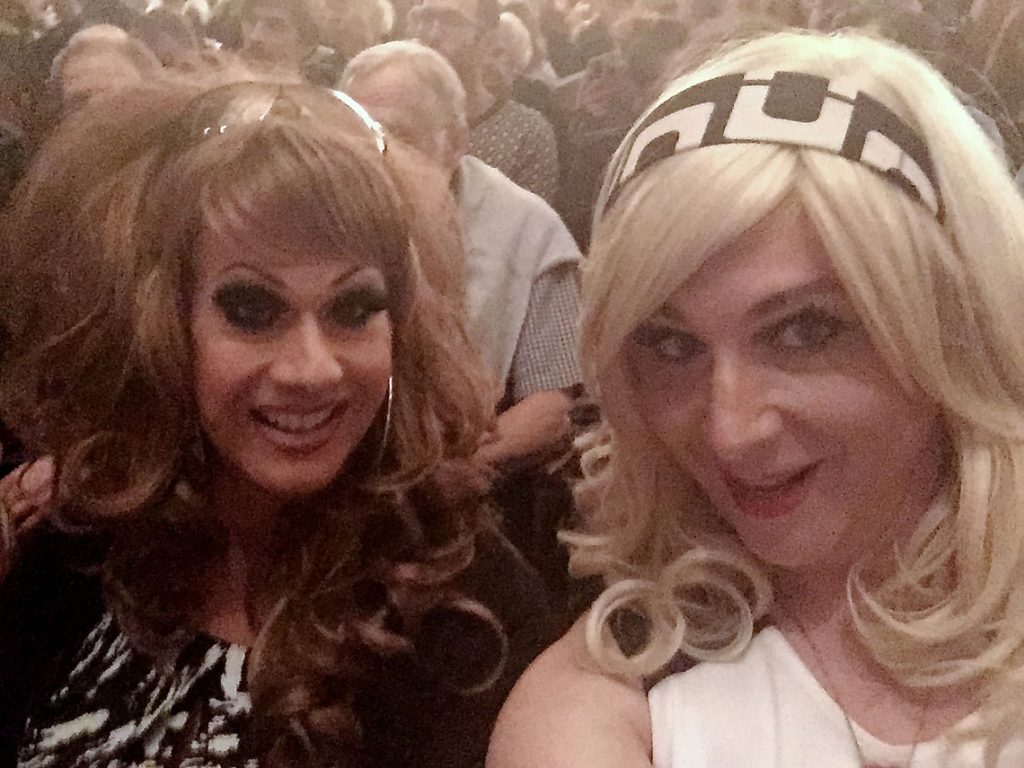
O’Hara and Goodman

I hope your hair didn’t block anyone’s view.

O’Hara: I was a little worried about that with the hair I was wearing, so I puffed it down a little bit.

Were people tripped out to see a pair of draq queens in the audience?

Goodmann: Several people came up and recognized me. We were waiting in line for drinks and these two girls, Ashley and Ashley, were like, “Ooh, Anita Goodmann, we know you! We love Ben de la Crème and Jinkx Monsoon.” [Cattily] Ok, great.

O’Hara: I saw my old boss. She didn’t know who I was and I didn’t tell her. I was standing about two feet from her. Her husband bumped into me and they had no clue. I was debating whether or not to tell her who I was and get a reaction, but it could spread like wildfire around the office.

Goodmann: These things we’re talking about really tied into the themes of the show. Something meta was going on.

As far as the play, do you feel like drag was presented in a positive, real light?

O’Hara: I think so. The whole theme of it was self acceptance and accepting people for who they are. There was this factory worker, Don, a big typical macho alpha-male type. When Lola came in there was some resistance from Don because it was threatening his masculinity, seeing this drag queen in the factory. They had to do a little work to learn how to accept each other. Both people were not who they necessarily seemed to be from the outside. Everyone wears a mask.

Goodmann: There’s also a really strong theme of parenting in the movie, with Charlie and Lola. Neither of the characters was the child they thought their dad wanted them to be.

O’Hara: There’s a powerful scene with Lola performing at an old folks home. There’s a guy in the corner slumped over, and as she does her thing he can’t really lift his head up. She goes over and puts her arm around him, and you see that it’s her father. As she walks away he kind of lifts his head a little. You have this sense they she had closure.

There’s also a number, “Not My Father’s Son,” a duet with Lola and Charlie that played into the the struggles they had living up to what their fathers expected of them. The singing was amazing.

Goodmann: The play’s obviously oriented toward a broader audience, so they work their way through a lot. 

O’Hara: I thought they did a really good job of walking the line. They had it geared so the general population will like it and not be offended. People who are familiar with drag shows will appreciate the production values. All the backup dancers were incredible! This one was doing backwards somersaults in six-inch heels. The finale, I bet they spent half their budget just on this one number. It was insane. The lighting and the tech were just amazing. It’s as good as anything I’ve ever seen.

Goodmann: The art direction, the stage direction, the breakneck pace of that show—it never lets up.
O’Hara and Goodman

The central conceit of the show is something I’m sure both of you have dealt with: finding sexy drag queen shoes in men’s sizes.

O’Hara: Well, I’m lucky because I wear a size 8 and I only weigh 125 pounds, so I’ve never had the problem that Anita has—she wears a size 13—

Goodmann: Size 12.

O’Hara: In our show I say Anita wears size “gunboat-and-a-half.”

Goodmann: It’s true. I’m lucky that I’m just on the inside edge of shoe sizes that are still made for women. I wear a women’s size 12, so I can order shoes online. But I weigh 190 pounds and I’ve broken heels off, clear off the block.

When you’re tall and heavy, the physics of wearing high heeled showsmen don’t really understand. I’ve had people who wanted to be in our show say, “Oh yeah, I’ll do a drag part in the show,” and I’m like, “Have you worn heels ever?”

They’re like, “How hard could it be?” And they put ‘em on: “I can’t walk in these things and they hurt like hell!” And I say, “Well, there’s 101 for you: we try to make it look easy.”

O’Hara: The first time it’s a little tough, but after 20 years it’s like anything; if you do it all the time you get good at it. After a certain point it becomes second nature. The shoes I wore last night were a 4-inch heel, simple pump. I can wear those all night and my feet don’t hurt.

Goodmann: I’m wearing flip flops today around the house, having worn boots. I needed a pedicure so my nails were a little long. They were crammed into the toe of the boot, so now I’m like, “Uhhh.”

Is that a “drag queen hangover?”
Goodmann: Sometimes you really do have a hangover in the morning, because you block out all the pain while you’re in the moment but in the morning your body’s like, “You rocked me, dude.”

We took Uber from my house. On the way home I was talking to the driver and he referred to me as “sir.”

O’Hara: He seemed like, “What did I just pick up?”

So you did get to experience a frisson of awkwardness.
O’Hara: If that’s the only intolerance I have to put up with, a guy doing his job and not wanting to engage, that’s fine.

Goodmann: I’ve been in a cab where the guy didn’t let me out, he drove around the block and said, “I’m gonna stop running the meter but I wanna talk to you just a little more, lady.” And, “You should really give me your phone number, lady.”

Are they making a pass on someone they think is a woman?

O’Hara: No, they just wanna be freaky.

Goodmann: They’re not fooled. They know what’s going on, but they also haven’t thought it all the way through, like the guy who wanted my phone number. I had this vision of him showing up at my door unannounced with a handful of flowers looking for Anita. “Uh yeah, Anita’s not home right now.”

Director Stephanie Shine on ‘I Am of Ireland’

Book-It circles back to one of their first critical and audience successes from two decades ago with I Am of Ireland, running through October 12. It’s a selection of Irish short stories and songs adapted in their unique page-to-stage manner.

Director Stephanie Shine, who helmed the original production, returns to Seattle from her new home in Tennessee to revisit the work of an earlier self. I asked her a few questions about the show.

What’s it like to revisit a play from twenty years ago?

It’s a very emotionally-wrought experience for a variety of reasons. I keep getting these “hits” from the past—somebody’ll say something and I’ll remember how another actor said it twenty years ago. It triggers me into this whole atmospheric experience. It was a very exciting time in my life artistically, and it’s responsible for many of the paths that I took subsequently.

One thing we all found was that the stories are even more meaningful to us as we’ve matured, both artistically and as human beings. We’re able to see even greater depth within the stories. They’re speaking to us like all great literature does, from where we meet it at this age in our lives.

It’s had so long to steep in your subconscious.

Right. Our own life experiences now color the material. We’ve lost parents and marriages, we’ve had children–so many things have changed.

I left Seattle three years ago to join my husband and help his fledgling Shakespeare company grow, and I haven’t really been back since, except for quick stops to see my family. I hadn’t even been to Seattle Center for three years after spending a decade there daily. It’s so different! Whoa! What happened to Mercer! Where’d the lake go?

It’s very interesting to see yourself as a young artist. I was just beginning my directorial career and many of the choices within the material and things that are inherent within the adaptation spoke to what was important to me twenty years ago. It’s a chance to look at yourself, in a way.

A snapshot.

Frozen in time, but living.

Book-It is now known for taking on sprawling novels, but this play is composed of shorter pieces. What’s the adaptation process look like?

Well, short stories were the format we started Book-It on, and then novellas, then novels.

You gotta work your way up.

Exactly, because we were learning the form. In the very early days it was a company policy that we would not edit a single word a writer wrote. By the time we got to Irelandwe were still doing that. The adaptation dealt with who says what, which changes the point of view for the audience and the importance of any given line.

By the time it was remounted in ‘97 we realized we did not have to say every single word a writer wrote, so some arbitrary “he saids” and “she saids” left. Now we’re seeing that we actually can take liberties and excise full chunks of narrative if we want.

What’s important about the short story format is that by its very nature it’s short so you really can’t cut too much or you don’t have anything. It’s learning how to activate this in the style we used to have down beautifully twenty years ago that we are now revisiting. It’s like, “Wow, we used to say all that? How did we do that? Let’s discover that again.” If you were to look at the script you’d see almost every word the writer wrote, and if I’m choosing not to say it, I make it a stage direction for the actor. But it’d look almost verbatim like the story itself off the page.

We don’t update any of the language. One of them was written in a very heavy Northern Irish dialect that we’re not adopting for the story, but I wanted my actors to see it so they’d understand the nature of the people who were speaking. We’re gentling it up a little, because if we spoke that way nobody would understand us!

People say, “What kind of Irish are you doing?” Well, it’s modified southern general Irish so we can understand it. I have a good chunk of my family who live in the south of Ireland, in Kerry County, which is famous for an accent you can’t understand. Honest to god, when I go home it’s like, “What did you say?” They all think I’m deaf.

You have some pretty immediate roots in Ireland so I’d imagine you might have an instinctive feel for the famed Irish storytelling style.

I’d like to think it’s coursing through my DNA. I definitely have a passion for it. It’s curious, because even though I have an Irish parent and dual citizenship and I go to Ireland frequently, I was still born and raised here so I have an American aesthetic. I’ve had to learn my Irishness artistically. I would hope it’s a little easier for me than someone who doesn’t have that ready familiarity and lifestyle I’ve had.

I’d imagine there’s got be some deeply ingrained cultural similarities just from the similar climates.

When my dad immigrated to America, this is where he came. It makes me laugh. “This feels like home, I’ll stay here!” Except we have much bigger mountains, and more trees. But there’s a huge Irish community here. Off-the-boaters, they like it here quite a bit.

John Markus and ‘The Fabulous Lipitones’

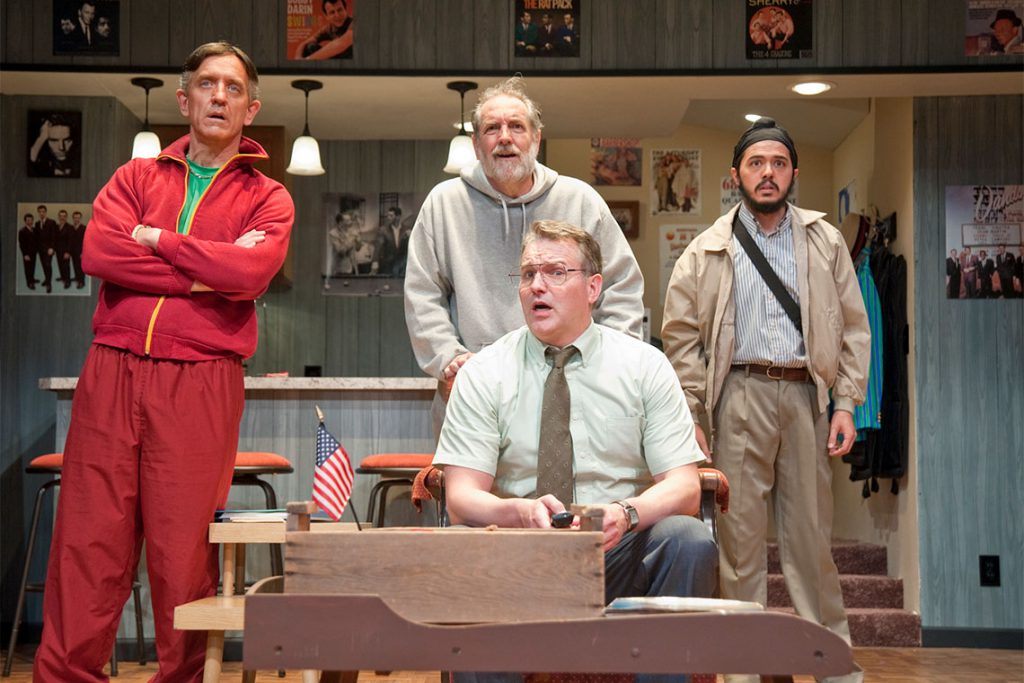
John Markus has written for some of the most popular and memorable sitcoms in television history: TaxiGimme a Break!The Facts of LifeThe Larry Sanders Show.  He was head writer of The Cosby Show for six years during its reign as a genre-reviving pop-cultural lodestar. Most recently, he’s made the transition to theatre with The Fabulous Lipitones, a comedy about a barbershop quartet he co-wrote with Mark St. Germain. It premiered last year and now runs at Taproot Theatre through October 18.

I asked Markus some questions about writing for television and theatre and learning about the art of storytelling from an undisputed master. 

How do you make the transition from episodic sitcoms to theatre?

It’s actually less of a transition than you’d think, because when you write shows done in front of live audience it’s like the first cousin of live theatre. All the TV shows I’ve worked on (except for The Larry Sanders Show) I’ve been writing for the people coming to see the [live] tapings. In terms of what unites an audience in understanding your story and feeling compelled by it, as far as the mechanics of writing, they’re very similar. 

I was very fortunate to know [Lipitones co-writer] Mark St. Germain, who has a very impressive resume in writing for the theatre. Mark has always been amused by my desire to be in theatre, because he knows firsthand the struggles. Compared to the pay scale of TV, it can be quite daunting. He used to teasingly refer to me as “theatre-boy.”

What does your collaborative process look like?

On Lipitones, Mark initially had the basic idea of setting a comedy in the world of barbershop harmony. He knew it’d be a group that had sung together since high school and that a member dies. He asked me to be a collaborator partly because he couldn’t figure out the story, which is unusual for Mark because he’s a writer’s writer. We sat at his picnic table in his back yard and I figured out an element that Mark embraced and the play wrote itself very quickly.

Cast of The Fabulous Lipitones

Which was the addition of the new [Sikh] member.

Yes, and the cultural differences he brought, and the challenge at self-awareness he’d bring to these men. So there’s a generational as well as cultural contrast.

Barbershop quartets seem perpetually unhip. What’s inherently funny about barbershop?

The word “earnest” comes to mind, and also “corny” and “white middle-aged.” Sometimes those are basically just synonyms.

Why theater? What’s the specific thing that attracted you?

The most attractive element is the control the writer has. The words are untouchable unless the writer agrees they need to be changed.

There are no “suits” getting involved.

You don’t get notes. You can have a director tell you what they’d want for the script, you can have actors struggle with the lines and ask for revisions, but you don’t have to do anything. If you want to protect your vision, you don’t have to alter it. They have to work with what you’ve done. 

Because I was raised in the collaborative atmosphere of TV, what’s great about the theatre for me is the back and forth between actors and writer and director. I sit in the audience every night I can with The Fabulous Lipitones and I enjoy hearing what the audience does, because it informs the rewrites I’d like to do on the play. 

When you were a writer for The Cosby Show it was a pop culture phenomenon. What’s it like to be at the helm of this massive ratings juggernaut?

I was 27 yrs old and had never worked full time on a show, and never lived in New York City. Even though it quickly became the number one show on TV, we were working in a remote part of Brooklyn where having a hit show did not elevate your life in any way. It was isolated, so we couldn’t know our impact working on the show. All we knew was that we wanted to deliver a script every week that Bill liked enough to not fire us.

That’s the gig: how long can you dodge getting fired? And the truth is, I was the only original writer who stayed with the show. I started as a story editor, the junior level, then my mentor Earl Pomerantz quit after six episodes because New York wore him down and he wanted to be home with his family. So they basically made me the head writer, and Bill hadn’t fired me.

He’s a towering figure in comedy. What did you learn about performance and comedic instincts from watching him on set?

You could learn from Cosby not just as a performer and standup comedian. I learned in listening to how his mind worked. Our sessions on the show every Wednesday afternoon would be Bill exploring stories and working out in his mind a funny build and surprising progression to a storyline. It was like being at the knee of a master storyteller. I was young enough to still absorb things, and I drank in his brilliance. Now, how much of it I kept I’ll never know, but I was with the show for six years as head writer.

Would he just work through it out loud and “spitball?”

These writing sessions varied. Sometimes I’d bring stories from my youth and family, and sometimes Bill would have an idea based on something he’d seen during the week and spin it out. Sometimes he would embrace our ideas from the writers’ side. It was a collaboration that happened every Wednesday; that session would be to plot out a show that would be in script form that Monday morning. There are very few shows that do it that way, but when you have someone like Bill as your captain, you can do it.

There were Mondays where the script would be read aloud and Bill would look at us like, “Why didn’t you guys do the job correctly?” Needless to say, it was a very complicated relationship.

Are you working on anything now?

I’m working on a new TV show idea with Tom Fontana, the man who created Oz and The Borgias. He comes to me when he wants to try his hand at something funny.

Are you saying Oz wasn’t a comedy?

Maybe I missed some of those episodes…

You also worked on The Larry Sanders Show, which is credited as being one of the best shows about showbiz.

I’d even revise that and tell you I believe The Larry Sanders Show is one of the best written comedies ever on TV. That’s not egotistical because I didn’t create it–I came in year five. The memorable thing about Larry Sanders for me is the character comedy that Garry [Shandling] employed in the show. The TV business was the seasoning for these highly dysfunctional, flawed characters. It had a wisdom to it that was informed by the sordidness of showbiz. 

Of course, any time you’ve spent more than a few years in TV, you get to know firsthand the lying, the backstabbing, the manipulation, and the paranoid behavior. The television business is a magnet for the dysfunctional.

So you decided to get into a field where everyone’s completely normal.

Believe me, nothing in TV prepared me for what I’ve been experiencing in the theater, let’s put it that way. [Laughs]