We sent illustrator/animator Joe Garber to the opening of Seattle Children’s Theatre’s Goodnight Moon, running through April 26. Here’s his stunning interpretation.
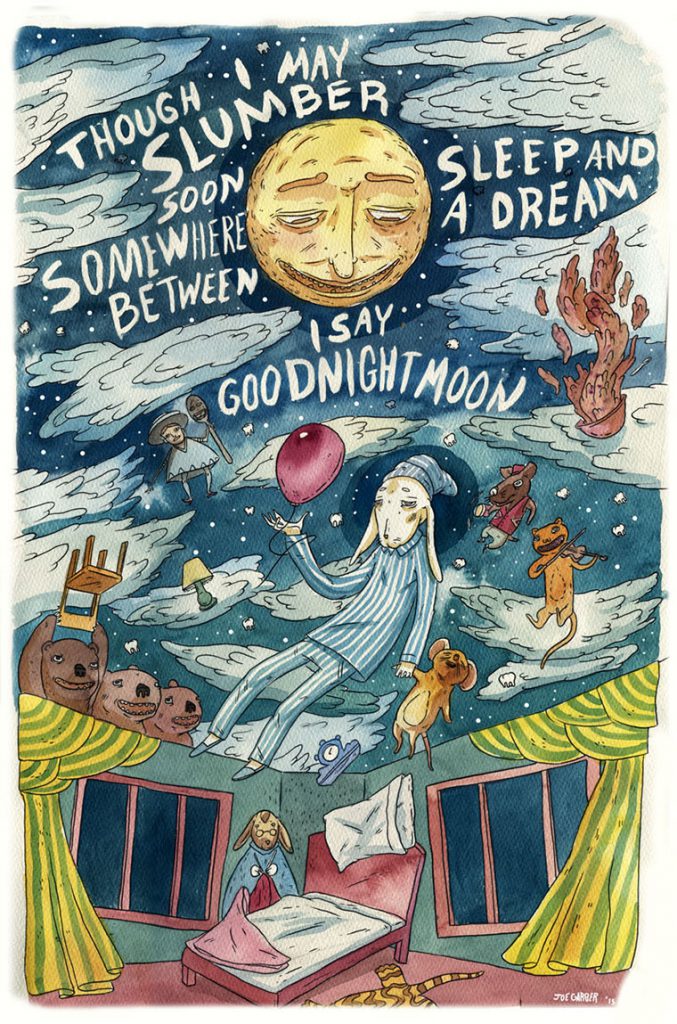

We sent illustrator/animator Joe Garber to the opening of Seattle Children’s Theatre’s Goodnight Moon, running through April 26. Here’s his stunning interpretation.
The 5th Avenue Theatre’s Rising Star Project puts kids in charge of a mainstage production with training and support from in-house professionals. This year’s show is Rodgers and Hammerstein’s Carousel, performed entirely by students with a student tech crew, running March 13 and 14. Even the administrative work, from fundraising to marketing, is run by the kids. It’s a big institutional undertaking that will reap long dividends in talent development, giving youngsters unprecedented access to the inner workings of a large theatre house.
Last week I visited 5thh Ave to observe a safety walk-through for the massive spinning turntablethat occupies most of the stage for Carousel. It’s been a while since I spent time in a roomful of teens, and I’m not sure what I expected—spitballs, screeching and incessant texting?—but my preconceptions were laughably off-base. The students were as focused and driven as the seasoned professionals who stood alongside them.
Program director Orlando Morales gathered the cast and crew and reminded them to plug the upcoming performances on Twitter and Facebook (has a generation ever been more media-savvy?) and in-house tech pros led a tour of the backstage layout. Then they rotated the turntable so the actors could familiarize themselves with the peculiar technique of walking on its moving surface. As the massive wheel revolved teens ambled, strutted, duckwalked, skipped and sauntered, each expressing their individuality while remaining intent on the larger endeavor at hand.

Mathew Wright has directed each of the Rising Star shows since the program’s inception in 2012. Last fall he was appointed ArtsWest’s new artistic director, but he’s back for another round. “Every year I learn as much from them as I hope they do from us,” says Wright, “It’s hugely instructive. It’s a great playground as a director, too, to try out different ways of explaining things to different levels of actors and to work those chops.”
I spoke to some of the Rising Star students about their experiences and what they’ve learned so far.
How did you get involved in the Rising Star Project?
I used to be involved in the drama program at the first high school I went to but now I go to a smaller high school that doesn’t have one, so I was looking for an opportunity to do theatre. I applied last year and did Spamalot, and now I’m back again for Carousel.
What are the most valuable things you’ve learned?
Being pushed to always be here five minutes early and get my things done. Being accountable and taking on responsibility and then following through with what I need to do, because if not the show won’t run as smoothly.
What kinds of things have you learned?
I’ve learned a lot about each respective area: lighting, sound, carpentry and now the rail. I’ve learned about how theatre functions, how cast and crew functions, what a call time means.
What do you plan on doing with this knowledge?
I’m hopefully going on to be a chemical engineer, but I’d definitely consider theatre as a career because I enjoy it and I know stuff about it. I could definitely see myself working here in the future.
Does any of that knowledge transfer over to chemical engineering?
I could see lighting or some of the electrician stuff transferring over to physics, but not really to chemical engineering.
What have you learned?
One of the biggest things I’ve learned is that things don’t always go as you’re expecting them to go. We were working on a lobby campaign where we were going to do a curtain speech asking audience members to donate money as they left the theatre. We tried it one night, but it was decided that the curtain speech didn’t go with the artistic vision of the show. We had to adjust our plan to how we were going to still try to raise money while being conscious of the show.
What have you learned about asking people for money to support the arts?
You definitely have to put yourself out there and be willing to take risks, because you never know who might support you. The development team procured items for a silent auction earlier this year. We went to businesses in the downtown area and some places we thought, “Eh, they won’t give us anything,” and they ended up being very generous.
What kind of work have you been doing?
We fundraise money for the show, so we do Kickstarter and lobby campaigns and write emails to ask people to donate to the Rising Star Project.
What have you learned?
It’s an interesting job because no one knows that side of theatre. I’ve learned what they do in the admin office, just a whole other side. A lot of time management, because juggling this with my schoolwork is a lot, and of course college applications. It’s going help me balance everything I’m going to do.
What have you learned so far?
On the orchestra side: how to play in a pit orchestra and lead a group of musicians. We’re playing off of monitors instead of seeing the actual conductor, so that’s a little different.
On the marketing side, I’ve learned how to promote the show through print media, creating postcards and posters, writing press releases, contacting press, taking production photos. There’s so much that goes behind marketing a show.
What have you learned so far?
Professionalism and trying to live in the moment. For a lot of actors it’s hard to still be that character and believe what you’re acting, but it shouldn’t be about acting, it should be that you’re trying to make it into a reality.
How do you stay in the moment?
By not losing focus, not losing sight of things that are in the outside world, staying in character and honestly believing what you say. My director, Mat [Wright], gave us some notes and he said when he was doing acting, he’d always feel like he owed something to that character. What was the character trying to pursue? What’s his main objective?
What are you going to do with this knowledge?
After I’ve learned everything I can—because there’s always new stuff to learn—I hope to take my talent to Los Angeles and pursue my career in acting and movies.
Emily Penick is a director, choreographer and artistic associate at ACT. Born in California and raised in New Jersey with an MFA in directing from Ohio University, she’s worked all over, from DC to New York to Milwaukee. She currently calls Seattle her home, and this year she’s directed readings at New Century Theatre Company, Northwest Playwrights Alliance, and the Young Playwrights Festival as well as associate directing alongside John Langs on Mary’s Wedding, A Christmas Carol, Bethany, and Seven Ways to Get There (running through March 15 at ACT). She’s currently choreographing Café Nordo’s Don Nordo Del Midwest (check out Jonathan Zwickel’s feature about the show over at City Arts) and associate directing Seattle Shakespeare’s upcoming Othello.
Penick is loaded up with projects well into the future, including the launch of ACTLab’s 2016 season next February with The Lover, a Pinter one-act that will be accompanied by live jazz and Café Nordo’s delectable food and cocktails. Penick took time out to join me for this week’s installment of Five Friday Questions.
What’s the best performance you’ve seen lately?
UMO Ensemble’s FAIL BETTER rocked my world. I saw it three times. I am a huge physical theatre and Beckett nerd. What the brilliant UMO Ensemble created in FAIL BETTER embodied all that I love about Beckett. It was delightful spending an hour with their unique cast of deeply human and hilariously tragic characters. The impressive live-mixed sound design and playground of a set were integral to the theatrical experience.
UMO used the architecture of the theatre in playful and surprising ways. And sure, it’s gloriously absurd to have a massive teeter-totter on stage, but when you see those dear clowns struggling to balance on it with each other you can’t help but recognize that very sensation in your own life. We’re all fools struggling for balance. Sometimes our efforts are virtuosic and impressive, and other times our efforts are hilariously pathetic. I loved FAIL BETTER, and I’m so glad we’ll be hosting them again at ACT this spring. They are definitely back by popular demand.
What’s the best meal in Seattle?
This little Ethiopian place, Meskel. I love to take a friend and share their lamb in berbere sauce with the veggie combo. It’s a very social food, eating off the same plate, with your hands. Wherever I make theatre I search out the best Ethiopian food in town. DC, NYC, even Milwaukee.
When I was getting my MFA in directing, a dear friend and wonderful playwright, Bianca Sams, taught me how to make injera and several Ethiopian dishes from scratch. That cooking lesson was worth a master’s in its own right. Delicious. There’s really nothing like a fresh spongy sourdough bread and bold spicy dish complemented by some home-brewed honey wine.
What music gets you pumped up? What do you listen to when you’re sad?
This is embarrassing. Gwen Stefani’s “Hollaback Girl” is my guilty pleasure if I need to get pumped up to pitch a show. If I’m about to host a party or go out, I’ll put on funk. Bill Withers’s “Use Me” is a favorite. If I’m sad, I’ll spend a little time with my beloved Talking Heads listening to “This Must Be the Place” or “And She Was.”
Do you have any opening night rituals?
Thank you notes!! Always, always. And usually a whiskey toast. I also love not wearing my glasses at opening. After a week of tech and previews, taking my glasses off is the final test, to see if the play works as a whole. One big blurry story-telling whole.
What’s the most useful thing anyone’s ever taught you about working in theatre?
All great art comes from trust. That wasn’t so much a spelled-out lesson as one I gathered from working with friends and mentors.
The most useful straight-up tip I ever got was: Don’t be an asshole to anyone. Chances are the girl who helped you with your quick-change in undergrad, or the shy little board op from your high school theater will one day be running the Rep or be in a position to give you a job. Assume everyone around you is bound for greatness, and treat each other well.
Annie Lareau has been directing theatre for the past twenty years. She’s served as the director of touring productions for Book-It with over fifteen shows at the helm, and more recently she directed the touring productions of Romeo and Juliet and Macbeth for Seattle Shakes. Last year she served as interim artistic director for ArtsWest, where she directed the acclaimed production of The Little Dog Laughed, and where next month she’ll direct David Henry Hwang’s Chinglish. Lareau stays busy. I caught up with her for this week’s installment of Five Friday Questions.
What’s the best performance you’ve seen lately?
I was lucky enough to attend the opening of a play called Disgraced by Ayad Ahktar on Broadway. Some of his other work has been premiered here in Seattleas well. What struck me about this play was all of the difficult questions about identity, race and ultimately human nature that it dares to ask unapologetically.
The performances were tremendous and powerful, each with its own storyline that lived in a very grey world where each character had darkness and well as light. It is the kind of play that leaves you thinking and struggling with your own biases and preconceptions and that kind of thought provoking theatre is right up my alley. Plus, I LOVED seeing such a diverse cast on stage. Such a rarity and it shouldn’t be.
What’s the best meal in Seattle?
I have a particular fondness for Bizarro in Wallingford. Love its funky ambience and the food and wine are amazing. Their seasonal ravioli at the moment is to die for. Plus it is run by another local artist, Jodi-Paul Wooster, and I love the chance to support other artists in their other passions.
What music gets you pumped up? What do you listen to when you’re sad?
Macklemore or Alicia Keys. When I am sad, I like a good Patti Griffin ballad.
What sunny weather activity are you most looking forward to?
I am looking forward to drinks and lounging with friends on my back porch as well as dusting off my kayak and perhaps having enough time to get out on the water this year. On particularly hot nights, I love a late night dip in Lake Washington after rehearsals when time allows.
What’s the most useful thing anyone’s ever taught you about working in theatre?
I had a wonderful professor in college who once told me two things that I live by in working with the theatre. The first was to always ask yourself before you take a job in the theatre if it fulfills two out of three of the following: Does it fulfill you artistically and push you to be better? Does it advance your career and get your more exposure to those who might hire you in the future? Does it pay the bills? If the job can fulfill two of those things, then take it. If not, think hard and long before you commit.
The same professor also told me to never spend my entire life in a theatre and only surrounded by theatre people. Go out and experience things outside your circle. If you don’t you will never have any material from which to draw from when you are immersed in the theatre.
Kaytlin McIntyre is a Kansas City-bred theatre director whose most recent work, the well-receivedworld premiere Zapoi! At Annex (written by previous 5 Fri Q’er Quinn Armstrong) runs through February 21 (tomorrow). She’s also the literary and casting associate at the Seattle Rep, where she started as an intern back in 2011. She handles casting and new play development like the Writer’s Group (showcase June 12-21) and Justin Huertas’ upcoming indie-musical Lizard Boy (opening April Fools Day).
I caught up with McIntyre via email at a national college theatre convention in Ellensburg for this installment of Five Friday Questions.
What’s the best performance you’ve seen lately?
Now I’m Fine at On the Boards in December left me totally undone. To this day I have trouble articulating that particular emotional catharsis, so I’ll throw you some adjectives: hypnotic, heartbreaking, seductive, disastrous, hopeful.
On the topic of hope, a year ago I was in Myanmar and happened across a political rally featuring Aung San Suu Kyi, winner of the Nobel Peace Prize and possible president. My Burmese is a bit rusty so I understood little, but she had more poise and command than anyone I’ve witnessed in front of a microphone. I could compare it to a 2008 Obama speech, but that doesn’t do it justice. For some of the faces in the crowd—faces that have lived under a brutal military dictatorship—this was like watching Nelson Mandela speak in post-Apartheid Africa. She is source of national pride and optimism. Most Burmese refer to her reverently as “the lady”.
What’s the best meal in Seattle?
I was born with no sense of smell, which means my taste buds have the sophistication of an eleven year old at Dairy Queen. If it’s excessively sweet or excessively salty, I’m probably on board. That being said, the blasted broccoli at Black Bottle in Belltown has rearranged my whole relationship to broccoli. That is some air-brushed, underwear model, pornographic kind of broccoli. It sets unrealistic expectations for vegetables everywhere.
What music gets you pumped up? What do you listen to when you’re sad?
Sleater-Kinney’s decade hiatus was worth the wait. “Price Tag,” in particular, is a scorcher. It pumps me up for kicking ass and staging mutinies.
I just bought Tracy Chapman’s self-titled at a vinyl record convention in Eugene last weekend. The yearning is almost unbearable, if you’re not sad when you start it, you will be by the time you hear “be someone, be someone, be someone…”
What sunny weather activity are you most looking forward to?
Despite all my better adult judgments, I just dropped the big bucks for Sasquatch at the Gorge. I’m typically a stingy killjoy with a “sale-bin-at-Grocery Outlet” frugality but I’ve never been to a music festival and feel as if my Seattle membership is pending until I make this commitment. And, once again, I can’t smell so that eliminates a lot of the carnal discomforts of sweating it out to Gogol Bordello with the Evergreen freshman class.
I’m also getting married this summer, which is exciting. Maybe I should have led with that?
What’s the most useful thing anyone’s ever taught you about working in theatre?
Anyone can take a car apart, but few people can put one together. It’s pretty easy to pick out flaws, but takes a bit of skill to find what works and what the right parts are that just need proper assembly.
I’ve also learned a valuable lesson from Erin Kraft and the late, great Jerry Manning about the power of emergency desk whiskey.
Christopher Morson is an actor and Cornish grad who’s playing the lead role of Ray Midge in the world premiere of The Dog of the South, opening tomorrow at Book-It and running through March 8. He also played Huck in Book-It’s well-received 2013 production, Adventures of Huckleberry Finn: Uncensored. More recently, he played Speed in Seattle Shakespeare’s Wooden O production of The Two Gentlemen of Verona and Sebastian in their mainstage production of Twelfth Night.
With final rehearsals underway for The Dog of the South, Morson took time out of his hectic schedule to join me for this week’s edition of Five Friday Questions.
What’s the best performance you’ve seen lately?
I’ve been watching the first season of Saturday Night Live, which I had never seen before. John Belushi, Dan Akroyd, Gilda Radner: Brilliant! There are two specific performances that have stood out thus far. The first would be Belushi singing “A Little Help From My Friends” with Joe Cocker and the second is him standing up to Rob Reiner about how the best they could come up with is “BEES!” Those are performances that I could watch over and over. Can’t wait to watch the rest of Season One!
Seattle theater scene: Jack Willis as LBJ in All the Way and The Great Society.
What’s the best meal in Seattle?
The best meal in Seattle is Purple Cafe & Wine Bar downtown. Not only is the food spectacular and the ambience perfect but every meal can be paired with a wine, from appetizers to dessert. My Italian roots are so happy anytime I go there. Good food and wine, what else do you need? (Also they have the most attractive staff.)
What music gets you pumped up? What do you listen to when you’re sad?
My pump up jam is “The Impression That I Get” by The Mighty Mighty Bosstones, a ska-core band from Boston. Dicky Barrett’s vocals are insane! My morning wake up jam since high school has been “Good Morning” by Kanye West. Yes, Kanye is a douche but his album Graduation got me through a lot.
“Your Hand in Mine” by Explosions in the Sky is my sad song. That whole album, The Earth Is Not A Cold Dead Place, really makes me feel… things. With its brooding, ominous melodies building into crashing climaxes. It brings back good memories and inspiration to get me through anything.
Do you have any opening night rituals?
Not really any specific opening night rituals, but I do have rituals. Any time I enter the theatre I “greet the space.” I literally walk into the theater and yell “HELLO SPACE!” as if it is a living thing. I figure if I’m nice to the space it will be nice to me in return. Also, just before the show starts I go and sit in random seats in the house and just look at the set. I try to imagine what people will be seeing.
What’s the most useful thing anyone’s ever taught you about working in theatre?
Awareness and redemption. Every performance should be better than the last. If something doesn’t go right in performance you have the next one to get it right. Every time you visit a show you can go deeper, find something new and be refreshed in the world of the play, all the way until closing weekend. I continually look at my script until the very last show. Thank you, Jim Gall.
This month Book-It premieres Dog of the South, their adaptation of the comic novel by Charles Portis, author of True Grit. In the book, hapless protagonist Ray Midge sets out to find his wife, who has run off south of the border with his Ford Torino and his best friend. Along the way Midge encounters a cavalcade of oddballs including Dr. Reo Symes, a scam artist looking to reach his missionary mother in Honduras to talk her out of a piece of land in Louisiana. It’s a wildly eccentric road story that’s been hailed as Portis’s true masterpiece.
For this production, Book-It brought back Judd Parkin, the LA-based screenwriter and producer whose previous adaptation for Book-It, 2013’s Adventures of Huckleberry Finn: Uncensored, received critical acclaim. Parkin, as it happens, is one of a growing number of Portis devotees (Portis-heads?) who regard the novelist as one of the great comic voices of the twentieth century. (See Parkin describe his devotion in this letter to the cast and designers of Dog.) I talked to Parkin about the joys and difficulties of adapting this unique work to the stage.
In my research, I found out that there are genuine Charles Portis superfans out there.
It’s funny. I felt like a lonely cult of one for a lot of years until Overlook came out with his books. The people I ran into who knew his work were few and far between. He was mainly known for True Grit and that was it. I saw the John Wayne movie when it first was released and, being a young movie enthusiast. I bought the tie-in edition of the novel and never read it until years later. I just picked it up and it was one of those moments where you go, “Holy shit! Why didn’t anyone ever tell me what a great book this was?”
What is the quality that makes you go from being a fan to a staunch true believer and cultist?
You come across a voice that just speaks to you, for whatever reason. It’s happened a few times in my life, particularly with comic novelists. I’m a sucker for first person unreliable narrators—I love that form. When I read Portis it was like, “My god! This is as good as Ring Lardner and Twain!” He creates a world and a reality and a consistency of character.
When you hear a voice that rings true for you in every single way, how do you not fall in love with that? It’s so distinctive. I can’t think of anyone else who writes like Portis. You could read an isolated page and say, ”That’s Portis.”
It’s got to be intimidating to adapt that voice to the stage.
It’s as bad as or worse than [Book-It’s adaptation of] Huck Finn was a couple years ago. You sit down and look at it and there’s that moment of terror where you go, “How can I do this justice?” That’s the challenge, what we call the sweet agony.
Jane [Jones, co-artistic director of Book-It] used to kid me, “Imagine how I felt when I get your script and I read the stage direction ‘and then the steamboat hits the raft.’”
“Your problem, Jane. Figure it out.” [Laughs] And she did.
We had a lot of the same challenges with Dog of the South. All of Portis’s books in one way or another are travelogues, journey stories.
How do you capture that propulsion?
By suggestion. The first half of Dog of the South they’re in the car. You just have to break that up. We did that with Huck Finn too—there were extended sequences of Huck and Jim on the raft, and we can’t have them on this little six-by-eight wooden platform for a half hour. So you find ways to break it up. You have to take some liberties.
You also write screenplays, so as you’re sitting down to visualize this, maybe you’re thinking: “Oh, a nice long tracking shot.”
Years ago I started tried to write Huck as a screenplay and just gave up because it’s why Gatsbyand a lot of other first person narratives don’t work as features. Even in the Coen brothers’ True Grit, which I liked, they didn’t do much with Maddie’s voice, and that was a disappointment. Yet I’m sympathetic to the movie because you can’t have wall-to-wall talking, you can’t have a voiceover all the time.
It’s been a really interesting experience because stage time is obviously very different than screen time. Onscreen, a quick montage and you get a sense of a long journey. I’m always surprised at how little you need in stage time; you can suggest a lot with a little. Jane’s been a great instructor in that. She invented this form and she knows it better than anyone.
As a writer, you’re really popping the hood on Portis’s writing. I’d imagine that would give you some extra insight into the mechanics and the language.
It comes down to: What’s the engine that runs the piece? Underneath all the craziness and detours and blind alleys, it’s a mission of a guy trying to get his wife back. He keeps telling himself he just wants to get the Ford Torino that his wife and his best friend stole when they ran off, but in truth he’s desperately trying to get his wife back, trying to understand why she left with this psycho, Dupree.
The comedy and the tragedy of this story is that everybody has a different god. Midge’s is rational. He tries to understand the world in empirical, rational terms. He meets up with Reo, whose god is gold. Then they meet Ms. Symes, Reo’s mom, this crazy born-again who started a mission in Honduras. Everyone has a different god that they worship in their own way. They don’t communicate; they talk at each other.
But going back to your question, what Jane and I wrestled with at the beginning: What’s this about? You can allow yourself the luxury of going off topic a few times, that’s the fun of these stories where there’s a little episode or vignette that pops up, but ultimately you can’t stray too far. That’s the pain of doing a book like Dog of the South. You end up being ruthless and cutting whole characters and big sections. There are three or four episodes that are hysterically funny in book form, but to do them [onstage] it’d just bog everything down. You have to get to the conclusion of the main arc.
And now you have to submit yourself to the same sort of judgment from other superfans that you might have levied on the Coen brothers, for example. The shoe’s on the other foot.
It’s true. That’s the risk you take and you just go, Oh well. You take your shots. With Huck I was absolutely convinced we were gonna get raked over the coals, because we basically cut the last third of the novel. I thought there would be a few quibbles but no one complained.
I produced a [TV] miniseries about Jesus, and talk about rife. I have a younger brother who’s an Episcopal priest, and I used to lie in bed at night thinking, “If we blow this I’m never gonna hear the end of it.”
You’re used to taking your lumps on these things.
I’m going through that now with Dog of the South. If there’s a Portis purist out there like me who asks, “What happened to this section?” I had to cut it! I feel your pain!
Quinn Armstrong is an actor, writer, filmmaker and Cornish grad. You might have seen him in last summer’s An Evening of One Acts at ACT or most recently in Slip/Shot at Seattle Public Theatre last fall. His work as a playwright is currently on display with Zapoi! at Annex Theatre, running through February 21.
Armstong is a multi-talented creator with some of the most eclectic, beguiling tastes I’ve come across in these Five Friday Questions. He joined me for this week’s installment.
What’s the best performance you’ve seen lately?
You will hear talk in your life about people like Meryl Streep and Daniel Day-Lewis and how they’re good actors because of all their emotions, and that’s cool. But there’s a bit in the original Halloween where Michael Myers is hiding behind a tree waiting to murder someone and you see his hand kinda stroking the trunk, very tenderly. You can tell the actor doesn’t even know he’s doing it. It is a true and real thing that monsters, fictional or otherwise, are usually people who want to love but don’t know how.
Also, Peter Crook is a human acting machine of incredible power.
What’s the best meal in Seattle?
I’m more into candy than actual, for real food. There used to be this candy called Kazoozles which were magic, but I guess didn’t sell that great. They went away but they’re back at the Regal downtown in these big eight-packs and so help me God I will see that those things sell if I have to buy every one of them myself, like Mark Driscoll with his book.
What music gets you pumped up? What do you listen to when you’re sad?
There is no better sad music than Schubert’s Winterreise. It’s a song cycle, kind of like a concept album about this dude who’s kicked out by his intended and he wanders around Germany in winter, pointing at bodies of water and saying “That body of water is like my feelings, ‘cause it’s frozen on top, but underneath it’s still flowing.”
As for pump-up, I’ve gotten way into Pig Destroyer lately. An occupational hazard with liking death metal and grindcore is you have to check that you’re not supporting crazy racists, but these guys are really smart and awesome and the lead singer is way into Baudelaire, which is perfect since death metal is a lot like Baudelaire: its grotesqueness and ugliness is just a front for its tiny, tender heart.
Also for pump-up: Kyary Pamyu Pamyu, who is kinda Japan’s Lady Gaga. Check out her music videos. Her imagery is incomprehensible, but the logic underneath it is ruthless.
Do you “treat yourself” to anything special after a show closes?
One of the downsides of having no self control is that it’s hard to make days special. I usually go buy books, I guess. My post-Zapoi! haul was: Carol J. Clover’s Men, Women and Chainsaws: Gender in the Modern Horror Film, Robert Musil’s The Man Without Qualities and Fernando Pessoa’s The Book of Disquiet.
What’s the most useful thing anyone’s ever taught you about working in theatre?
It’s not a level playing field out there. If (like me) you benefit from inequality, it’s important to keep working to develop your awareness of issues facing women and people of color in the theatre community (and the world in general) and do what you can to help.
Is there any space left? Can I say a thing? Theater people: bring back preshow curtains! Nothing kills the magic of a beautiful set like staring at it for half an hour before the show starts.
Keiko Green is a half-Japanese writer/performer from Georgia who came to Seattle via New York three years ago. Since then, she’s appeared in numerous productions: Annex’s Chaos Theory, WET’s Bengal Tiger at the Baghdad Zoo, Pony World’s Or, the Whale. This March she makes her debut at the Rep in The Comparables and at Seattle Shakes in next May’s production of Othello. Her original musical Bunnies, inspired by the Woodland Park bunny infestation with music by Jesse Smith, will have its world premiere as part of Annex Theatre’s mainstage season this April.
Green is preparing for a creatively prolific year. I caught up with her for this week’s installment of Five Friday Questions.
What’s the best performance you’ve seen lately?
That fake field goal in the NFC championship game. I’m obsessed with it. I can’t stop watching loops of it online. It’s everything you want in a performance: a solid set-up and a beautiful twist in the plot. I want all my work to be like that fake field goal.
There’s also been so much good theatre in town so far this year. I saw seven shows last week. The performance that is currently sticking in my mind is Robin Jones as Blanche in Civic Rep’s A Streetcar Named Desire. She was so layered. Her Blanche was so delicate, and yet she would victimize herself in a way that fooled no one. You wanted to shake her and scream, “Stop pretending to be broken! You’re broken already!”
What’s the best meal in Seattle?
I’m a sucker for a good happy hour. I often end up eating dinner really early because of this happy hour obsession.
The grilled sardine tartine at Lecosho is the single most delicious bite in Seattle, and it’s only available at happy hour unless you use your puppy dog eyes, which I have used to varied success.
Add a salad with a perfect egg, some sausages to share, and a glass (or two) of wine for the perfect meal. If I could get the roasted bone marrow from Quinn’s Pub added to that, well… a girl can dream.
What music gets you pumped up? What do you listen to when you’re sad?
I like danceable music to get pumped up—or at least something I can jump up and down to. I really like Metric’s “Black Sheep,” though the intro is way too long, so I usually skip 30 seconds in. I actually like the actress who sang it in Scott Pilgrim’s voice better, so I often listen to the movie version online instead.
Also my classmate from the Experimental Theatre Wing at NYU is the lead singer of this band Avan Lava, and they’re amazing. Their song “Feels Good” gets me pumped not just because I love the song, but also because it reminds me that I’ve worked with tons of people who are way more talented than I am—it taps into my competitive nature.
“Don’t stop never stop.” It’s my mantra. Don’t get left behind.
When I’m sad, I like to listen to songs from Young Jean Lee’s band Future Wife. Their song “Horrible Things” puts things into perspective. The lyrics are depressing and hilarious: “Who do you think you are to be immune from tragedy? What makes you so special that you should go unscathed?” But it’s set to this really cute music and her voice is so sweet. All the songs are like that. “I’m Gonna Die” is also really great. I like to play cutesy, sad music and just lie there and wallow, if time permits.
Do you “treat yourself” to anything special after a show closes?
Well, I think the Olympus Spa or “naked spa” in Lynnwood will be my new treat. A friend introduced me to it last October, and I’m pretty smitten. They have a Korean restaurant inside the spa! How am I supposed to resist going to that place?
Other than that, I pretty much like to celebrate all night after closing then lock myself in the house the day after, cooking and eating all day. Near the end of a run, I’m eating out more often than I like. So I spend this lazy day filling my body with hot, stinky, healthy Asian foods. I’ll stock up on everything fermented at Uwajimaya a couple days before, preparing for this stinkfest.
What’s the most useful thing anyone’s ever taught you about working in theatre?
In an audition, the people on the other side of the table are always on your side. Auditors want you to walk into the room and blow everyone else out of the water. It makes their job easier. They are rooting for you.
In August Wilson’s The Piano Lesson, at the Rep through February 8, two siblings in post-Depression Pittsburgh confront the brutal legacy of institutional racism in a quarrel over the ornately carved piano of the title, a family heirloom that spans generations. Haunted—literally—by the specter of slavery and hemmed in by harshly constrained possibilities, Berniece and Boy Willie Charles struggle to forge a path forward with rage, humor and music.
Wilson’s play masterfully distills decades of the black experience into the events of a single household. I saw it last Friday (the show was stellar—see Gemma Wilson’s review over at City Arts), and in an effort to tease out a deeper understanding of its historical context and contemporary relevance, I brought along two special guests, social justice organizers who grapple daily with the many still-ongoing issues embodied in the play.
Mijo Lee is program director for the Social Justice Fund, an innovative non-profit that funds community organizing through five states in the Northwest to address the root causes of injustice through grant-making programs as well as political education around race, class and social change.
Dustin Washington is the director of the community justice program for the American Friends Service Committee, coordinating anti-oppression trainings and projects in Seattle and across the country for the People’s Institute for Survival and Beyond, Youth Undoing Institutional Racism and the Tyree Scott Freedom School. He also organizes with No New Youth Jail, the group opposing construction of a new $210 million youth detention facility in Seattle.
Lee and Washington do bold, skillful work directly confronting racism as it exists in 2015. They were both moved by the play (especially the performance of Stephen Tyrone Williams as Boy Willie) and energized to see the historical roots of their work portrayed onstage so pitch-perfectly. As Washington said, “I gotta see more plays!”
We sat down at a bar on Queen Anne afterwards to talk about it.
You both work in racial equity and social justice, so I wanted to hear your take on a play like this. What struck you?
Washington: I thought it captured the time period and showed the dynamics that existed in 1937. A lot of what they spoke of then still plays out today, in terms of the conversations about white people and understanding the ways of white people. It reflected that desperate seeking for place within the American society for black people. Boy Willie captured that angst of being a black man in America and having to struggle to carve out a space and all the tension that can bring up within a family. The play also spoke to the internalization of racial oppression.
It was fascinating for me to experience that play in a room that was 90 percent white and wondering about their interpretation of what was being said and how they maybe would’ve seen this as something that happened a long time ago. I wonder if they could see how they’re connected to the story that was told tonight.
As a white person, I was privy to conversations I would not normally be privy to, which is a great thing about theatre.
Washington: Absolutely. People were let into a secret, sacred conversation, especially in a city like Seattle with the low numbers of African American people. I hope more black people get a chance to catch this play before it closes. The performances were brilliant and it captured a powerful story.
Lee: I identify as Asian, but I am mixed—my mom’s white—so I also have that feeling of hearing a conversation I wouldn’t normally be in and a living room I wouldn’t be in. I’m thinking about how rare it is to see an all-black cast in anything other than a stupid sitcom. I was thinking about Selma and how upset people are that LBJ is not the hero and how disconcerting it is for white people to not have a white person at the center.
I’m always thinking about the potential of art as a tool for social change. It’s more than just creating a conversation and creating awareness. That’s the starting point, but a lot of people stop there. I was imagining what you could do with a play like this if you were organizing around it.
The Rep is actually doing a lot of community engagement events around the play.
Lee: It’d be amazing to see the youth of Youth Undoing Institutional Racism have a conversation about the history of criminalization from slavery until today. What does this little slice tell us about the evolution of police brutality? There are so many threads you could pick out.
Just the matter-of-fact way Boy Willie spoke about being forced to work for a guy—he’s talking about the prison-industrial complex and prison labor.
Washington: They talked about Parchman Farm which is still active and still oppressing people right now. What the play did for me was capture the brutality of racism and the resiliency of black people in the face of it: the sense of humor, the music, the family bonds, the spirituality. Even though they were living in an era of very overt racism in this country they were still able to fully express their humanity.
And the music, those moments of uplift. When things in the play got dicey, music led them out of that—
Lee: The moment where the men are all singing together, that was so beautiful. So much pain and resilience coexisting in that moment. When they all stop and Doaker is the only one singing, it flipped so fast from intensity to humor!
Washington: The show was uncompromisingly black, from the language to the hot comb on the young girl’s hair to the talk of turnip greens and ham hocks and cornbread. The music, the sense of humor; everything was black and uncompromising.
For me again, the question is how is the audience holding that and how did the audience impact the performance? How might the performance be elevated in front of an all-black audience? Not even all-black, even just 40 percent. I wonder. It made me think about growing up on the East Coast—if this was Philly, 50 percent of the audience would’ve been black, guaranteed.
Can you speak to the binary between Boy Willie and Berniece? He said, “You think the world’s better off without you, but I think the world’s better with me.”
Washington: When you think about internalized oppression and the psychic/spiritual impact of living in a racialized, oppressive society, people responded in many different ways, different modes of survival. He needed to see the glass as half full and she had a sense of “we just gotta survive.”
Fatalism.
Washington: I gotta say though, her needing to hold on to that piano and that memory also really showed a level of hope. I don’t know that it’s a binary. There were a lot of things jumbled into the interaction between Berniece and Boy Willie.
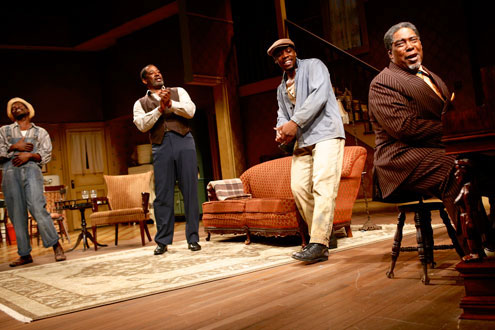
Stepping outside of that dynamic, I’m thinking a lot about the talent that was shown on that stage and hoping that talent could be allowed to blossom. I’m thinking about the work we’re doing around juvenile incarceration and racial disparities and the prison-industrial complex. Imagine if more of our young people were exposed to the arts in this way.
And seeing themselves represented onstage.
Washington: Exactly.
Lee: My son is eleven and I would love to take him to see this. He just started writing a fantasy novel—he’s about four pages in—and when he introduces the characters, he immediately talks about their race. There are three friends—one is Asian, one is Asian and black, and one is white—and he talks about the food they eat and how they interact. I was fascinated that he did that! I’ve worked so hard to expose him to books that have protagonists of color and it’s not easy. It was interesting to see how that came out in his own creation.
Washington: For me, there needs to be more funding and more opportunities presented to young people. They’re cutting funding for arts and we don’t have enough stuff based in the community. Instead of spending $210 million on a jail, why don’t we spend some of that money to expose people to the arts? It touches souls and emotions in a different way than a training or workshop. The possibilities are limitless.