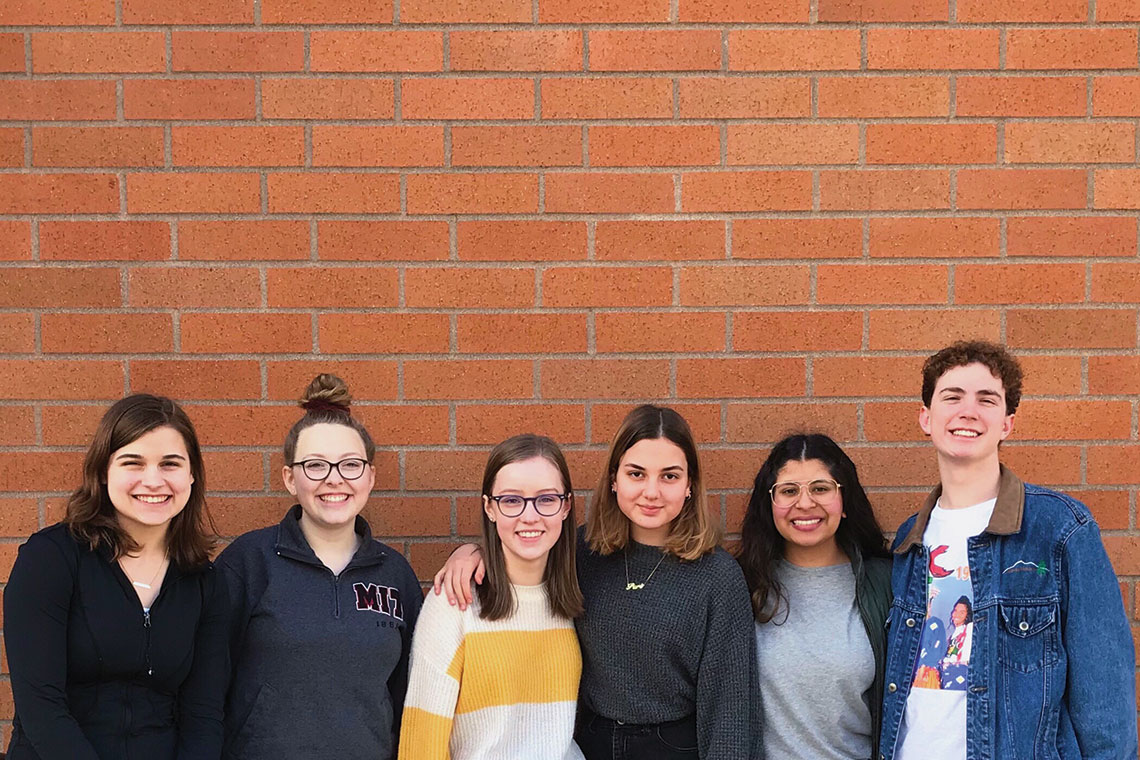
Encore asked TeenTix if one of their members from the TeenTix Press Corps program would contribute a piece about what teen activism means to them. Huma Ali shares her experience as an activist and feminist as a teen today.
As I’ve gotten older, activism has become increasingly popular among my peers. Maybe it’s because we desire a sense of belonging, have discovered unwavering principles to hold on to, or seek to create change—each individual has different motivations. But collectively, my generation has found power in our voices. As students, we have begun to speak out about the changes we want to see in society. We’ve planned walkouts, formed clubs and attended protests—we have become activists. But while some of us have pursued activism, another group has set out to bring us down. Growing up among a fairly kind bunch of students, it was unusual to see kids doubt the activism of their peers. Yet, I have come to realize that such a reaction is inherent to activism; someone will always second-guess you.
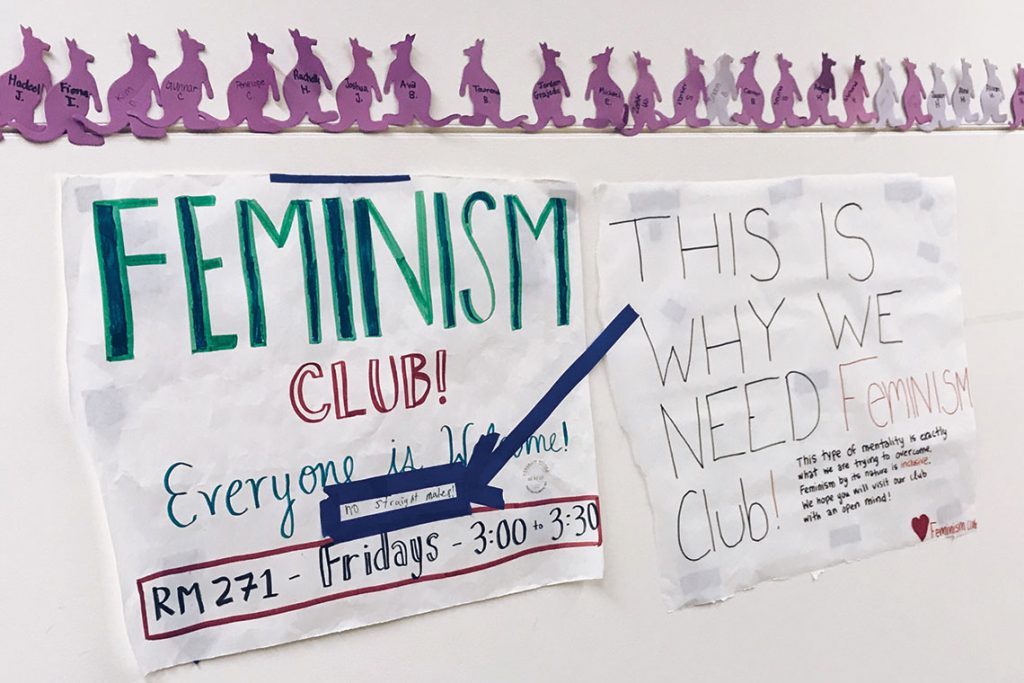
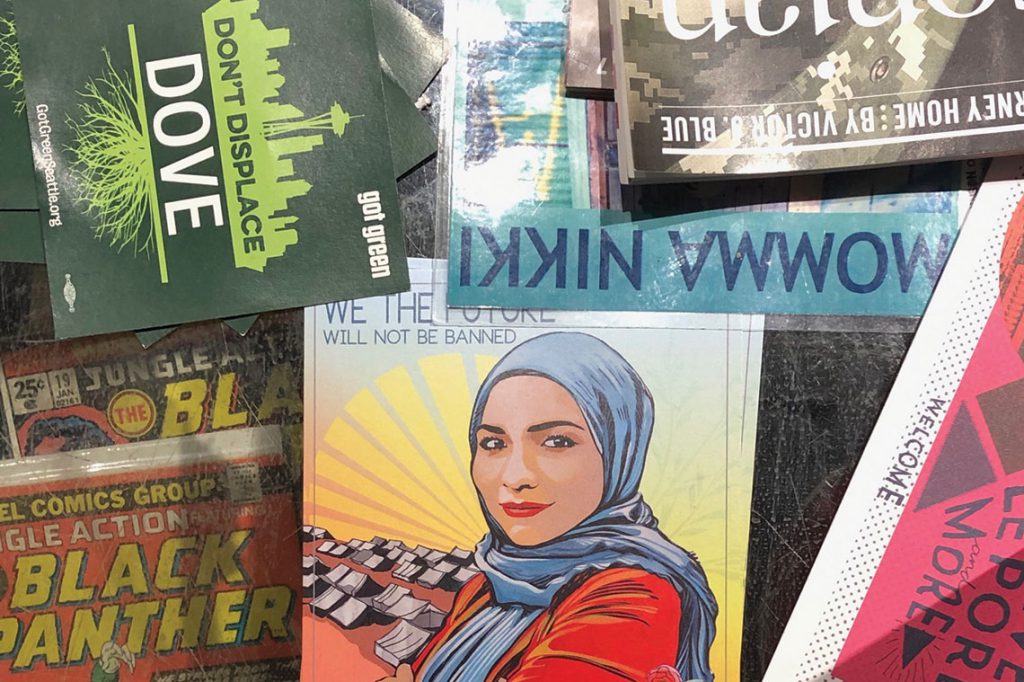
“Everyone is welcome” sign for Ali’s Feminism Club
In the seventh grade, I befriended an upper-class student who introduced me to activism and the need for it in today’s world. Until that point, I had been under the impression that conflict was absent in our world. I thought war was a tale of the past, and that we lived in a utopian society. To some extent, I blame my elementary school curriculum for this because every Martin Luther King Day lesson left me, and other students, thinking that racism didn’t exist anymore. Well, I soon realized that’s not true. I learned that the world is not a perfect place. The world probably can’t be perfect, but it can be better. I became an avid human rights activist, labeling myself a feminist. Activism provides an outlet for individuals to support their beliefs in a way they will be heard. The power of their words allows for change, in a society that needs it.
We’ve planned walkouts, formed clubs and attended protests—we have become activists. But while some of us have pursued activism, another group has set out to bring us down.
Freshman year I joined my high school’s Feminism Club. It was a nice space, quite positive and full of like-minded individuals. But a torrent of hate lingered behind the club. Many students thought it was unnecessary—and some still do. Another group tried to start a “Meninist” club. Many of my peers thought of feminism as a derogatory term, and often called our events, like one of our walkouts, “stupid.” But these people wouldn’t make time to understand the reasons behind our actions. It is safe to say that it wasn’t always easy to be a part of the club. Recently, someone defaced our “Feminism Club! Everyone is Welcome!” poster by adding a line that read “no straight males.” It’s hard to comprehend a student’s motivation behind writing such a comment because our club’s priority is inclusivity. In response, we created an arrow out of tape, at the tail of which was another poster reading, “This is why we need Feminism Club. This type of mentality is exactly what we are trying to overcome. Feminism by nature is inclusive. We hope you will visit our club with an open mind!” I hope they actually come to one of our meetings. If they do, I don’t think I’ll be mad at them for defacing the poster—I’ll be happy they showed up and gave feminism a chance.
Being a teen activist, the most important thing I have learned is that you must stay rooted in your beliefs. People have agendas, intentional or not. You need to know what you are fighting for. There is value in the ideas of others, but there is power in the ideas you form by yourself. Activism empowers youth to fight for their beliefs through a viable means, in which they are given a chance to influence change in our society—at the very least, this is what it has done for me.
Huma Ali is a junior at Lake Washington High School who is passionate about the power of words. She is a patron of the arts, an active writer and works to make teen voices heard through TeenTix’s Press Corps program.
In an unassuming building that used to be home to a wine bar, a community library and bookstore lies, ready to be explored. With a focus on social justice, ethnic studies and liberation movements, Estelita’s Library is open to anyone and has something for everyone.
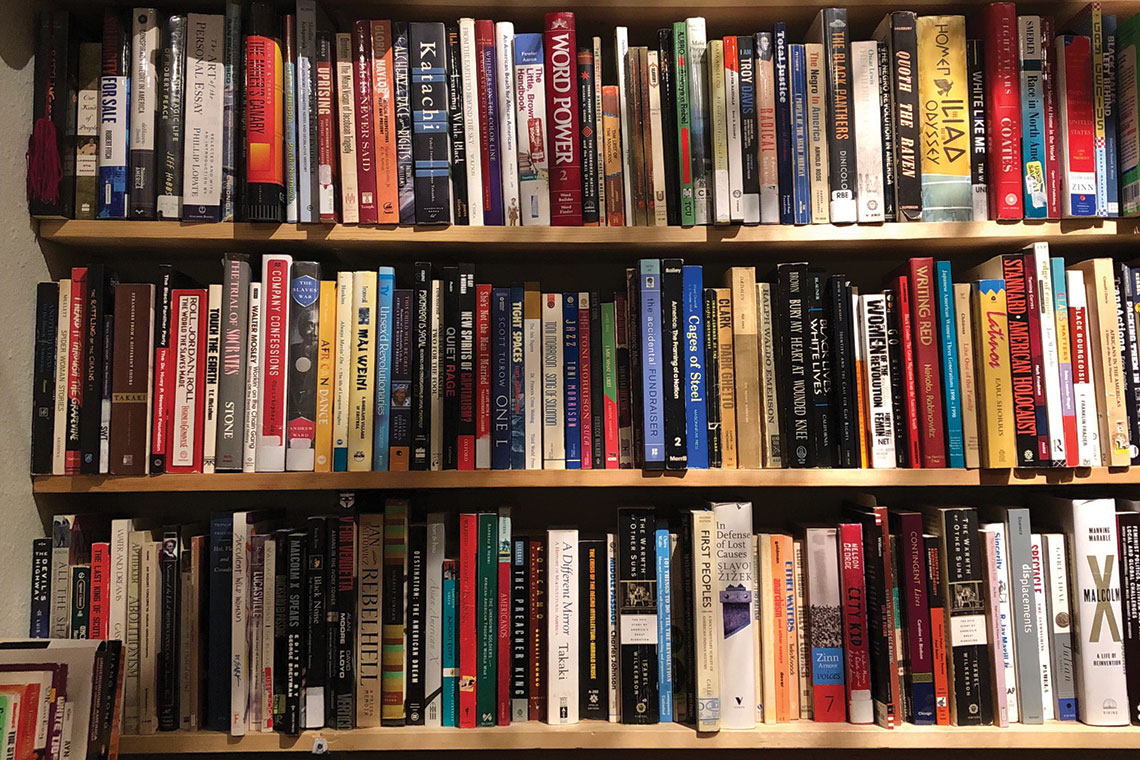
Invisible Man, by Ralph Ellison. Ceremony, by Leslie Marmon Silko. To Be Young, Gifted and Black, adapted by Robert Nemiroff. There is no order to the books on the shelves. There is an element of discovery. Chinese Communism and the Rise of Mao, by Benjamin Schwartz. The Souls of Black Folk, by W.E.B. Du Bois. Homer’s The Iliad. It’s like someone’s den. A few shelves long against one wall. Another shelf on the far wall with paperbacks. Most of all the books dealing with race, politics, gender, justice. Crazy Laws and Lawsuits: A Collection of Bizarre Court Cases and Legal Rules, by Robert Allen.
The books on the shelves have been placed there by Edwin Lindo. He’s never run a library before. He teaches at the University of Washington with the Department of Family Medicine. He got his BS in Business Administration/International Relations from the University of the Pacific in Stockton, California and a Doctor of Jurisprudence degree from the UW School of Law. He’s never worked in a bookstore, either. He runs this place—Estelita’s social justice library, bookstore and community space crammed into a little space on Beacon Hill. It’s across the street from El Centro de la Raza and behind a place called Chop House—a beauty salon.
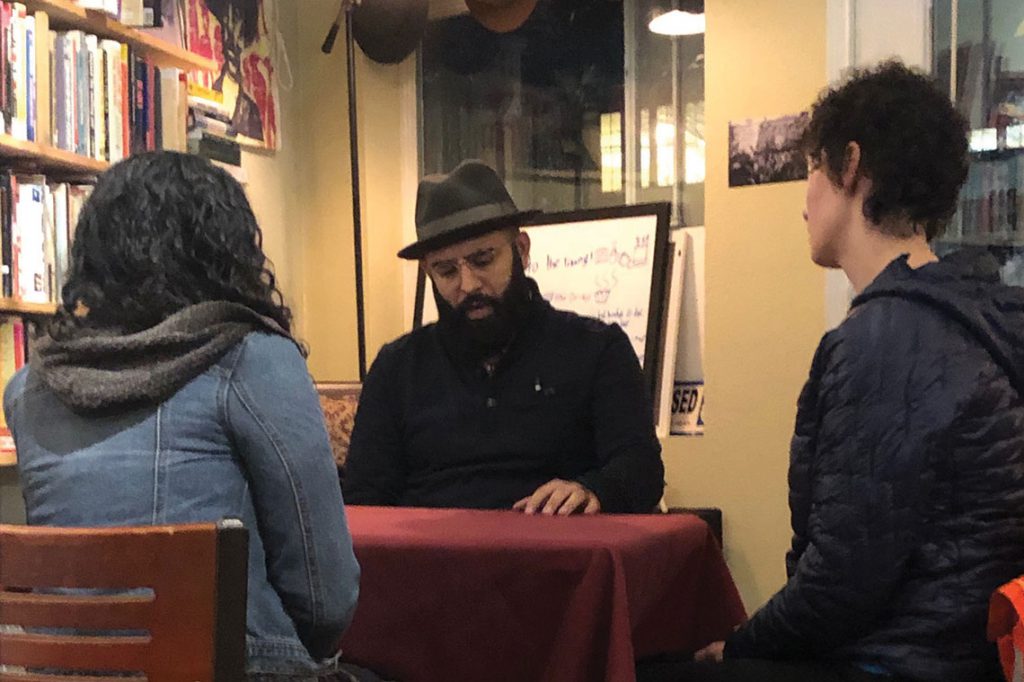
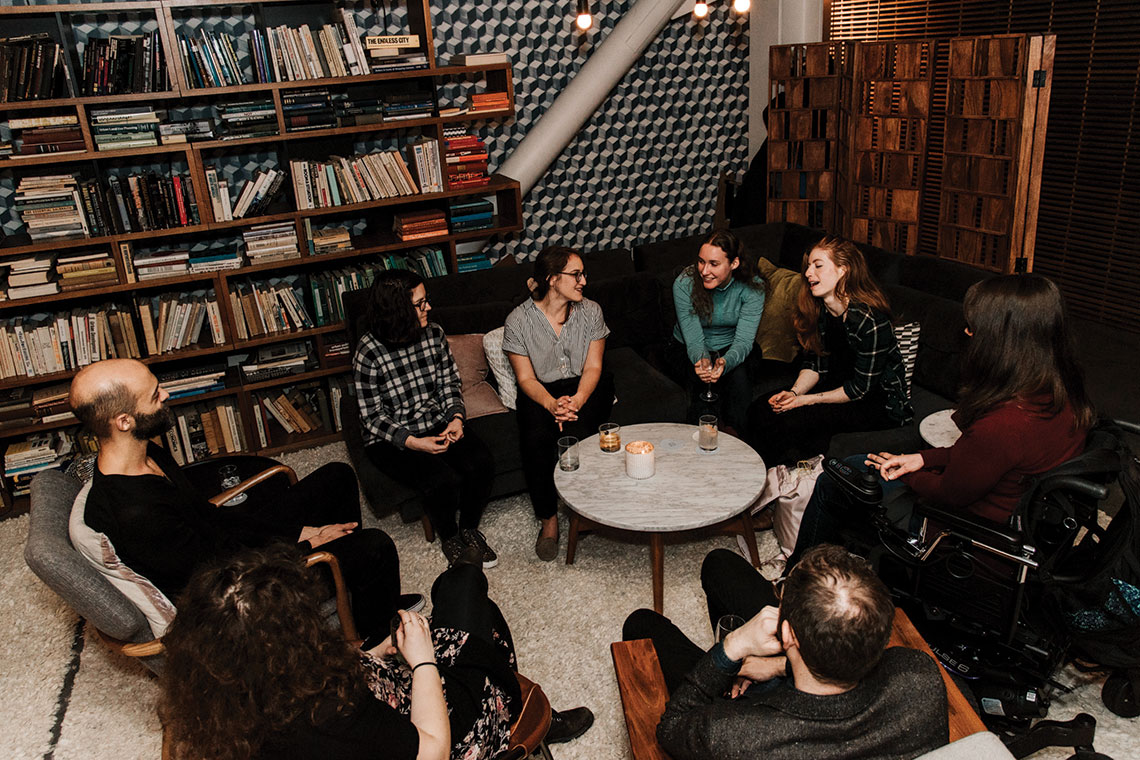
Edwin Lindo (center) in conversation with patrons
Estelita’s was in a wine bar. The old counter now has vintage Black Panther comic books in it, old Black Scholar magazines, too. There are “Democracy is Power” postcards available for the taking. On the walls—African masks, tree branches with little bird nests in them (art created by local Briar Bates). Paper skeletons sweep across the front window. There are Che Guevara posters. An upright piano is shoved in by the window. There’s a church pew. There are a couple of tables with burgundy tablecloths on them to read, or commiserate, or to play chess.
The Responsibility of Intellectuals, by Noam Chomsky. The Buddha in the Attic, by Julie Otsuka. Long Walk to Freedom, by Nelson Mandela.
“This is the sort of place I grew up in,” Lindo says. He grew up in the Bay Area to a Nicaraguan father and a Salvadoran mother. His dad would take him to a restaurant where there would frequently be discussions of art and politics, books and the news of the day.
“I wanted to bring that here,” he says. “I hated books, I didn’t really start reading until after college. It was when I started listening to my elders that I started reading. They told me that books are where the secrets lie.”
The Rights of Indians and Tribes, by Stephen Pevar. Radical Dharma, by Jasmine Syedullah, Lama Rod Owens and Rev. angel Kyodo Williams. Roots, by Alex Haley.
The books on the shelves are mostly his own. It’s an interesting collection. Behind the counter he has piles of The Black Panther newspapers. The official newspaper of the Black Panther Party began in 1967, founded by Huey P. Newton and Bobby Seale. He believes he may have the greatest collection of them in the world. Approximately 400 editions of the paper were created. He’s got 380 of them. He’s angling to get the whole set. “I tried to show them off to Bobby Seale. He said, ‘Cool, cool.’”
A collection of postcards at Estilita’s
The library is named after his daughter, Estelita, and opened in March 2018. The library operates through membership. From $30 to $50 or so, you can have access to the books (about 1,200 are in circulation now and he’s always looking for suitable donations) and have the books for a two-week stretch. Currently, Estelita has 336 members. “It’s amazing,” Lindo says of the growth. And more, the non-profit is already growing. He’s received a grant from the city to open a second location. It’ll be in the Central District. Plans are still being formulated.
The Quran. How to Rap, by Paul Edwards. The Macho Paradox, by Jackson Katz.
More than a place for knowledge to decentralize, it’s a place for the community to gather—play chess, have conversations with strangers, debate. Eager to bring people off the street, Lindo is also wanting to partner with like-minded community organizations. He wants to offer classes, book talks, lectures. “My wife asks me why I spend so much time here,” Lindo says. “It’s because I love it. I can spend hours here—jazz playing on the speakers, people coming in to talk, all these books.”
The Negro Revolution in America, by Louis Harris and William Brink. Native Son, by Richard Wright. Stamped from the Beginning: The Definitive History of Racist Ideas in America, by Ibram X. Kendi.
Teenagers sit in the corner of the shop, peruse the titles and chitchat. It’s raining outside and they didn’t want to go home quite yet. Two old women come in, warmly chatting. Two thirty-somethings come in soon after. They ask Lindo about that night’s poetry open mic. “It’s been cancelled,” Lindo says, reluctantly. But then, “That doesn’t mean you can’t have it anyway,” Lindo tells them.
The old women sit at a table with the thirty-somethings. They don’t know each other. They introduce themselves. They start talking. They get to know each other.
“That,” Lindo says, smiling. “That right there is what this is all about.”
Playwright Danielle Mohlman reflects on a three-year effort to bring Millennial audiences to Seattle theatre and her hopes for the future of this theatre group.
When I moved to Seattle in 2015, I didn’t know anyone involved in theatre. In fact, I didn’t know anyone who even enjoyed going to the theatre. So rather than learn a new city and the seemingly infinite number of theatres that came with it all by myself, I made a rational choice: I created a group for Millennials to experience theatre together.
The first outing I planned was to see Come from Away at Seattle Repertory Theatre in December 2015. Only two friends joined me in the audience that night, but it remains the most talked about outing—even three years later. But here’s the thing: I didn’t know Come from Away was going to blow up the way it did. I couldn’t have predicted a cast album, a Broadway run and a national tour that sells out houses almost every night. And I remind these regretful friends of this fact: I can do all the research in the world, but at the end of the day I’m inviting them to take a chance on a new play with me.
I started with an email list of ten Millennials who wanted to give theatre a try. The list has now grown to forty theatre lovers, including folks who work in the industry but want to make friends while seeing new plays. The group started as a pay-what-you-can experience, but we’ve moved away from that as folks become more comfortable spending money on theatre. And while the original scope was broad—“Let’s see some plays!”—we now exclusively attend plays written by female and non-binary playwrights, playwrights of color and LGBTQIA+ playwrights.
“You have been a huge influence on me from an arts perspective,” Greg Socha, a marketing manager in his early 30s told me. “My go-to entertainment option used to be microwaveable popcorn and Netflix. And it still is. But I’ve realized that I love having the theatre as something to look forward to.”
Over the summer, I talked Socha into subscribing to the 5th Avenue Theatre with me. They were running a special on preview performances and I, knowing what a big fan of musicals he is, immediately reached out to him.
“I was counting down the days until we saw Come from Away—so worth it,” Socha said to me. “At this point, I’m getting more comfortable with actually making arts plans. I’ve even invited you to stuff!”
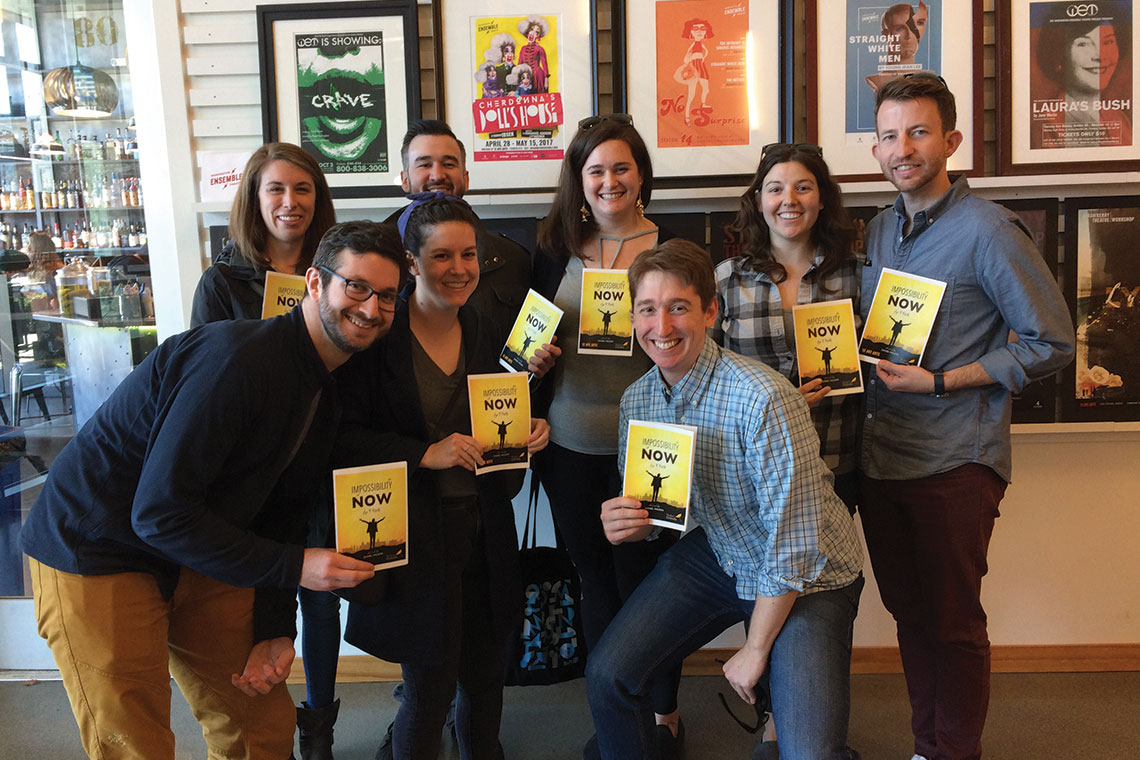
It’s true. Last season, Socha went with me to see two shows, The Impossibility of Now at Thalia’s Umbrella and Patti & the Kid at On the Boards, neither of which we connected with. It turned out our favorite show all year was Two Trains Running at Seattle Rep—a play that Socha invited me to.
“One year ago, I wouldn’t have even considered going, or at the least would have talked myself out of it but knowing that I had a theatre buddy made me reach out,” Socha said. “When we actually got to the theatre, I would say that I was nervously excited. I was hoping we would have a good time, but you never know.”
Socha was put at ease five minutes into the performance and at intermission we were both beaming.
Siddhi R. Ghai, a volunteer festival coordinator at Tasveer, has been with this group from the beginning. While she was living in India, she’d often see one or two plays a month. When I learned about Pratidhwani, Seattle’s only South Asian theatre company, I knew that Ghai was going to be a fan.
“The few Pratidhwani plays we went to, Queen and A Small History of Amal, Age 7, were very interesting for me because I got to share a little bit of my culture with you,” Ghai told me.
She added that she loved getting all the cultural references without having to think about it. When we attended A Small History of Amal, Age 7 earlier this season—a play Ghai invited me to—she grabbed my arm as soon as we walked into the theatre. She was having a visceral reaction to the sound design—audio from a train station in Mumbai, the city where she grew up.
When I asked her what it’s been like to see plays in a group setting, with people she may or may not know, her response was overwhelmingly positive.
“Before meeting you, I never had the opportunity to discuss plays with a diverse group or people who I don’t know,” Ghai said to me. “It’s so interesting to get different perspectives because I feel it helps us expand our own cultural horizons.”
Jennifer Voorn, a manager of product management in the healthcare IT sector, has also gotten a lot out of these group outings. She’s part of the theatre group’s origin story and, along with Ghai, attended that first performance of Come from Away with me. In the last year, she’s come with me to see The Crucible and The Wolves at ACT Theatre, Native Gardens at Intiman Theatre and The Impossibility of Now.
“I have greatly enjoyed meeting new people and hearing their perspective,” Voorn said. “I also enjoy experiencing the different levels of response a group can have to the same piece of art, in terms of what can make someone laugh, cry or be visibly uncomfortable. It’s amazing how the same piece of art can impact people so similarly—or so differently!”
Last season, Voorn took visiting family to see Into the Woods at Village Theatre. And, of course, she took a chance on some last-minute tickets to see Hamilton with her husband at The Paramount.
“We bought last minute tickets on SeatGeek thirty minutes before the show,” Voorn said. “I was so nervous we wouldn’t make it to the venue on time. Once we arrived downtown, the smile on my face was so big. I will always remember that night.”
Melissa Herrett folded into my theatre group when she moved to Seattle in 2016, but a new dog and a job that requires her to travel has prevented a more consistent theatre habit.
“I do see more shows now but that’s mainly because you invite me,” Herrett told me, adding that she wants to start bringing theatre into date nights with her boyfriend, substituting plays for the standby of dinner and a movie.
Herrett did see Lauren Weedman Doesn’t Live Here Anymore at ACT and The Impossibility of Now with the group this year.
“I prefer seeing shows with other people because my favorite part about them is being able to discuss after the fact,” Herrett said. “It’s nice to go together so you all have the experience of seeing the same performance. It would also be interesting to discuss a show that someone saw on a different night or at a different theatre and discuss how things varied from performance to performance.”
Marissa Spiegel, an accountant, also enjoys the group outings.
“I think it’s really fantastic to go see plays with a variety of people,” Spiegel said. “I think the people around you can really influence the show—not just the people you know there but the rest of the audience as well.”
Spiegel attended group outings to see The Wolves and The Impossibility of Now. For The Wolves, Spiegel stayed with me to participate in the post-show discussion, which meant a lot to me.
“My favorite type of experience has been when there is a group of people that has never seen the show and has
relatively little context or background knowledge,” Spiegel said. “It’s great to see the show with a group that has fresh eyes to digest and talk about it afterwards.”
I have big dreams for the future of this group. I average about one theatre outing each month, but I’d love to get to a point where those outings happen on a day that people can count on—the first Wednesday of the month, for example. I’d love to create partnerships with local restaurants, so audience members can gather for a discounted drink or appetizer after the show and talk about what they just saw. I’d love to expand my network beyond Millennials I know, encouraging regulars to bring a friend along each time. And I’d love theatres across Seattle to work together to incentivize a younger audience base, rather than treating ticket sales like a competition for resources.
But for now, while this is still an endeavor run by a volunteer staff of one, the most important thing I can do is keep planning events.
I wish I could say that in the last three years, the group has grown exponentially and that every single event is a rousing success. But that would be a lie. Sometimes I email my group of forty and the only person who responds is my husband. Sometimes I can’t even get him to come with me. But I keep coming back, I keep putting in the work and I keep growing my network. Because I know these audience members count on me to take a chance on something new with them. And that’s enough to keep me going.
How to Start Your Own Arts Group
Excited about introducing your friends to more art? Start your own group for art lovers.
Choose a focus.
Danielle decided to choose theatre as her group’s focus, but yours could focus on dance, the symphony or even museums! Identify folks in your friend group who are curious about your passion and you’re on your way.
Pick a performance.
Identify a performance that’s interesting to you and check Goldstar and TodayTix for discounts before you buy. Most performing arts organizations offer discounts for groups of ten or more, so be sure to check in with the box office if your group is large enough.
Make a night of it.
Invite your group to get dinner before the performance or gather for a post-show drink. Not only is it a fun way to create community, it’s also the perfect place to download what you’ve just seen or excitedly anticipate what you’re about to see.
Keep it going.
The key to a successful arts group is to just keep scheduling outings. Not every outing has to be a roaring success with fifteen of your friends. Sometimes only one or two others will be able to attend. That’s okay! Any opportunity to introduce friends to art is a success in our book.
Every time I walk into The Cloud Room, I remind myself to breathe. Inhale one, two, three. Exhale one, two, three. It’s a stage direction I’ve included in my plays more than once—a necessary one because it’s a reminder to trust, to let go, to be vulnerable. This Capitol Hill co-working space is more than a place to gather and share new work. It’s also the place where I’ve shared my most vulnerable work: new pages from a script that terrifies me, its creator. Inhale one, two, three. Exhale one, two, three.
When Sara Keats, Umbrella Project’s director of dramaturgy, told me she was starting a writers’ group, I was immediately interested. I’d been kicking around the idea of writing a play about the fanaticism of college football and the way campuses address rape allegations when players are involved.
Most of my plays come from a place of rage and Rushing was no different. I’d read Missoula by Jon Krakauer and Unsportsmanlike Conduct by Jessica Luther, two books that report on sexual violence at the hands of Division I football players. I spoke with mentors about the topic—including one playwright who’s made his career on the football as hero’s journey story—and everyone was very encouraging. But I’m a playwright—a particularly anxious one. And no matter how much encouragement I receive, it’s not going to change the fact that I ultimately need to write the play alone. And, for this play, that was a terrifying idea. Which is why, when Umbrella Project accepted me into their inaugural Writers Group, I knew that this was the play I wanted to write.
Umbrella Project’s work stems from a philosophy of radical dramaturgy. For Sara Keats, that means a flexible, dynamic and anti-oppressive artistic practice that marries more traditional dramaturgical practices with producing, advocating for and generally being incredibly involved in a new play’s journey from first page to final production.
“The Umbrella Project Writers Group was, in a lot of ways, a natural outgrowth of our mission as an organization,” Keats said. “Umbrella Project is all about serving plays and playwrights, and we think the best way to do that is to inspire and empower new play dramaturgs.”
She added that most good playwrights have a dramaturgical streak within them, one that’s often activated within the confines of a writers’ group. But it’s a different experience altogether to be part of a cohort solely as a dramaturg.
“The biggest difference between Writers Group at Umbrella Project and other script development opportunities is that the dramaturgs are there from the beginning,” Keats said.
In addition to the sheer amount of dramaturgical support, Keats is proud of the flexibility the Writers Group timeline offers. While I used the February to December calendar to write a first draft of Rushing, Seayoung Yim used our monthly meetings to get feedback on Summoning Frankie, a play that was produced at Seattle Public Theater. Now that the show has closed, she’s oscillating between bringing in new drafts and starting a completely new play. Meme García is working on an adapted play but paused midway through to bring in new pages of House of Sueños in advance of their 18th & Union and Bumbershoot performances. And Brandon J. Simmons came into the Writers Group with a play he’d been simmering on for a long time—but ultimately decided to start writing an entirely new play just a few months before our showcase.
Simmons says that the most challenging part of the Writers Group is his struggle to simply write.
“Umbrella Project is all about serving plays and playwrights, and we think the best way to do that is to inspire and empower new play dramaturgs.”
“Having space and time to work on a piece I’ve been struggling with for years allowed me to actually explore the limits of the idea before moving on to something more interesting,” Simmons said. “Goldberg is no longer nagging at the back of my brain. It’s effectively been put to rest, and I have space for new ideas.”
Yim applied to the Writers Group because she’s always admired the artists who make up Umbrella Project. She’s found that the most rewarding part has been meeting other playwrights and digging into their artistic processes.
“I have worked with Erin Bednarz, the director of engagement, on previous productions of my play Do It for Umma and she’s an amazing delight,” Yim said. “I’ve found the Umbrella Project folks are a brilliant and kind group, so I knew I would really enjoy working with them.”
Summoning Frankie, the play she’s spent the most time with in Writers Group, is a nod to the wizarding world of Harry Potter. It’s a comedy about a magical school, but it’s also a play that tackles classism, gender and the politics surrounding school funding.
“Writing about wizardry is something completely foreign to me, but I’ve been surprised how much I enjoyed making magical elements up,” Yim said. “It’s also the first time I’ve written for an all youth cast and it was really challenging and fun to write for that age group.”
García applied to the Writers Group because they wanted to see how other playwrights work and what their process is like.
“I’m a relatively new playwright,” García said. “My play, tnc, isn’t exactly autobiographical, but I’ve been exploring what the concept of love looks like through queer Latinx eyes. Many of the speeches or songs in the play are poems I’ve written about people in my life. So, having them read aloud is oddly cathartic but also terrifying. As a genderqueer Latinx person who is not out to their family, the concept of love tends to simmer inside me until it bursts forth in erratic ways. What would it look like if the poems I write could just be said aloud, spoken for the world to hear, not hidden? What does love look like in a world where Latinx people are being detained, imprisoned and shunned? How do we continue to love in a time so bent on hate?”
The play García has been spending the most time on in Writers Group is an adaptation of William Shakespeare’s Troilus and Cressida, simply titled tnc. It’s set on the border of Texas and Mexico in 2025 and is about a group of Latinx guerrilla soldiers fighting against a white supremacist, patriarchal United States. García came up with the idea earlier this year, when they were yelled at for speaking Spanish on the bus here in Seattle.
“As a Latinx person there are very few instances where I have felt true power on stage or in a rehearsal room,” García said. “Spaces and productions were not designed for my body in this current political climate. My past traumas and fears are never taken into account and I frequently feel like a commodity—on display and dancing for white theater-goers and artists. I cannot express how many times I’ve been asked to use my “native dialect” on stage—or how many times I’ve had to play a prostitute or a maid. These stories, while important, do not reflect the true nature of Latinx communities. We are so much more diverse than that. I wanted to write plays which place Latinx folx at the heart of the story. I wanted to create epic worlds of war, love and loss. And I wanted it now!”
Sara Keats (left), Umbrella Project Writers Group director of dramaturgy with Writers Group dramaturgs Rachel M.E. Wolfe (center) and Iphigenia Rising (right)
Of course, these four plays wouldn’t be the same without the army of dramaturgs we’ve been fortunate to work with. Andrea Kovich, one of the four Writers Group dramaturgs, considers the collaboration among playwrights and dramaturgs the most rewarding part of the program.
“So far in my career, I’ve done more production dramaturgy, which involves a lot of solitary work,” Kovich said. “It’s not until rehearsals start that a dramaturg really gets to engage with others and have meaningful conversations. Some local theatres and directors recognize the value of having a production dramaturg, but it’s not as common here that a dramaturg has been involved in the development of the script. Having an organization like Umbrella Project that recognizes what dramaturgs can do for new plays is hugely important to the creation of new work in Seattle.”
Mario Gomez has also enjoyed the energy of the cohort.
“Most of my script development work had been one on one with the playwrights, where we’re both focusing on the same project,” Gomez said. “In the Umbrella Project Writers Group, we’re working with four playwrights and four dramaturgs, which makes for a completely different dynamic!”
And while that dynamic is exciting, it also presents its own set of challenges.
“For me, the challenge is that there are eight other people in the room—smart and talented playwrights and dramaturgs—all giving valuable insights and feedback,” Gomez said. “This makes it hard for me to find the balance between the amount and type of contributions I make, while leaving enough space for everyone to contribute and, especially, making sure that the playwrights receive the feedback and support they are looking for in each meeting.”
Dramaturg Rachel M. E. Wolfe has loved seeing her impact show up on the page.
“Seeing my suggestions surface in the next version of a script has been pretty rewarding, I’m not going to lie!” Wolfe said. “There’s a lot of satisfaction and validation in knowing that you’ve helped shape a play into the best version of itself that it can be.”
What Iphigenia Rising most appreciates about the Writers Group is the time she’s been able to spend with playwrights this year.
“Many of the new work opportunities that I’ve been part of before have been a month or two long—super short—so having a whole year to work with four different playwrights and see their journey is really amazing,” Rising said.
From the beginning I knew that Rushing was going to be in good hands in Writers Group, but I couldn’t articulate why. I started this play with so many doubts—maybe I’m not qualified enough to write about football, maybe I’m not smart enough to tell this story, maybe this isn’t a play at all and I’m trying to force something that will never be. I still have some of those doubts. But Writers Group gives me the energy to keep going. These artists care for me—and my characters. They question my choices and remind me of seeds I planted in early scenes. They challenge me to be better. And isn’t that the dream?
The Umbrella Project Writers Group showcase runs December 7–16. Find out more at umbrellaprojectnw.org.
Female playwright-director teams are still a rarity nationwide, but this fall is full of women-led projects. Danielle Mohlman explores four plays coming to Seattle that showcase the talent, wit and power of women.
According to a nationwide study conducted by Theatre Communications Group, during the 2016–17 theatre season, only 26% of produced plays were written by female playwrights. This statistic is personal to me. I’m a female-identifying playwright working nationally. I’m a speck on that scale, but I do count. Which is why I’m a little ashamed to say I was actually excited to see this number. For several years, I’d been telling folks that female playwrights make up only 20% of produced plays. That six percent jump—that’s huge!
I don’t have to tell you that 26% is an abysmal statistic. And this number doesn’t even include plays by genderqueer and non-binary folks, which only make up 0.004% of produced plays nationwide.
But theatre companies across Seattle are doing their part to balance the scales and bring gender parity to their stages. I had the opportunity to speak with women championing other women—artists from Seattle Repertory Theatre, ArtsWest, Washington Ensemble Theatre and Seattle Public Theatre. These theatres are not only producing plays by female playwrights, they’re also enlisting female directors to take the reins. Females are strong as hell, y’all.
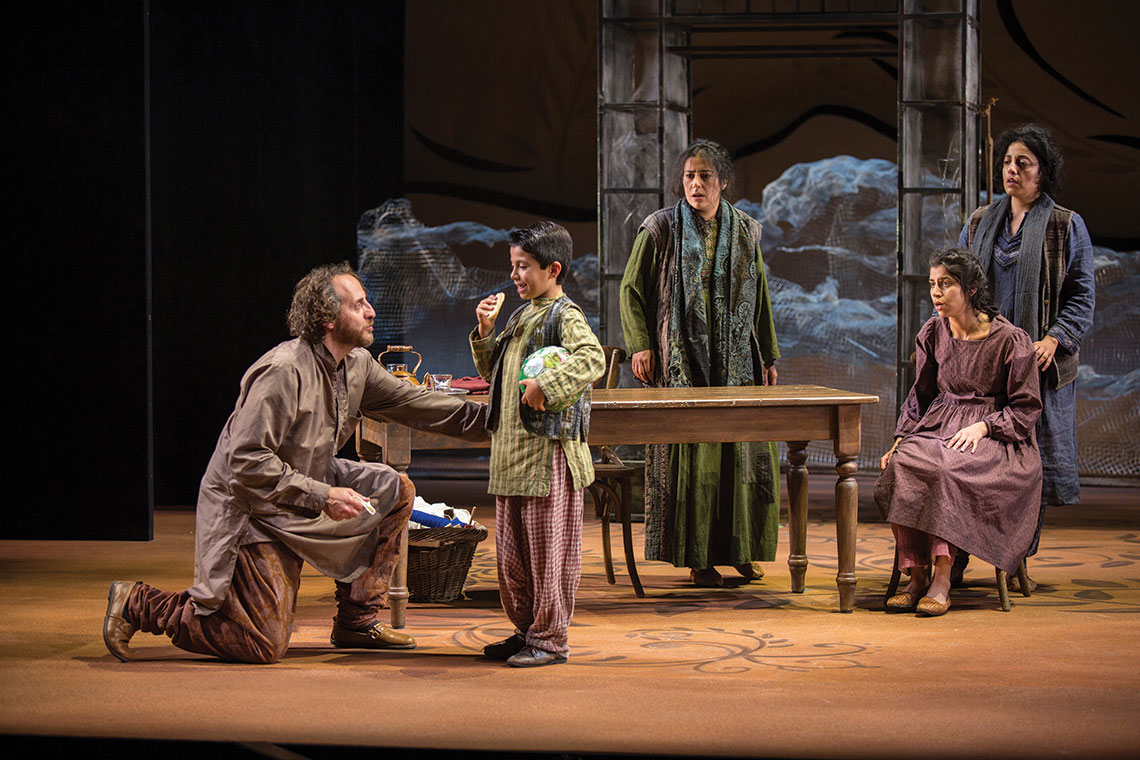
Carey Perloff, director of A Thousand Splendid Sunsat Seattle Repertory Theatre, fell in love with Khaled Hosseini’s novel—of the same name—as soon as she read it. She was directing Scorched by Wajdi Mouawad, a play set in the Middle East, at the time and turned to Hosseini’s novel as a piece of research and inspiration. She found the novel so richly drawn, so captivating, that she wanted to see the story on stage—as soon as possible. Perloff, then the artistic director of A.C.T. in San Francisco, met with Hosseini, who lives in the Bay Area, and asked if he would consider allowing A.C.T. to adapt his novel for the stage.
“For the most part, when we read news about Afghanistan it focuses on war and destruction,” Perloff said. “But A Thousand Splendid Suns is a gorgeous story of three generations of women over a twenty-five-year period, forging a very unlikely friendship and finding love—and even joy—in a whole new future, amidst political chaos.”
Once Hosseini agreed to the adaptation, Perloff set out to find the perfect playwright for the job. She was familiar with Ursula Rani Sarma’s writing through a play produced at A.C.T.’s Young Conservatory. Perloff was drawn to the poetry of Sarma’s playwriting.
“She has a stunning visual sense and an ability to convey extreme emotion without excess,” Perloff said. Sarma had experience writing adaptations, which was important to Perloff. But more importantly, she had a connection to Afghanistan and the characters Hosseini had created. “She knew the part of the world that Khaled was writing about, so her lens was personal, intimate and true.”
The play just finished a run at A.C.T. in San Francisco, part of a planned collaboration between A.C.T. and Seattle Repertory Theatre.
“I have always found Seattle audiences to be adventurous, engaged and generous,” Perloff said. “I also know that Seattle audiences are excited about work from diverse cultures and multiple points of view. This is such an unusual piece in every way, both in terms of form and content, so it’s exciting to think of it playing in a city with such a strong theatre tradition and a really committed public.”
Perloff was quick to add that this isn’t a literal adaptation of Khaled Hosseini’s novel. Rather, it’s a reimagining—utilizing all the tools of theatre at its disposal, including live scoring using found instruments like saws and bed springs to create the music of this world.
“Seattle is in for a treat!” Perloff said.
A Thousand Splendid Suns runs October 5 to November 10 at Seattle Repertory Theatre.
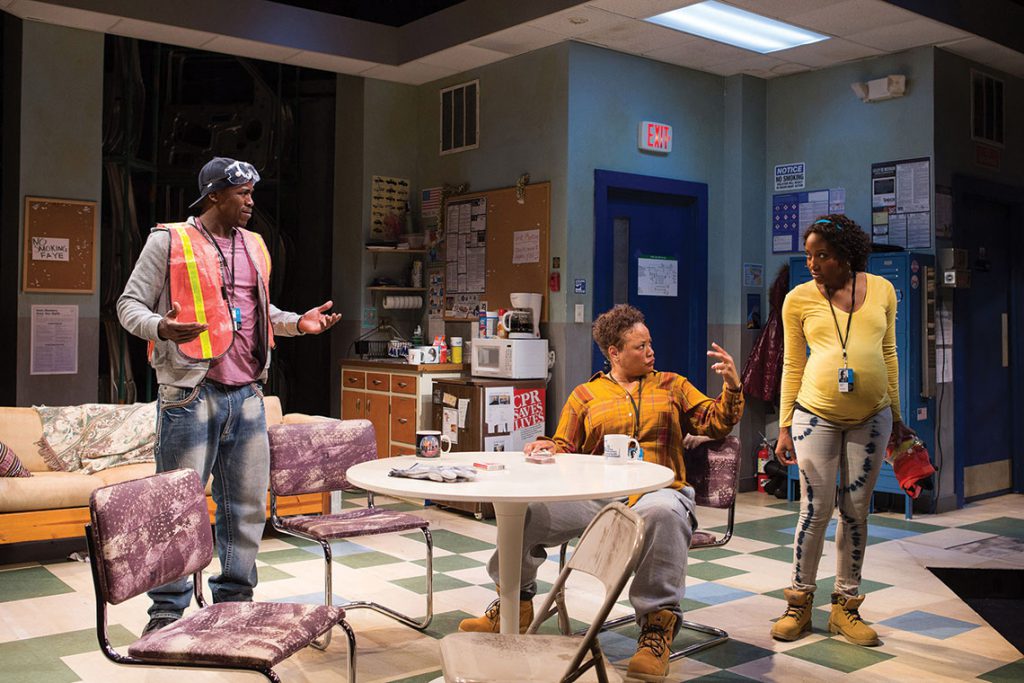
Jason Bowen, Caroline Stefanie Clay and Shannon Dorsey in Skeleton Crew at Studio Theatre
Dominique Morisseau’s Skeleton Crew, the final play in her three-play cycle “The Detroit Projects,” was the third most produced play in the United States last season. It’s also the play that ArtsWest has chosen to open their 2018–19 season—an ensemble drama about one of the last auto stamping plants in Detroit and the people who work there.
Jay O’Leary, the play’s director, describes Skeleton Crew as a play about survival and having power over your own soul.
“Skeleton Crew explores how we persevere,” O’Leary said. “The humans within this play are very good at what they do. They are funny. They are smart. They are passionate. The key to surviving and thriving in life in general is how we fight. Do we fight with the soul in mind or do we fight with bitterness and ugliness within our hearts? These questions directly apply to our socio-political climate right now. The more ugliness we give, the more ugliness we receive.”
O’Leary added that not only are these characters dealing with how to survive a potential job loss, they’re also navigating morality and whether their definition of right and wrong can change when their hopes, dreams, even their next meal, are all in jeopardy.
O’Leary discovered Morisseau’s plays at a point of frustration.
“I was screaming about how desperately we need playwrights who are female-identifying artists of color,” O’Leary said. “My friend tossed over “The Detroit Projects” and I was immediately in awe of this woman’s power and poetry. Dominique Morisseau’s words sing and pulsate and thump their rhythms into the marrow of your bones. That’s how she builds up the humans of her scripted worlds—from the universal dust that creates the sack of blood and water which cradle our souls.”
She added that the people in Morisseau’s plays are so rarely seen depicted on stage and screen as fully fleshed out human beings, rather than grotesque stereotypes.
“The fact that I, a young woman of color, get to direct this piece out here in very white Seattle means that the seats at the table are shifting,” O’Leary said. And she’s determined not only to take that seat, but to make the table bigger than it’s ever been. “Because who the hell wants to eat the same bland meal with the same exact people over and over again? I don’t, and neither do you.”
Skeleton Crew runs September 20 to October 14 at ArtsWest Playhouse and Gallery.
Kevin Kelly, Cheyenne Barton and Kiki Abba from Everything You Touch at Washington Ensemble Theatre
Maggie Rogers discovered Sheila Callaghan’s playwriting her senior year of high school. She was auditioning for college acting programs and fell in love with a monologue from Tumor.
“Sheila Callaghan’s work keeps popping up in my life as a constant reminder to take risks,” Rogers said. “Her work is exciting to me because she doesn’t apologize or write ‘pretty’ people. Her characters are raw, visceral and in your face.”
Years later, Rogers is directing the Northwest premiere of Everything You Touch at Washington Ensemble Theatre, her directing debut with the company.
“What I love so much about this play is that it is a love letter to every person who thought they were not enough,” Rogers said. “It bluntly tackles body image, food shaming, anxiety and the horrors of going home, in a way that deeply resonates with my dark sense of humor.”
And she knows it’s a play that Seattle needs right now.
“Seattle loves to pride itself on being politically correct, but I feel like fat shaming is the only widely accepted prejudice in the city, and the country for that matter,” Rogers said. “When I moved to Seattle I found that I was often the fattest person in the room and a hot commodity on the Tinder dating scene. Over the past three years I have grappled with being called fat—on public transit, by drunk dudes on Capitol Hill—and have investigated why it hurts so badly, even though I know a stranger’s opinion should not hold any weight.”
Samie Smith Detzer, Washington Ensemble Theatre’s artistic director, agrees that now is the perfect time to produce this play.
“This play is particularly potent when you consider that we have only begun to scratch the surface of understanding the degree to which our society believes that our bodies do not personally belong to us,” Detzer said. “This play explores how we can own our bodies. Plus, it’s funny! And witty! And raunchy! And sweet!”
In addition to being a prolific playwright and writer and executive producer on Shameless, Sheila Callaghan is also a founding member of The Kilroys, a group of female-identifying playwrights and producers dedicated to achieving gender parity on stage.
“The Kilroys have exposed a messed-up system that was essentially created to keep marginalized voices and identities out of the conversation,” Detzer said. “They took the idea that there are no great women or trans playwrights and completely struck it down. What an amazing gift they have given us, the ability to move on to the next important question: Why the f— aren’t these plays being produced?”
Everything You Touch runs September 21 to October 8 at 12th Avenue Arts.
Cast of Fade at Primary Stages
Washington Ensemble Theatre isn’t the only company in town working with a Kilroys founder. Tanya Saracho, perhaps best known as the showrunner of Vida, is also fighting for nationwide gender parity on stage. Her play Fade opens at Seattle Public Theatre this month.
“The Kilroys are such a valuable resource for me,” said Director Pilar O’Connell. “The celebration of female and female-identifying playwrights and folks of color is incredibly important.”
O’Connell first encountered Saracho’s work when she was in college. She was researching Latinx artists working nationally and stumbled upon Teatro Luna in Chicago, a theatre company Saracho co-founded with collaborator Coya Paz. O’Connell dug deeper, read-
ing every Saracho play she could find.
“I was drawn to Fade because I was looking for a smart show that gave me a different perspective of the Latinx experience,” O’Connell said. “This play addresses the idea of classism within your own culture, and although it is a Latinx story, I think it’s universally relatable.”
O’Connell added that she loves Saracho’s style—witty and realistic with just a hint of film magic. It’s a combination that’s incredibly appealing to actors.
Seattle Public Theatre’s co-artistic director, Annie Lareau, is looking forward to sharing this play with Seattle audiences.
“We were drawn to Fade because of the intersectional conversation it presents around class, culture and the price of ambition many women and women of color face in white and male dominated professions,” Lareau said. “Through this microcosm of a play, we see the larger struggles faced by women in the workplace—all while calling into question the world of television and how it perpetuates dangerous stereotypes and the responsibility we have for shifting them.”
Fade runs October 12 to November 4 at Seattle Public Theatre.
This fall—and throughout the entire 2018–19 theatre season—make a commitment to see more plays by female and non-binary playwrights. Dig into The Kilroys list, reward theatres that demonstrate gender parity on their stages. Because who knows? You may be part of a national shift, one that will make today’s 26% feel like ancient history.
When you think about the board that supports your favorite performing arts organization chances are you’re picturing an older sect—folks who are established in their careers, have saved for retirement and have money to spare. It’s a group, when imagined this way, that’s difficult to join and impossible to keep up with. But what if I were to tell you that performing arts boards come in all shapes and sizes, and that some are even actively recruiting young people into their fold? I had the pleasure of speaking with members of the BRAVO! Council at Seattle Opera, Young Patrons Circle at Pacific Northwest Ballet and New Guard at TeenTix—three organizations that are not only recruiting Millennial and Generation Z board members, they’re also training the next generation of arts advocates.
In 1996, Seattle Opera founded BRAVO!, a young professionals group aimed at audience members ages 21 to 39. For an annual fee of $79, BRAVO! members receive discounted opera tickets, invites to year-round social events and access to an exclusive intermission lounge, complete with complimentary wine and coffee. Now in its twenty-second year, BRAVO! is one of the largest organizations of its kind nationwide.
But BRAVO! would be nowhere without its council members. Nine dedicated young professionals run this leadership board with the mission to make opera an integral and rewarding part of their peers’ lives.
BRAVO! Council member Evan Bennett has been an opera fan nearly half his life. The 32-year-old joined BRAVO! a year ago, after leaving a position in the opera’s community engagement department.
“The first thing I did once I left my position was to join BRAVO! as a member,” Bennett said. This year marks his first season as a BRAVO! Council member. “I genuinely love the art form and joining Council is a meaningful way for me to help get people my age involved in a centuries-old tradition.”
It’s an art form that Bennett and the rest of the BRAVO! Council are passionate about—one that still resonates with audiences today.
“You certainly don’t need a music degree to be a part of this group,” Bennett joked, nodding to his own background in music performance and as an employee of Seattle Opera. “Everyone on the council has come to opera in different ways. This diversity of experience has been an excellent catalyst for innovation around how to get people in their twenties and thirties involved in the art form.”
Young professionals groups are cropping up at performing arts organizations across the country, but Seattle Opera credits the vitality of BRAVO! to its council members.
“… folks under 40 years old are not only a growing demographic in Seattle Opera audiences but also a growing donor base.”
“BRAVO! has over 800 members and almost all of them are season ticket holders,” said Kristina Murti, director of marketing and communications at Seattle Opera. Murti credits council members like Bennett and Eoin Hudson, BRAVO! Council president, for this conversion rate. “Our council is very active in programming events and bringing in their own professional and personal networks to try out opera.”
The numbers don’t lie. Hudson joined the leadership council in 2013 and since that time BRAVO! membership has more than doubled—it had less than 400 members when he joined.
“In that time there’s been a lot of change—at the opera and in Seattle,” Hudson said. The change he’s most excited about is the fact that folks under 40 years old are not only a growing demographic in Seattle Opera audiences but also a growing donor base. “It’s exciting to see the art form being embraced by my generation and watching the preconceptions about opera shift.”
When I asked Hudson which opera he was most looking forward to this season, he named Benjamin Britten’s The Turn of the Screw. The ghost story will be performed in October, just in time for Halloween.
Seattle Opera patrons interested in joining BRAVO! or the BRAVO! Council can learn more at seattleopera.org.
Seattle Opera isn’t the only arts organization prompting their young audience members to get involved in the world of non-profit board leadership. For $60 a year, Pacific Northwest Ballet audience members ages 21 to 39 can enroll in the Young Patrons Circle, a social and educational group that offers ticket discounts, ballet after–parties and the collective sponsorship of an original piece of choreography at Pacific Northwest Ballet’s annual NEXT STEP performance.
Young Patrons Circle’s Night with a Choreographer fundraising event to benefit PNB’s NEXT STEP program
A fifteen-member board of directors serves as leadership liaisons for the Young Patrons Circle with the mission of supporting and engaging this new generation of ballet audiences.
Meeka Charles was wrapping up her first year as board chair when we spoke. In addition to growing the Pacific Northwest Ballet audience, Charles has worked with the board to develop the ballet’s marketing and social media campaigns. Ballet has been a part of her life for over twenty-five years.
“I grew up overseas and moved often,” Charles said. “Attending ballet was something my mother and I did together no matter where we lived. When I moved to Seattle, buying ballet tickets was one of the first things I did. For me, attending the ballet makes a new place feel like home.”
Charles added that she loves engaging her peers in ballet. It’s the reason she joined the board.
Pacific Northwest Ballet is personal for Board Member Emily J. Yamada too. The Young Patrons Circle Board of Directors enjoys a rotating leadership structure and Yamada is preparing to begin her first year as chair. But it won’t be her first time in the Pacific Northwest Ballet spotlight.
“I was a ballet student and amateur dancer from early childhood into early adulthood,” Yamada said, sharing that she studied at Pacific Northwest Ballet for six of those years. “I got to perform in The Nutcracker, which I loved. I’ve always admired the incredible company dancers.”
In the years since her Nutcracker performance, Yamada has lived all over the world and has always made ballet attendance a priority.
“I can see why Pacific Northwest Ballet has such a reputation for excellence in the global dance community,” Yamada shared. “It was an easy decision to become a subscriber when I moved back to Seattle.”
During her upcoming year as chair of the board of directors, Yamada is hoping to expand Young Patrons Circle’s relationship with not only young patrons, but also other young professionals groups across Seattle. And, of course, continue the board’s work hosting events tailored to the interests and needs of Young Patrons Circle members.
Pacific Northwest Ballet audience members interested in joining Young Patrons Circle and its corresponding board of directors can learn more at www.pnb.org.
Thirteen– to nineteen–year–olds across Seattle and Tacoma know that TeenTix is the performing arts organization to join. For the duration of their teenage years, TeenTix members are eligible for $5 day-of tickets to arts organizations across the region. The organization is supported by a passionate staff and two boards—an advisory council and The New Guard Leadership Board, an eight-member board made up entirely of TeenTix members.
Neha Gupta joined the New Guard because she wanted to strengthen her leadership and public speaking skills. She fell in love with TeenTix because it gave her the opportunity to see theatre and attend museums without worrying about each organization’s price point. She still loves seeing as much theatre as she can, but it’s the people that make Gupta’s work worthwhile.
“The New Guard Leadership Board is the home of some of the most talented, inspirational and kind-hearted individuals I have ever met,” Gupta said. She identifies as reliable, but shy. “The Leadership Board, as cheesy as it sounds, forced me to break out of my shell.”
This season, Gupta is taking over as the New Guard Director of Partnerships, working with TeenTix’s arts partners to organize events and strengthen their bond with the teen community.
Isabel Schmidt joined the New Guard Leadership Board because she was eager to connect with arts lovers in her peer group. Schmidt became a member of TeenTix as soon as she was eligible but took advantage of TeenTix’s 2-for-$10 days as her friends’ plus one in the years leading up to her thirteenth birthday. She’s going on her fourth year as a member of the New Guard, this time as the board’s president.
“My favorite thing I’ve done on the New Guard has been giving advice to arts organizations in the city who are interested in highlighting youth voices and want advice on how to reach this important group of audience members,” Schmidt said. “I appreciate being valued as an arts-goer. As we say at TeenTix, teens know what teens want.”
Schmidt also loves having thought–provoking conversations with her peers and TeenTix’s arts partners about what arts access really means. When she’s not serving on the New Guard—and going to high school—Schmidt enjoys playing cello. She cited Seattle Symphony’s upcoming Octave 9 space, an immersive performance and community space in the heart of downtown Seattle, as a place to watch.
“I’m looking forward to Seattle Opera’s coming season,” Schmidt said. “There are a lot of impressive shows coming up!”
Watch out, BRAVO! Council, Isabel Schmidt might be coming for your job.
TeenTix members interested in joining The New Guard Leadership Board can learn more at teentix.org.
Whether you’re a teen, a twenty-something or solidly in your thirties, chances are there’s a place for you on a performing arts board here in Seattle. The first step is to show up. We’ll let you take it from there.
Danielle Mohlman is a nationally produced feminist playwright based in Seattle. Her play Nexus is among the 2015 Honorable Mentions on The Kilroys list. She is an alumnus of the inaugural class of Playwrights’ Arena at Arena Stage and a member of the 2018 Umbrella Project Writers Group.
Our Favorite Ticket Deals for Folks Under 40
Not ready to join one of the boards profiled? There are still plenty of opportunities to see theatre, dance and opera at an affordable price. Here are some of our favorites.
Club 20/30
Club 20/30 is Seattle Repertory Theatre’s free program for audience members in their 20s and 30s. Single tickets at Seattle Repertory Theatre start at $17, but Club 20/30 members are eligible for seat upgrades, happy hour pricing at the theatre’s bar and free ticket exchanges.
The Pointe
The Pointe is Pacific Northwest Ballet’s email list for audience members ages 20 to 40. Throughout the year, The Pointe sends out discounts ranging from $15 balcony seats to 50% off any seat in McCaw Hall.
TeenTix
If you’re 13 to 19 years old and live in the greater Puget Sound area, you’re eligible for TeenTix. Members are eligible for $5 day-of-show tickets at partner organizations across Seattle and Tacoma—including Taproot Theatre, ACT Theatre, Book-It Repertory Theatre, Seattle Repertory Theatre and many more.
MySymphony
MySymphony is Seattle Symphony’s free program for patrons ages 21 to 39. Members are eligible for $25 tickets to performances at Benaroya Hall.
Playwright Julie Taiwo Oni explores the difficult, yet necessary task of casting actors who authentically represent characters written and the effect this representation has on marginalized identities.
How do you cast authentically when there is not a single actor of a certain identity to be found within your community? If my mission as a playwright is to share stories of the underrepresented, then how can I cast an actor who lacks the marginalized identity my script requires? This obstacle is an important element of the current fight for fairness in casting, and I encountered it full-force on my own journey to find a Black teenage male actor with albinism.
As a Nigerian-American and a storyteller, I am in constant conflict between heightened awareness of widespread misconceptions of non-Western cultures (my global side) and sheer shock and horror at the encountering of some ritual practices (the good ole American in me). When I first heard about the persecution of PWAs (person with albinism) in Africa from my father a few years back, I thought it must be an ancient myth; I was mistaken. In fact, even today, Tanzania has one of the highest global rates of people with albinism, and they are frequently attacked and killed for the sale of their bodies to witch doctors for good luck potions.
To dramatize this unfortunate story, I wrote Chisel, a two-character play about a Black American teen with albinism and his interaction with a biracial Tanzanian art student. Sal, my teen protagonist, is in conflict with his albinism because he doesn’t feel that he’s accepted as a Black Lives Matter activist due to his lacking pigmentation. He therefore engages in an aggressive activity that lands him in a juvenile detention center. Alice—his counter—struggles with being mixed race in a culture that often resents non-native citizens. I finished a draft of the play and placed it aside a few years ago, mainly because I had no idea who would perform either role, especially that of Sal.
The representation struggle has become all too familiar these days, from the rampant cultural appropriation of hip-hop, to Katy Perry’s kimonos and dreadlocks, to the whitewashing and gender identity-crossing of Hollywood via the likes of Scarlett Johansson. Yet an important part of the conversation is the challenge of representing marginalized identities when privileged bodies are so much more accessible on casting couches. Constant rejection and appropriation discourages under-represented actors, making it even more difficult to get them into the room. The unfortunate result is that more privileged actors get more opportunities to hone their skills in all levels of theatre.
Sometime into my own representation journey, my friend Bri, who was set to perform the role of Chisel’s Alice for a reading, sat down to help me brainstorm possible actors to play the PWA male character Sal. We were at a loss. Would an audience be able to gather the full weight of the story—centered on the identity of a young man with albinism—if the actor playing the role did not have this condition? It felt so important to see him. We decided that the absolute minimum at that moment was to find somebody who would understand Sal’s journey intellectually and be willing to engage in conversation about the PWA plight. We decided to cast Tom, a TV actor and friend. The reading went well, but the question of course came up: was this play castable?
Is it worth the ongoing and discouraging search for an actor of a marginalized identity when there are so many of privilege willing to play the role?
I believe it is.
So, I persisted. Everywhere I went, to anyone I met, I mentioned Chisel and my struggle to find an actor. I spoke of the PWA attacks in my classes on culture. I emailed modeling and casting agencies. I asked my acting students for recommendations. The result was a sharing and tagging anytime a friend or colleague saw a story on albinism and a collection of books and magazine articles sent by friends, yet still no Sal.
Perhaps six months after the reading, I got a message from Tom: “I see the Tanzanian albino girls we talked about in rehearsals.” The girls were Tindi and Bibiana Mashamba, sisters who were in Los Angeles on refuge after Bibiana had been attacked and lost a leg and fingers. They were at his local lunch spot. My heart jumped with joy. “Well talk to them!” I waited impatiently. Hours later, he told me he’d lacked the nerve to speak to them: “I didn’t know what to say. Sorry.”
And here we encountered the next obstacle on our mission: the hypocrisy of drawing attention to albinism when the heart of Chisel’s story is about a desire for acceptance instead of social isolation. If I were to pass a Black male with albinism that looked like a possible Sal, what would I say to him, “You’re a PWA, I need you”? Fortunately, Tom saw them again a few months later and asked if they would be interested in meeting up with the Chisel team. They were overjoyed (probably because they recognized him from TV, but I’ll take it). Their host and co-founder of African Millennium Foundation, Malena Ruth, arranged for us to all have tea. During our meeting, they told the story of Bibiana’s attack, and we were all horrified by their trauma yet inspired by these two warriors.
If only these girls had been actors.
Despite these frequent roadblocks, I firmly believe that the theatre community can work together to hold each other up in the mission toward authentic casting. I think most of us want representation; the challenge is the grit that it requires.
A year or two after the initial Chisel reading, with a second reading under our belt but still no PWA actor for Sal, a new theatre colleague sent me contact information for a Black actress with albinism she’d heard about in Chicago. I emailed her a long, detailed, impassioned letter about my journey and how excited I was to be connected with her. I didn’t expect a reply. Ten minutes later, I got one. She was as excited as I was to be in touch.
I sent her Chisel and thought that perhaps I could find a way to cast her in the male role or adjust the script’s gender dynamics. She gave me the most heart-felt and thorough script feedback I had received, noting the ringing-true to her experience and sharing questions that came up. Casting her proved an impossibility because of the story’s essential commentary on Black male experience, but I promised to keep in touch and update her on the process. We made plans to collaborate in the future, and I asked if she knew any male PWA actors.
She did!
This is it, I said to myself, crafting another heartfelt email, this time, at long last, to a Black male actor with albinism. I got no reply. I was back to square one, even with some strong and inspiring ladies in my court.
A few weeks later, I was scrolling through my Instagram when I saw a post from @albinism_beautiful, a group I’d been following for years. It hit me that the members of this particular community might be worth approaching. The second I passed the profile of Jordan White, an eighteen-year-old young man from Atlanta, I knew I’d found my Sal. He was a Black teenage male with albinism with the description “Actor/Model.” I didn’t wait this time. I messaged him immediately and heard back within an hour or so. We began an ongoing dialogue about my play.
It turned out one of Jordan’s most prominent performances was tied to another PWA actor’s casting in a TV series shot in his city. Marginalized groups do have this profound ability to hold each other up, but we need to see that others respect our stories as well by pushing forth characters that are multidimensional—not archetypal. And we need the space to bring them to life ourselves. This is the key to representation.
On June 14, 2018, Jordan flew to LA for the first time to perform in a reading of Chisel at Pepperdine University, where I work. The Department of Humanities and Teacher Education generously hosted him for Albinism Awareness Day. After months of talking through the script and planning, we finally met in person.
I was shocked by this young man. He reminded me of the importance of life experience and observation to breathe humanity into a story. Jordan was an articulate, enthusiastic, hilarious and confident guy. When he entered the theatre, fresh off a long flight (and the first of his life), he greeted us all with handshakes and hugs, pumped and ready. I had anticipated—after all these years of studying the oppression of PWA—to encounter a shy and self-conscious young man who would need time to warm up to us; he was just the opposite.
“I like to be seen,” he said as we drove down Pacific Coast Highway after that first rehearsal. “I used to be mad all the time and hate the stares, but now I just smile.”
In a world of rampant cultural and identity appropriation, we have a responsibility as practitioners of live performance to allow the audience to experience another’s story truthfully. The joy of encountering an underrepresented actor onstage playing a character of his or her actual identity is too powerful to forego. The more marginalized actors see themselves represented authentically, the more they will start to fill our casting couches. The maze will dwindle.
Julie Taiwo Oni is a Nigerian-American playwright with an interest in exploring the African diaspora through narrative. Recent plays include nat&EM, Bunk, Denim, Black-Proof, and Chisel—a story that displays the oppression of people with albinism in Tanzania. Oni is Visiting Assistant Professor of English at Pepperdine University. julietaiwooni.com
This piece, Casting an Actor with Albinism: The Importance of Authenticity on Stage by Julie Taiwo Oni was originally published on HowlRound on August 2, 2018.
Shakespeare, chamber music, puppetry…no matter your preference, there’s a way to soak up the arts and the sun this summer. Danielle Mohlman previews Seattle’s arts al fresco.
Living in Seattle means living for the summer. Between hiking, biking and visits to the city’s incredible beaches and lakes, it’s easy to fill every evening and weekend with glorious outdoor activities. But while you’re solidifying your summer schedule, don’t forget to make room for the arts.
Several intrepid Seattle arts organizations program their summers around the great outdoors, taking advantage of public spaces to bring art to the entire city. The Seattle Art Museum programs a biweekly concert and arts series at the Olympic Sculpture Park in Belltown, aptly named Summer at SAM. GreenStage produces the Seattle Outdoor Theater Festival at Volunteer Park in Capitol Hill each summer, a festival that boasts sixteen performances on three stages across the park. And the Seattle Art Fair takes over the CenturyLink Field Event Center every August, attracting local and national art aficionados alike.
I had the opportunity to speak with the artists behind three of our city’s most anticipated outdoor performances: Wooden O’s productions of King Learand The Merry Wives of Windsor, Seattle Chamber Music Society’s Chamber Music in the Park and Common Area Maintenance’s inaugural puppetry production. Don’t forget the sunscreen!
George Mount, artistic director of Seattle Shakespeare Company, started Wooden O twenty-five years ago as a way to reconnect with his Pacific Northwest roots. The Mercer Island native noticed that the island’s annual summer festival, Mostly Music in the Park, was entirely music in the park. Eager to bring outdoor performance to his hometown, Mount solicited the Arts Council of Mercer Island for a grant to perform Shakespeare at the Luther Burbank Park Amphitheatre—just three nights of Much Ado About Nothing to justify the “mostly” in the festival’s title. Twenty-five years later, Wooden O has expanded its scope to include parks across the Puget Sound region. But one thing remains the same all these years later: the festival opens and closes at Mercer Island’s Luther Burbank Park Amphitheatre.
David Pichette and Meme Garcia in ’King Lear.’ Courtesy of Seattle Shakespeare Co.
I had the
opportunity to speak with George Mount about the significance of Wooden O’s
twenty-five year anniversary and his role as director of this summer’s King
Lear.
“We’ve never done it outside,” Mount said of Shakespeare’s
tragedy. “It’s a monster of a play and an audacious choice to present in the
summer under two hours. But Wooden O was pretty much started as an audacious
endeavor.”
Mount
pointed out that King Lear’s cynicism makes it the perfect play for 2018.
“So many of the people act out of venal self-interest and casual
disregard of others around them,” Mount said. “I worry about that behavior when
I look at our politics, our consumerism, digital isolation, tribal isolation
and ideological insulation.”
Actor Vanessa
Miller’s Wooden O connection is longer than the festival’s history. Miller
attended Mercer Island High School with George Mount and when he asked her to
return to Washington to play Beatrice in Much Ado About Nothing, the
decision was simple.
“I really think that free theatre is important,” Miller said.
“When I was a kid, I remember seeing some park shows produced by Empty Space.
Watching those shows changed my life, inspired me to follow a path into
theatre. It only takes one beautiful summer evening in front of a happy
crowd of people eating picnic dinners, laughing or listening to the beautiful
poetry, to get hooked for life.”
She loves the community aspect of Wooden O and the way the actors
truly connect with the audience. And she’s always aware that she could be part
of an audience member’s first Shakespeare experience.
“Our job as actors is to be very specific with the language and
the relationships,” Miller said. “If we know what we’re saying, and we act with
intention, then it clicks for the audience too. If we, as actors, are bluffing
it, or generalizing, then it’s really hard for the audience. Plus, Wooden O
shows are very physical and lively. It’s not an academic experience.”
Annie Lareau, Charles Leggett and Eleanor Moseley in ‘The Merry Wives of Windsor.’ Courtesy of Seattle Shakespeare Co.
Reginald Andre Jackson made his Wooden O debut eighteen years ago and
says that there’s nothing like performing Shakespeare outdoors. He loves seeing
audience members reclined on a blanket, enjoying a bottle of wine and a cheese
plate or sending their kids off to play as they enjoy the performance.
“Every
now and again, nature will come in and lift the play in unexpected ways,”
Jackson said. “We took Macbeth to Walla Walla. One night during dusk, bats began to swoop
and circle in a feeding frenzy near the trees that surround the stage. Wooden O
has hired some pretty great designers. But nature—she is queen.”
George Mount left me with some words of advice for audience
members who are hesitant to give Shakespeare a try.
“Wooden O was founded on the conviction that Shakespeare’s plays
are popular entertainment,” Mount said. “That’s been a driving force in how we
approach the plays. Shakespeare’s plays entertain the whole person. The
language challenges the brain. The romance lifts the heart. The pathos hits the
gut.”
Mount added that even if a play isn’t to an audience member’s
liking, they still spent two hours in a gorgeous Seattle park, with a picnic
dinner, surrounded by friends and family. Who could ask for a more perfect
evening?
King Lear and The Merry Wives of Windsor run July 12 to August 12 in parks throughout the Puget Sound region.
On a walk through Capitol Hill’s gorgeous Volunteer Park one
summer, James Ehnes, director of the Seattle Chamber Music Society (SCMS), and
his wife Kate, came across a small stage perfectly sized for a chamber
orchestra. She suggested that Ehnes program a summer concert in the space and
Chamber Music in the Park was born.
“Bringing this music, for free, into Seattle parks has been a
wonderful way to spread this beautiful music to listeners from all over the
city who might not have the chance to hear us downtown at Benaroya Hall,” Ehnes
said. “It’s tremendously gratifying to see all the families and young people
that attend these events in the parks.”
From left: James Ehnes, Stephen Rose, Jordan Anderson, Edward Arron and Jonathan Vinocour. Photo by Tom Mark Photography
Last summer, SCMS introduced a community play-along component to
Chamber Music in the Park, inviting string players from the Puget Sound region
to play alongside SCMS musicians.
“Everyone had a really fantastic time,” Ehnes said, “and it was
very meaningful and moving to see so many cross-sections of Seattle represented
in the group—people of different genders, ethnicities, ages and backgrounds,
all sharing in the joy of music.”
Violinist Amy Schwartz Moretti loves performing in any venue, but
whenever she performs outdoors she feels a deep connection with the world and
the lives around her.
“One of my favorite memories of a Volunteer Park concert was
during a performance of the Dvorak Viola Sextet,” she shared. “I had a moment
when I wasn’t playing for a few measures where I was so taken by the beauty of
the scenery and music-making. I saw an airplane flying over carrying people to
their various destinations, heard children laughing and dancing, and just had a
general sense of all being right with the world.”
Concertgoers get into the performance. Photo by Tom Mark Photography
Violinist Erin Keefe also loves performing at Volunteer Park
because the setting is more casual than the orchestra’s Benaroya Hall
performances.
“The nice thing about it is that parents can bring their children
without worrying about upsetting anyone if they get a little restless,” Keefe
said. “People can enjoy the weather and maybe a picnic while they listen to us
play. It’s very fun for the performers and it’s something I look forward to
every summer.”
When Alexander Mostov joined Common Area Maintenance (CAM), a
community gallery and generative studio in Belltown, he was looking for an
inspiring workspace where he could interact with fellow creatives. In the years
since, CAM has provided much more than that community. It’s become a space
where Mostov, an artist who works primarily in two-dimensional gouache and
computer illustration, can challenge his work and experiment with new forms.
Which is how he came up with the idea to produce a puppet show that audience
members can view from the sidewalk.
The puppetry performance will be the first of its kind in this
space, but one that has the potential to become an annual summer tradition.
“I saw a traditional puppet show while I was studying abroad in
Barcelona and was totally inspired,” Mostov shared. “I love magic realism and
the idea of injecting fantasy into one’s everyday life. There’s something about
puppetry that lends itself to that everyday fantasy.”
When I asked him what he was looking forward to the most about
this collaborative art form, Mostov shared that he’s excited about merging his
own visual style with the aesthetics of artists who work in other mediums. For
example, how will an artist who works primarily in sound enhance the script?
When Mostov and I spoke in the spring, he was in the process of
assembling a team and writing the script, in collaboration with two other CAM
artists.
“We’re playing with the idea of adapting a whimsical picture book
script I wrote last year,” Mostov said. “We’re planning on adding adult-level
humor, political references and sarcasm.”
Sounds like we’re in for a treat.
Common Area Maintenance’s puppetry performance will run May through June at their space in Belltown.
So, pack a picnic and a wide-brimmed hat. Because whether you’re a
puppetry fan, a Shakespeare fiend or an orchestra aficionado, there’s a
performance for everyone this summer in Seattle.
Danielle Mohlman is a Seattle-based playwright and arts journalist. She’s a frequent contributor to Encore, where she’s written about everything from the intersection of sports and theatre to the landscape of sensory-friendly performances. Danielle’s work can also be found in American Theatre, The Dramatist and on the Quirk Books blog.
Danielle Mohlman examines the women laying claim to sports via the theatre, and their inspiration for doing so.
My dad was a star athlete in high school. Letterman jacket, full page in the yearbook, the whole nine yards. He was a water polo goalie and to this day the number he wore on his swim cap – 22 – is significant for both him and my mom. Every “22” they’ve ever seen in the wild has been photographed and framed. It’s the date of their wedding anniversary. And it was etched into the pin cushion my mom used in home economics, silver-headed pins forming the curves of each number. My parents met in high school. She was a cheerleader, full of school spirit and there for every water polo game and swim meet. Pom poms in hand, she watched him pull through the water, breaking records in freestyle and backstroke.
As a teenager, I lived for the
hours between the end of school and the beginning of sunset. I’d flash my
completed homework at my mom and then run down the street to my neighbor
Gilbert’s house. If we could assemble a team of neighborhood kids, we’d play
touch football in the street, yelling “Car!” every time someone’s parent got
home from work. We had more timeouts than any regulation game and, it seemed,
just as many injuries. If we couldn’t get a team together, I’d strap on my
roller blades and speed up and down the sidewalk, jumping off our homemade
ramp. If he was patient and I was calm, Gilbert would continue his lifelong
quest – teaching me how to ollie on his skateboard. I was never any good, but I
was relentless. Still am. I’d fall and get back up again, bloody palms and all.
Despite everything, I’m the furthest thing from an athlete. But sports are starting
to creep their way into my plays – and I’m not the only one.
Spend enough time on the field and you’ll come away with blood. But the blood that opens Sarah DeLappe’s The Wolves isn’t skinned knees or thousands of burst blood vessels congealing into a purple bruise. It’s menstrual blood – in all its coagulated glory. The Wolves’ thirst for blood isn’t quenched by the jealousy-fueled competition these young soccer players seem to thrive on. Their drug instead, is frantic whispers about a sheltered teammate who chooses pads over tampons. And jokes about pregnancy that quickly become unchecked abortion rumors. These girls are sixteen and it shows.
Interspersed in this dialogue
about uterine lining and inefficient feminine products is a discussion about
former Prime Minister of Cambodia, Nuon Chea, who at 90 years old is giving
testimony about the Khmer Rouge genocide. The audience is momentarily faced
with an odd juxtaposition: the murder of hundreds of thousands of Cambodian
citizens and the torture of a particularly heavy period. Offstage, another
soccer team warms up – a team just as driven, just as talented, just as
vicious.
Production photo from the Studio Theatre production of ‘The Wolves.’ Photo by Teresa Wood
Sarah DeLappe’s dialogue
in The Wolves perfectly intones a teenage and athletic
vocabulary. These girls turn around crude language as though they just learned
how to form the syllables with their mouths. They litter their sentences with
expletives, gossiping about a “sweet old lady” with only one breast, claiming
that the winter air is “colder than a witch’s” – well, you can finish the rest.
As the Wolves warm up for their games, they name-check each other by jersey
number and masculine epithets like “man” and “dude,” as though their feminine
first names betray the very nature of their competitive spirit. It’s reminiscent
of every male dominated sport out there. They don’t want to be weak, so instead
they’re “man” and “dude.” It’s easier that way. It’s armor.
In my own play, Dust,
I also dive into the ferocity of teenage girls. My athletes are a high school
swim team, condemned to an unfinished life – the entire play lives in the
memory of the young man who killed every one of them, but even in his distorted
lens they’re magnificent. The swim team’s captain, Wendy, is the queer object
of this vicious man’s attention. Everyone else was just in the wrong place at
the wrong time. Even in death, they work together as a team, shifting the
perspective memory by memory.
When I told my parents about
this play they were surprised I’d chosen an athletic path. Those football games
on the street went on for years and at one point I actually took a chance on
organized sports, playing two seasons of softball. But their perception of me
has always been divorced from the athletics they know and love. They describe
my upbringing as musical – a decade of clarinet and nearly the same amount of
dance classes. Today, I lack grace. It’s like my body has forgotten how to
move. But as a teenager, I’d show up at my community center on Tuesday nights,
poised to learn another thirty seconds of choreography. I wanted so badly to
dance to Tchaikovsky. Instead, my teacher brought in the Runaway Bride soundtrack.
To this day I can’t hear Shawn Colvin without thinking about those long
mirrors, the ballet barre, and the smell of high school girls learning to
dance. As I raised my hands high above my head, blood dried on my palms. My
mind was on the asphalt road of our makeshift football field.
All those years of dance make
their way into Dust as well. In an effort to communicate with
the audience that something is very wrong, the play never stops moving. Dance
is an integral part of the play’s vocabulary, conveying everything from an
overactive imagination to a mass murder. This play lives in a zone where words
are not sufficient on their own. It’s the unsquareable moment of my bloody
palms in a ballet class. It may look delicate at first glance, but upon closer
inspection it’s everything but.
Lauren Yee’s father, Larry Yee, blocking a shot. Photo from excerpt of ‘The Great Leap’ on New Play Exchange, courtesy of the playwright
While I was finding inspiration for Dust in my dad’s legendary tales about his high school swim records, Lauren Yee was looking to her own father’s obsession with basketball as she started writing The Great Leap. In her author’s note, Yee writes that her father played basketball all day and all night growing up. As a 6’1” Chinatown kid from San Francisco’s projects, he dominated asphalt courts and recreation center floors. He was never going to go pro – he knew that even then. But he was good. He was really good.
Lauren Yee’s father first
visited China in the 1980s, playing a series of exhibition games against
China’s best teams. Yee says that The Great Leap isn’t her
father’s story – his American team was defeated too many times to count. But
it’s a story like her father’s. In The Great Leap, Manford, a rec
center-trained teenager from Chinatown, busts into a basketball practice
uninvited, barreling at the team’s point guard, twisting his ankle in the
process. With a newly injured player and a life changing exhibition game
against Beijing University on the horizon, the University of San Francisco
coach, Saul, is livid. In the moment before the play begins, Saul tells Manford
that he has thirty seconds to explain why he was “sh—ing all over his
practice” before he calls security. While other players might leave
immediately, running through the door they came in, Manford takes full
advantage of the thirty seconds.
“I will win you games. I will
score you points. I will make you layups. I will shoot from half court, full
court. I will shoot over whatever, whenever, whoever is getting in my way. I am
quick. I am relentless. I am the most relentless person you have ever met, and
if you’ve met someone more relentless than me, tell me. Tell me and I will meet
them, and I will find a way to become even more relentless than them.”
Despite his short stature and
brash introduction, Manford makes his way onto the University of San Francisco
team. Because he’s right. He is relentless. But he’s also undeniably
talented.
We live in a city that pulses
with Seahawks spirit, even in the off season. But March through May, a new
cavalry of athletes is taking over. Manford and the University of San Francisco
are commanding the Leo K. Theatre at Seattle Rep. Wendy and the Mermaids are
taking over Youth Theatre Northwest, aptly surrounded by water on Mercer
Island. And the Wolves are running drills up and down the Allen Theatre at ACT.
It’s an athletic embarrassment of riches, helmed by three female playwrights
who aren’t afraid to walk away with a scraped knee and a couple of bruises. As
every coach we’ve ever encountered has said, “Rub some dirt on it and walk it
off.”
The Wolves by Sarah DeLappe runs at ACT from April 20 to May 13.
A workshop production of Dust by Danielle Mohlman runs at Youth Theatre Northwest from May 11 to 12.
Danielle Mohlman is a Seattle-based playwright and arts journalist. She’s a frequent contributor to Encore, where she’s written about everything from the intersection of sports and theatre to the landscape of sensory-friendly performances. Danielle’s work can also be found in American Theatre, The Dramatist and on the Quirk Books blog.
Tell your friends you’re going to a play and chances are
their minds will unconsciously jump to William Shakespeare, the balcony scene
in Romeo and Juliet, the pained “Et tu, Brute?” from Julius
Caesar, Lady Macbeth scrubbing her hands of blood. Shakespeare is part of
our cultural landscape. And soon, permutations of his work will be all over
Seattle.
This Spring, nearly twenty-five arts organizations across the city are participating in Seattle Celebrates Shakespeare Festival. I was fortunate enough to speak with artists involved with four of the festival’s productions: Kiss Me, Kate at the 5th Avenue Theatre, Mac Beth at Seattle Repertory Theatre, 12 Ophelias (a play with broken songs) at the University of Washington, and Beatrice & Benedict at the Seattle Opera. Each production promises a thought-provoking and imaginative take on Shakespeare’s original text. But these four productions couldn’t be more different.
Alan Paul recently directed Kiss Me,
Kate, a musical adaptation of Shakespeare’s Taming of the Shrew,
at the Shakespeare Theatre in Washington, D.C., where he also serves as
associate artistic director. The musical, which ran from November 2015 to
January 2016, attracted the attention of David Armstrong, 5th Avenue Theatre’s
former executive producer and artistic director. Armstrong flew to Washington,
D.C. to see the production, and later asked Paul to revive the production in
Seattle, for the 5th Avenue Theatre’s contribution to Seattle Celebrates
Shakespeare.
“What I am most excited about is the chance to use many of
the great Seattle-based actors in the production,” Paul shared. “I was knocked
out by the performers I met at our auditions and I know they will bring
something special to the show.”
Ben Davis and Cayman Ilika Cayman in ‘Kiss Me, Kate.’ Photo by Tracy Martin
Because Kiss Me, Kate centers on workplace
sexual indiscretion in the entertainment industry, albeit through a 1948 lens,
the conversation turned to the recent unmasking of pervasive sexual harassment
in the film industry and the wider impacts of the #MeToo movement.
“It’s an interesting moment to direct a show that centers
around gender politics so frankly and openly,” Paul said. “Kiss Me, Kate is
really about how women and men relate to each other—and for all its comic
moments, it also has some deep insights. I’m ready to take a new look at Kate
and Petruchio, and to re-examine their relationship for 2018.”
The Seattle Repertory Theatre will be premiering
writer-director Erica Schmidt’s Mac Beth, an adaptation of
Shakespeare’s Macbeth told through the lens of seven young
women. The adaptation promises to examine the dangerous effects of ambition as
the line between real life and murderous fantasy increasingly becomes more and
more blurred.
Seattle Repertory Theatre’s artistic director, Braden Abraham, was drawn to Erica Schmidt’s adaptation for the Seattle Celebrates Shakespeare Festival.
“I find her work as a director and playwright boldly
imaginative and artistically sensitive,” Abraham said of Schmidt’s work.
Cast of ‘Mac Beth.’ Photo by Navid Baraty
The two of them began discussing Mac Beth three
years ago – around the same time Seattle Repertory Theatre was considering
their own participation in the festival. Abraham brought Schmidt to Seattle in
2016 for a workshop of the play and a public showing of the work in progress as
part of the theatre’s new play program, The Other Season. In Abraham’s mind,
it’s a natural fit for the theatre and for Seattle as a whole.
“There’s something daring about seven young women performing this play,” Abraham said. “It’s one of Shakespeare’s bloodiest works and we’re still conditioned as a culture to associate violence with men. Erica’s adaptation makes the violence feel dangerous and complicates Shakespeare’s rich insight into the creative and destructive forces within us all.”
Amanda Friou first encountered Shakespeare at
seven years old. Friou sat in the audience of a production of Comedy of
Errors, understanding the language of physical comedy when iambic
pentameter eluded. And while those early Shakespeare experiences are enough to
scare away even some adult audience members, Friou stuck with the Bard.
“We spent what felt like months studying Macbeth,”
Friou said, remembering her high school English classes. “We did these
exhaustive text excavation exercises where we had to find the most used words
in a scene and write about the implication of their use—things like that. I
really credit that teacher for giving me my first tools for breaking open any
dramatic text. Little did I know that she was essentially teaching me to be my
own dramaturg.”
Friou is a second year MFA directing student at the University of Washington where she is directing Caridad Svich’s 12 Ophelias (a play with broken songs), an adaptation of Shakespeare’s Hamlet. She approaches directing from an intersectionally feminist perspective, tending to gravitate toward new plays by female and transgender playwrights.
Porscha Shaw and Xavier Bleuel ‘12 Ophelias (a play with broken songs)’ at UW Drama. Photo by Isabel Le
“I love Shakespeare on the page, but for the most part his
plays aren’t stories I have a passion to tell,” Friou said. She doesn’t see
Shakespeare as a particularly feminist playwright. “With this show, I got to
dig into Hamlet and tell a feminist story. I get the poetry
and the romance and the drama. But I also get to give a previously
one-dimensional female character a voice of her own. The power of that act is
incredible, especially when I’m surrounded by an all-female creative team, an
all-female band, and a cast that includes nine women.”
Our conversation about feminism naturally turned to the
gradual unmasking of toxic masculinity in today’s society.
“Caridad Svitch has done an excellent job of highlighting
the ways in which the traps of misogyny catch everyone—Hamlet, or in our case
Rude Boy, included,” Friou said. “I had no idea when I chose this play a year
ago that our production would coincide with the beginning of the #MeToo
movement, but the essence of the movement really is at the heart of this play.”
The Seattle Opera production of Beatrice & Benedict will be a unique experience for even the most diehard opera fan. This production of the Hector Berlioz adaptation of Much Ado About Nothing is not only being translated into English from the original French; Seattle Opera general director Aidan Lang has made the bold decision to expand the world of the opera to include scenes from Shakespeare’s original text.
“The great advantage that Beatrice & Benedict has
over other Shakespeare operas is that it uses dialogue, rather than sung
musical forms to move the plot on – much like musical theater,” Lang said.
“We felt that given the context of the Seattle Celebrates
Shakespeare Festival, Beatrice & Benedict gave us the
opportunity to lean into the original Shakespeare—more than any other opera we
considered.”
Because of this production’s relationship to Shakespeare’s
original dialogue, Lang was adamant about hiring a theatre director to take the
helm.
“As well as being ACT’s artistic director, John Langs is also a wonderful director of Shakespeare,” Lang said. “We don’t want this production to seem like a conventional opera, but more like going to the theatre or to a musical.”
It’s a bold direction that Lang is looking forward to
sharing with the rest of Seattle.
Daniel Sumegi, Alek Shrader, and Craig Verm in ‘Beatrice & Benedict.’ Photo by Jacob Lucas
I spoke with Daniela Mack, who is alternating performing the
role of Beatrice with fellow mezzo-soprano Hanna Hipp. Mack has had her eye on
the role of Beatrice since discovering the score over a decade ago during her
fellowship at the San Francisco Opera.
“The premise is timeless, and anyone can identify with the
characters that drive the story,” Mack said. “The undeniable attraction between
Beatrice and Benedict and the resulting over-the-top rejection of each other is
the stuff that romantic comedies are made of. At its heart, it is a story about
finding one’s way to love, but its other themes—including deception,
infidelity, and the gender roles we play—are just as engaging.”
Mack and I spoke before rehearsals were underway and she
shared that she’s most looking forward to rehearsing with so many dear friends.
She shared that it feels more like play and less like work when the room is
filled with people she knows and that this production is a rare and delightful
opportunity to skip the sometimes awkward process of feeling out the energy of
the rehearsal room.
“Dramatically, Beatrice is a wonderfully complex character,”
Mack said. “She is strong, spunky, has a razor-sharp wit, but she has moments
where she shows immense vulnerability too. As a bonus, the sparring that she
gets to do with Benedict will be doubly fun, since I get to perform opposite my
real-life husband.”
Beatrice & Benedict runs February 24 to March 10 at
the Seattle
Opera.
There’s so much to see during Seattle Celebrates Shakespeare.
Catch any of the upcoming performances in this piece or any of the other
Shakespeare-inspired pieces coming soon, including Sergei Prokofiev’s Romeo
& Juliet performed by the Seattle Symphony and an immersive
multi-room adaptation of Hamlet by the Horse in Motion at the
Stimson-Green Mansion. And while you’re sitting in the audience, take a moment
to revel in the fact that even 400 years after his death, William Shakespeare’s
words continue to inspire artists worldwide. We’re just lucky enough to have an
embarrassment of riches in our own backyard.
Danielle Mohlman is a Seattle-based playwright and arts journalist. She’s a frequent contributor to Encore, where she’s written about everything from the intersection of sports and theatre to the landscape of sensory-friendly performances. Danielle’s work can also be found in American Theatre, The Dramatist and on the Quirk Books blog.