Trina Gadsden on Youth in Focus

Trina Gadsden talks with us about Youth in Focus, a 24-year-old youth development photography program whose mission is to empower young people to experience their world in new ways and to make positive changes in their lives through photography.

What is Youth in Focus?

We put cameras in the hands of adolescents and place them in a challenging environment surrounded by high-quality, talented teachers and nurturing adult mentors, creating a strong community of support. Through photography our students find their voice, identity, creativity, and gain new confidence in their worth and abilities.

We are the people who teach kids how to develop negatives into positives. Nobody has as much fun creating a safe community of trust and support for youth through photography, as we do. Our impact is empowering youth to find their voice and gain self-confidence as they learn life skills and discover who they are, and what matters to them.

Are you a photographer yourself? What got you into the art form?

Back in the day my father bought me a second-hand film camera before I headed off to college. Since that time, I see the world in light and shadows. Photography has always been a magical medium for me to explore human emotions and nature’s gifts.

How did you get involved with Youth in Focus?

While in graduate school, I was fascinated with the nonprofit and partnered with them any opportunity I could, to see how the organization could play on a larger scale and serve more youth through the gift of photography. When the former Executive Director decided to leave, the Founder, Walter Bodle, left me a voicemail and said, “You need to apply.” At the time, I was running a nonprofit doing work in Uganda, but I knew I couldn’t pass up the opportunity to help empower youth in our community through a camera lens.

Who are some of your favorite photographers? Why?

Our Youth in Focus students who create profound work and continue to vulnerably reveal their inner struggles through a camera lens. We often rush through our busy lives without truly noticing or appreciating all the unique things that surround us. Our students continue to remind me of the beauty in the small things.

In the professional realm, Joyce Tenneson’s portraits have always been hauntingly beautiful and unworldly to me. And Alan Ross, who was Ansel Adams’ assistant for years, chases light and captures emotions in nature, like no other.

What are some specific events or activities throughout the year that the kids participate in?

We offer quarterly Core Classes for youth ages 13–19 in digital and black and white photography. Throughout the year we partner with schools, community centers, libraries and other organizations within the community through our Partner Programs, and we work with populations ranging from elementary school children to 92-year-olds through our Seniors in Focus program!
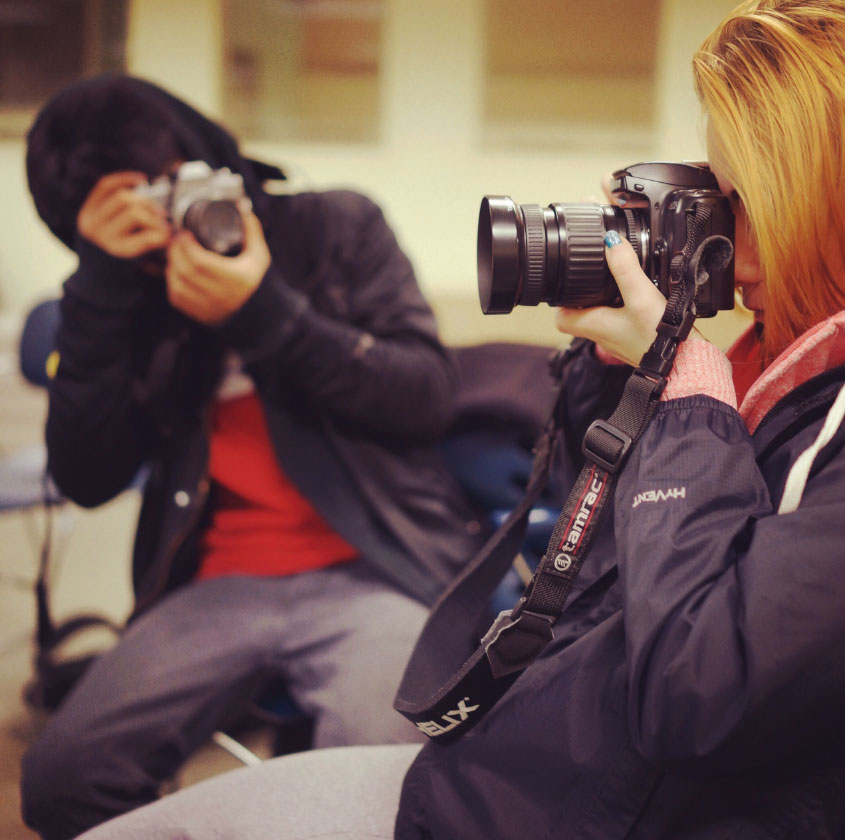
Two girls focus their cameras.

What are some of your favorite memories of Youth in Focus?

One of my favorite memories at Youth in Focus has nothing to do with photography and more about the connection with the youth. A few years ago, there was a student named Tony, who was personally struggling because he had been moved around so many times while in foster care. He would come early to class and would sit in my office and we would talk about his day, sometimes he would ask for advice on how to get along with his foster parents better as he didn’t want to get moved again, but most of the time I just listened and let him know I saw him and appreciated him. About a year into our program, after changing schools and his foster care home again, he ran in my office and said he was getting adopted by one of his teachers in his school! We were both so excited, we started crying and jumping around my office! His new “Dad” showed up to his End of Quarter Show and Tony was grinning from ear to ear as he shared his final image and spoke to the crowd about his work and experience in our program.

What do you hope for the organization in both the near and distant future?

My goal has always been to be a sustainable organization that can serve more kids through quality programs. Long term, we have been working with Mahlum Architects to help design “Youth in Focus in a Box” so we can expand to other communities in the state and nationwide.

How can one support Youth in Focus?

Individual donations go such a long way in our nonprofit and help cover scholarships, film and cameras, just to name a few things! Corporate sponsorship of our classes is extremely helpful, along with simply spreading the word and sharing the work we do with more people to gain support!

Anthea Carns, a Bard and Some Nerds Walk into a Bar

Anthea Carns, a Bard, and Some Nerds Walk into a Bar

Anthea Carns is a busy woman. After pursuing a degree in dramaturgy at Carnegie Mellon University, she splits her time here in Seattle between stage managing, acting with HERON Ensemble, dramaturgy, playwriting, and Bard in a Bar, which is basically Shakespeare karaoke.

She recently sat down with us to talk nerds, obscure dirty Elizabethan-era jokes, and Shakespeare plays set in near-future rainforests.

What is Bard in a Bar?

Bard in a Bar is basically Shakespeare karaoke. I pull together a “highlights reel” of scenes from a chosen play and then get volunteer readers from the audience. They get a couple of minutes to talk together, go through my big bag of silly props and costumes, and then they read the scene. I explain all the stuff that happens in between each scene so it’s kind of a half Drunk History stand-up routine, half karaoke bar, half Rocky Horror Picture Show. It’s a lot of halves, but it’s really rooted in my feeling that Shakespeare should be fun and accessible. It’s a bit like a Shakespeare in the Park model, but with more booze—and audience participation—and heckling.

How did you get involved in the project?

There’s a great organization called Nerd Nite that hosts regular talks from folks about the things they’re nerdy about. I think I heard them describe it once as “That thing that when you start talking about it, your friends’ eyes start to glaze over? We want that.” I presented a talk with them about how to recognize dirty jokes in Shakespeare—which is actually not that hard, but there are some obscure Elizabethan English jokes that it helps to have context for—and the owner of the bar and I decided to see if we could make it into a recurring event of some kind. That was in December 2014. It’s gone through a lot of development since then, including a venue change to Solo Bar, a partnership with the Seattle Public Library, and a lot of refinement of the format.

Why does Shakespeare continue to resonate century to century?

I was just reading some great history about this! Back in the 1700s the French, the Germans and the English were all having spirited critical slap fights about whether Shakespeare had real artistic merit because he completely ignored the Aristotelian unities in favor of, you know, telling compelling stories. There is an argument that Shakespeare’s ability to incite empathy outweighed any formal flaws he had. So, there are a few elements: I think the great plots still excite us; I think his sheer prolific-ness means that there’s something for everyone; and I think Shakespeare had a real genius for creating complex, ambiguous, human characters. We keep coming back to him because we haven’t completely figured his characters out, just like we haven’t completely figured out our own human experiences.

Why do some interpretations of Shakespeare succeed while others fail? This is to say, why does one Hamlet that takes place in a 1980s shopping mall work when another, set in a near-future rainforest, doesn’t?

I’m so glad you asked me this. I’ve seen so many “high concept” Shakespeare productions where the concept just didn’t add anything. It’s just a fun aesthetic. Which is fine, but that’s as far as it goes! It forces you to ask, though, “Why are you doing this in a near-future rainforest?” What does that rainforest mean, semiotically and culturally, and how does that meaning intersect with the play’s meaning? If it’s just because you want Puck to do a bunch of lemur-based animal work, I would push you to think more deeply about what the forest means in the play and to us now. On the flip side, if you’re doing Merchant in a 1980s shopping mall to riff on commercialism and “greed is good” culture, sign me the hell up. I think you’ve got something with legs.

What has/does Shakespeare mean to you? As a person—as a writer?

Every couple of years I have a new idea for a Shakespeare adaptation I want to write. My first real foray into playwriting was an exploration of Hamlet called Bad Hamlet that I co-wrote with my dear friend Lillian DeRitter. And I have this whole Tempest thing I want to do. Like I said’I think I keep coming back to Shakespeare because I find facets of myself there. And those facets change every few years, so there’s always something new to mine; some new aspect of the human experience to try and dig into, personally and artistically. I think as an artist, having good material to start from makes it that much easier to produce good material yourself.

When is the next Bard in a Bar?

Tuesday, March 13, 8PM, at Solo Bar! And you can keep up with future events by liking the Bard in a Bar page on Facebook.

How can one get involved in Bard in a Bar in the future? Are there volunteer opportunities?

Everybody is welcome and indeed encouraged to come and read! Trust me, you do not have to know anything about Shakespeare to participate. It’s a pretty streamlined process, but if people have resources like printing, props, photography skills, or performance spaces, I’d love to hear from them at bardinabar@gmail.com.

Shaya Lyon and the Live Music Project

Shaya Lyon and the Live Music Project

We sent Encore Stages contributing writer Jonathan Shipley to meet Shaya Lyon, founder and executive director of the Live Music Project. The Live Music Project (LMP) is an organization that connects people with live classical music, strengthening communities, celebrating listener agency, and amplifying local resources. They talked about LMP’s successes, classical music today, and what’s coming up in the Seattle classical music scene.

What is Live Music Project?

At the core of our work is a comprehensive performance calendar that has been described by one concert-goer as “the overture to the concert experience.” Since we launched it in Seattle in 2014, the calendar has included more than 1,300 ensembles, series, presenters, and individual performers. Later this year we will expand our calendar platform to support communities nationwide.

What else are you excited about in regards to LMP?

I’m excited about our Spontaneous Free Tickets program. SFT offers a limited number of free concert tickets to its subscribers: students, families, and the elderly, for whom ticket prices are often cost-prohibitive; traditional classical audiences cautiously curious about hearing newer ensembles or compositions; and others who leverage the program to explore events in unfamiliar neighborhoods or venues. The tickets are donated by classical music organizations.

How did you get involved in LMP?

I love this question. It takes me back to falling in love with the Brahms double concerto. A few years ago, I came across a video of David Oistrakh and Mstislav Rostropovich performing the Brahms double. I was enthralled. As I scoured the internet for the next performance of the Brahms double in New York City, where I was living at the time, it turned out to be more difficult that I’d expected to find concert listings based on that particular piece of music. I moved to Seattle. With knowledge of the vast array of orchestral ensembles that are so special to this region, and some time in the technology industry, it struck me that tech might be able to bridge the information discovery gap for concert-goers.

What is the state of classical music these days?

I think the experience of classical music is shifting. The industry once thrived on subscriptions and is now having a more spontaneous approach. It might be difficult for you to imagine, this evening, what will make you feel alive on a given Friday night next April—but you probably have an idea right now what would make you feel alive and complete today. If the trend is toward scanning a list of upcoming concerts and deciding on a whim which concert space will make us feel what we need to feel right now, I see LMP’s comprehensive listings as one way to fill that role.

Are you a classical musician?

When I was nine, a piano appeared in our house. My babysitter taught me the first bars of Moonlight Sonata by ear, and I’d play it over and over again in the dark of night. I loved that.

Who are your favorite composers?

That’s a trick question, right?

What are you excited about on the Seattle calendar in the next few months?

So much! The Seattle Symphony and Everett Philharmonic are both performing Elgar’s Enigma Varations. Early Music Guild is premiering a work for electric theorbo—sort of a cross between a lute and an electric guitar. Thalia Symphony Orchestra will bring us Vaughan Williams.

What are some ways locals can listen to contemporary classical music?

How to narrow it down—Seattle is teeming with new music. The Seattle Modern Orchestra is solely devoted to the music of the 20th and 21st centuries. The Wayward Music Series at the Good Shepherd Center presents works by living composers frequently. Seattle Symphony’s [untitled] series is rich with contemporary works. KING FM’s Second Inversion is dedicated to contemporary classical music.

How can someone help LMP?

We’d love your help. Whether it’s submitting your organization’s events to our calendar, hosting an event-a-thon, writing code for our new nationwide calendar platform, making a donation, or partnering as a sponsor, community participation makes the world go ’round. Your readers can learn more at livemusicproject.org.

Midweek News: Ludovic Morlot, SIFF and ‘Muriel’s Wedding’

News from Seattle’s performing arts community and beyond for the (mid-) week of June 14, 2017:

Congratulations, Ludovic Morlot. Soon, he’s going to be conducting for the Berlin Philharmonic for the first time. 

Talking about the Seattle Symphony. City Arts calls recent concert “moving”

The 5th Avenue Theatre is showcasing a world premiere of Romy and Michele’s High School Reunion. Learn more about it from Seattle Magazine and the Seattle Times

The 5th Avenue honored high school productions with their annual awards show. Learn about the winners at Broadway World.

And yet more congratulations. This time to the winners from this year’s Seattle International Film Festival. 

Still more congratulations! This, to the Space Needle, who is going to go under major renovations

What’s this? More congratulations? To retiring Pacific Northwest Ballet dancer, Carrie Imler.

The Seattle Art Fair is returning this August. Learn more from Seattle Channel.

How do we shelter local artists from skyrocketing rents? Some thoughts from the city, via the Seattle Times.

It’s summer movie time in Seattle. What are you going to see? 

Do you like the movie Muriel’s Wedding? A musical is coming.

Midweek News: 5th Avenue Theatre, Ballet and Pavarotti Movies

News from Seattle’s performing arts community and beyond for the (mid-) week of June 7, 2017:

The 5th Avenue Theatre is presenting the world premiere of Romy and Michelle’s High School Reunion. Learn more about the show at City Arts.

Did you see the Seattle Symphony performance of a not-often-seen Ravel opera? The show will not be soon forgotten. It was a shimmering thing.

Talking about the symphony, here’s an interview with Seattle Symphony’s guest conductor, Thomas Dausgaard

The Pacific Northwest Ballet’s latest production is exquisite and bittersweet

SIFF is celebrating Anjelica Huston. Learn more from the Seattle Times.

In a bit of bad news for Seattle cinephiles, Seven Gables and the Guild 45th are closing

Welcome to Braggsville is being showcased at Book-It Repertory Theatre. Learn more about the production from Seattle magazine.

Have you gone out to Village Theatre to see Dreamgirls yet? It’s a dream

Congratulations to Annex Theatre. They’re celebrating their 30th anniversary.

Town Hall Seattle is getting a big makeover. Seattle magazine has the story.

The Drama Desk Awards were recently given out. Come From Away was a big winner. It was at Seattle Rep before making its way to Broadway. 

Ron Howard is making a biopic about the opera legend Luciano Pavarotti

Five Friday Questions with Leigh Ann Larkin

Leigh Ann Larkin is playing the role of Sally Bowles in the coming national tour production of Cabaret, being showcased at the Paramount Theatre. She is best known for her performance as June Havoc in the 2008 Broadway revival of the musical, Gypsy. She also was in the 2009 Broadway revival of A Little Night Music, starring Angela Lansbury and Catherine Zeta-Jones. She recently sat down with us to talk about parents, Hamilton and donuts. 

When did you realize that you wanted to be an actor?

I realized that I wanted to be an actor from a pretty young age. I think I knew for sure by my sophomore year in college when I discovered that you could actually go to college to study acting. My parents were so incredibly supportive. I had been performing beginning in the early years of elementary so I don’t think they were surprised to find out that I wanted to continue.

What artistic performance are you excited about seeing and why?

At some point I would love to see Hamilton because I love Lin and his work. Not to mention that it’s an incredible piece of theatre. I also love plays and try to catch as many of them as possible. As soon as I get back to NYC I’ll see what’s running and go from there!

What do you to do prepare right before you hit the stage?

My prep right before I hit the stage is a good vocal and body warmup. This show is a marathon for me so my whole body needs to be prepared!

What artwork has always inspired you and why?

There is Chicago-based artist that I love named Laura Lee Junge. I have two of her paintings. They are really fun pieces! I also love an artist named Bats Langley. He sent me a piece of art that he made for me during A Little Night Music. It’s hanging on my wall and I love it.

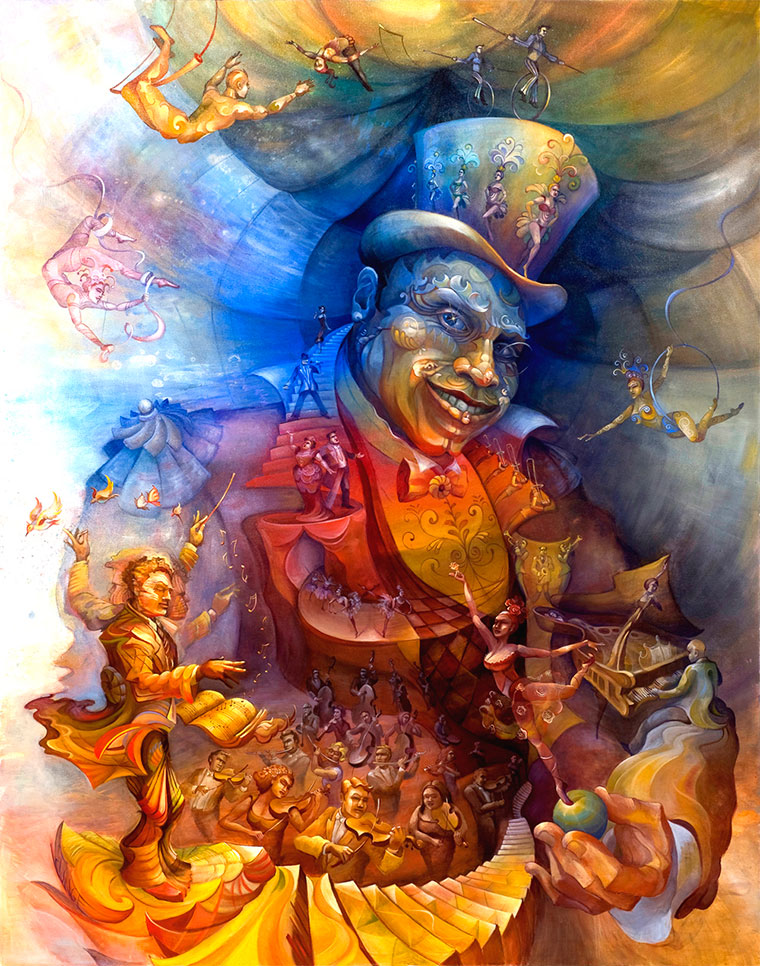
Laura Lee Junge’s Mr. Entertainment

What are you looking forward to during your visit in Seattle?

I’m looking forward to exploring the city of Seattle and eating some yummy donuts! I haven’t had them in years! I’m excited to have two weeks to take my time and soak up all that Seattle has to offer. It’s such an incredible city!!!!

Midweek News: SIFF, Seattle Rep and Muppets

News from Seattle’s performing arts community and beyond for the (mid-) week of May 17, 2017:

The Seattle Foundation’s GiveBig event was last week. The moneys given to Seattle’s nonprofits that day totalled nearly $19 million

The Upstream Music Festival was last weekend. Check out some photos of the festivities over at Seattle Met.

City ArtsArt Walk Awards were held last week. Check out some photos of the festivitiese.

SIFF starts tomorrow night! Being the largest film festival in North America, there’s plenty to see. Where to start? Some direction. Also—are there Seattle connections to all those movies? Yes

Seattle Repertory Theatre’s popular Here Lies Love is so popular they’ve extended the run. 

Seattle Opera’s production of The Magic Flute is, indeed, “filled with magic.” 

The Seattle Symphony and the Seattle Men’s Chorus are teaming up for the first time.

Muppets at MoPOP? Yup yup yup uh huh uh huh

Five Friday Questions with Jayne Muirhead

Jayne Muirhead has lived and worked as an actor in Seattle for decades. She has performed with the Seattle Repertory Theatre, Village Theatre, Seattle Shakespeare Company and many other theatre companies. She’s done quite a few shows at Seattle Children’s Theatre and can seen currently on SCT’s stage in Fire Station 7, a show about fire safety and an alley cat named Coco.

We recently sat down with Muirhead to discuss pretending to be other people, running up and down hallways and Roy Lichtenstein.

What first inspired you to be an actor?

It was getting cast in The Skin of Our Teeth in high school and hanging out with edgy, poetic, smart and goofy theatre people. I had been dancing since 2nd grade and was quite comfortable performing in front of people. Pretending to be another person took it up a notch and that hooked me for life. I also spent three months in London, in 1972 and 1974, seeing plays, ballets and concerts. Seeing such superb actors and such incredibly realized productions set my personal bar for excellence. I saw the power of theatre and I wanted, and still want, to be a part of that power. 

I realized I could make it a career when I kept getting cast. I joined Equity when I was 30 and I have been working steadily now for 36 years.

What artistic performance are you most excited to see? Why?

I’d like to see who is going to be in our Fire Station 7 because we have been fighting the flu!

[An illness has run through the cast which required a person to “voice over” one of the roles while understudies were covering two other roles]

What do you do before you hit the stage?

I always warm up my voice and body. I eat food that is full of protein and not too heavy. I take a long steamy shower at home. My physical warm up depends on the part I’m playing. For Fire Station 7 I need to stretch my legs, back and neck. I jump up and down. I twirl my arms in circles. I run up and down the halls.

What piece of art (performance or not) has always inspired you? Why?

When we were first married my husband, John, bought quite a large Roy Lichtenstein poster of a man looking through a peek hole in what looks like a door and he is saying “I can see the whole room!… and there’s nobody in it!” For me, that’s like theatre. The actors and the audience are not really in the same world, yet we share the same space. The audience is peeking at the world on stage and the world on stage is pretending that we aren’t being peeked at. I guess I like art that messes with time and space. And I think the poster is funny because, of course, I AM in that room. 

What do you like about Seattle’s artistic community?

A year and a half ago I was diagnosed with breast cancer and I chose to share that information with my community. I think it was one of the smartest things I’ve ever done. I love that my community is so supportive and present and helpful. And, it’s full of talented, edgy, smart and goofy people. It’s a family that is thicker than blood and I am so grateful to be a part of it.

Five Friday Questions with Sara and Leigh-Ann Esty

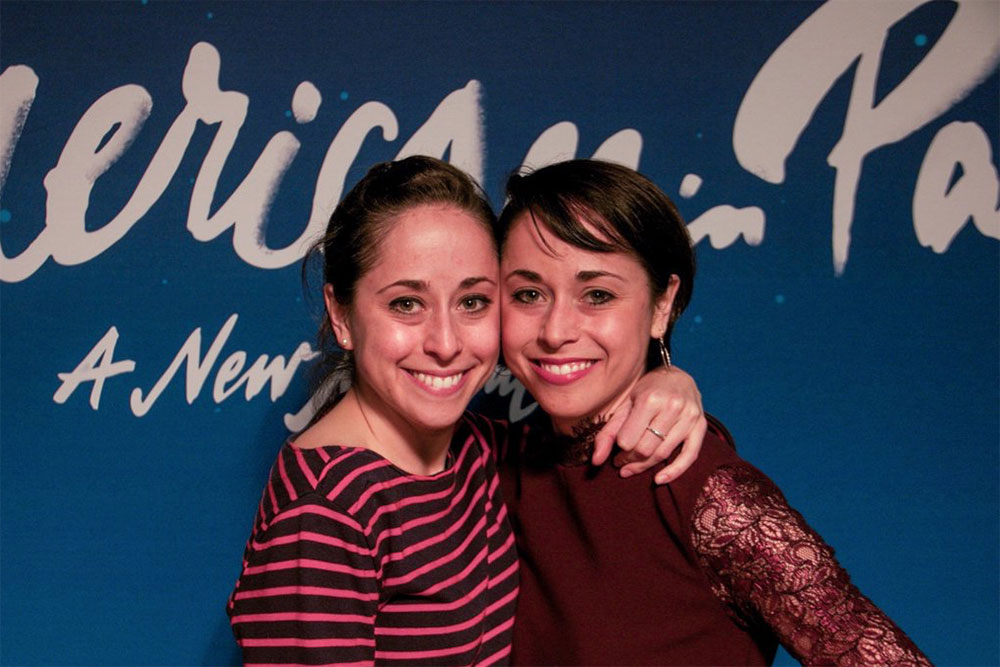
Twin sisters, both former ballet dancers with the Miami City Ballet, are now both going to be on stage at the Paramount Theatre for the coming Broadway touring production of An American in Paris. We recently sat down with the Esty twins to discuss ballet, Impressionism and hot showers.

What first got you interested in performing arts? When did you realize it could be your career?

Sara: Growing up as a rambunctious indentical twin was pretty fun, but stressful for mom at times. She put us into creative movement classes and it stuck! It was the best outlet for all our energy and still is to this day! Throughout high school I started realizing I was just not meant for the “normal” path that most kids were following. It was a gut feeling I couldn’t ignore.

Leigh-Ann: Our mom made sure that music was a large part of our life. She would show us movie musicals and we both fell in love with the song and dance world. I didn’t think it could be a career for me until high school. 

What artistic performance are you excited about seeing? Why? 

Sara: I am constantly inspired every time I go to see theatre. I did get to see Dear Evan HansenSunday in the Park with George and Hello, Dolly! on Broadway. I was blown away! I love studying the actors’ every move and reaction. 

Leigh-Ann: I always look forward to seeing other Broadway musicals, even new movies that come out in theatres. Even if the movie doesn’t interest me, I watch the actors closely. I am still new to the acting world and I take every chance to learn what I can. 

What do you do to prepare before you hit the stage?

Sara: I have a few different warm ups I do. Of course I do a ballet barre warm up. 

Leigh-Ann: Before performing, I have been warming up my body and voice in a hot shower. It really loosens up your muscles and vocal chords! After hair and makeup, I do a warm up for the body parts that still have kinks in them. 

What piece of artistry has always inspired you? Why?

Sara: This may sound corny, but when Julie Andrews sings “I Have Confidence” in The Sound of Music, I always get so inspired and teary that I feel like my heart may explode. It is such a great message. 

Leigh-Ann: I have always enjoyed going to art museums, mostly to see the Impressionists. There is something so inspiring about the work in a classic art museum—that art can be interpreted in so many ways. 

What are you most looking forward to in coming to Seattle?

Sara: I have never been, so I’m looking forward to exploring and finding new little hangouts. So many people have already recommended spots to check out. I can’t wait!

Leigh-Ann: I have heard it’s a beautiful place for hiking. I grew up in Maine doing a lot of outdoor activities, so I’m hoping to get outside and explored when we are there!

Do the Classics Have to Be a Drag?

A woman cannot be herself in modern society,” Henrik Ibsen once said. A Doll’s House, a play he wrote in 1878, explored that thought, arousing great controversy. The protagonist, Nora, wants to discover herself and so—spoiler alert—she leaves her husband and children to do so, very much against the social norms of the day. It was scandalous when the play made it to the stage.

Today, entering stage right, is Cherdonna Shinatra eager to play in Ibsen’s house to see what to make of it. Can a drag queen have much to say about a fusty old play written a century and a half ago? Is it a controversy to take a classic and rework it for our modern sensibilities? How far can you revise a classic and still have it maintain it’s power? Or is it powerful because it can be reworked time and again? 

One of the actor’s in Cherdonna’s Doll’s House, now being staged by the Washington Ensemble Theatre at 12th Avenue Arts, is a pre-teen boy. He gets to say “fuck” on stage, much to his delight. Controversial? Shocking for an Ibsen play? In this day and age? And, particularly in Seattle, haven for boundary pushers, creative seekers, imagination fiends, and people who pride themselves on being themselves? Is there a better place to showcase these questions than on stage with a drag queen eager to say something more about a play long since written? The show, being touted as a “sort of world premiere” tries to answers these questions.

Adapted by Ali Mohamed el-Gasseir and Cherdonna (Jody Kuehner), the original work was one Ibsen based on real-life events. Nora was based on his good friend, Laura Kieler. Much of what happens on stage between Nora and her husband, Torvald, happened to Laura and her husband, Victor. Victor found out about Laura’s secret financial dealings and so divorced her and had her committed to an asylum (she would later come back to him). 

What would Ibsen make of this new production? One in which the script has been truncated, chopped up, rewritten and redone? The show is directed by Ali Mohamed el-Gasseir. Having loved the Ibsen piece for years he began talking about it with Kuehner. Could they take a feminist classic and showcase it through a modern feminist lens? What would that do? Make people laugh, for one. 

Reviews are in. It’s “laugh-out-loud.” A drag queen in A Doll’s House is funny stuff. But what else could it do? Entertain people. Maybe even make them think. “What’s the purpose of the classics?” asks Samie Spring Detzer, the Artistic Director at Washington Ensemble Theatre, who also has a role in the play as Mrs. Linde. “We have to test them. We have to see if they’re still valid.” 

Test, this show does. Actors play the roles in Ibsen’s work but when Cherdonna starts playing in the doll house, as it were, the actors also being playing themselves as they play the characters. Samie Spring Detzer admits of the Ibsen’s original play, “It doesn’t mean a lot to me today.” Feminist play or not, she continues, “if you don’t recognize yourself in the work, it loses its power.”

The creative team, then, decided to try and give it a different kind of power—take a modern day feminist and get their take on what feminism was (though that was yet a term in Ibsen’s day). “It is a collaborative process,” Detzer notes. The director and Cherdonna worked arduously reworking the text to meet the demands of the questions they hoped to answer. They also wanted to make the audience laugh. Dance sequences and cookie breaks help. “It’s the collaborative process,” Detzer notes, “that’s valued beyond most anything else.”

A Doll’s House has taken quite a journey, then, from those initial performances in the late 19th century that scandalized the world to today, where a drag queen boundlessly delights about how marvelous Nora is and, by doing so, how marvelous classics may still be.